
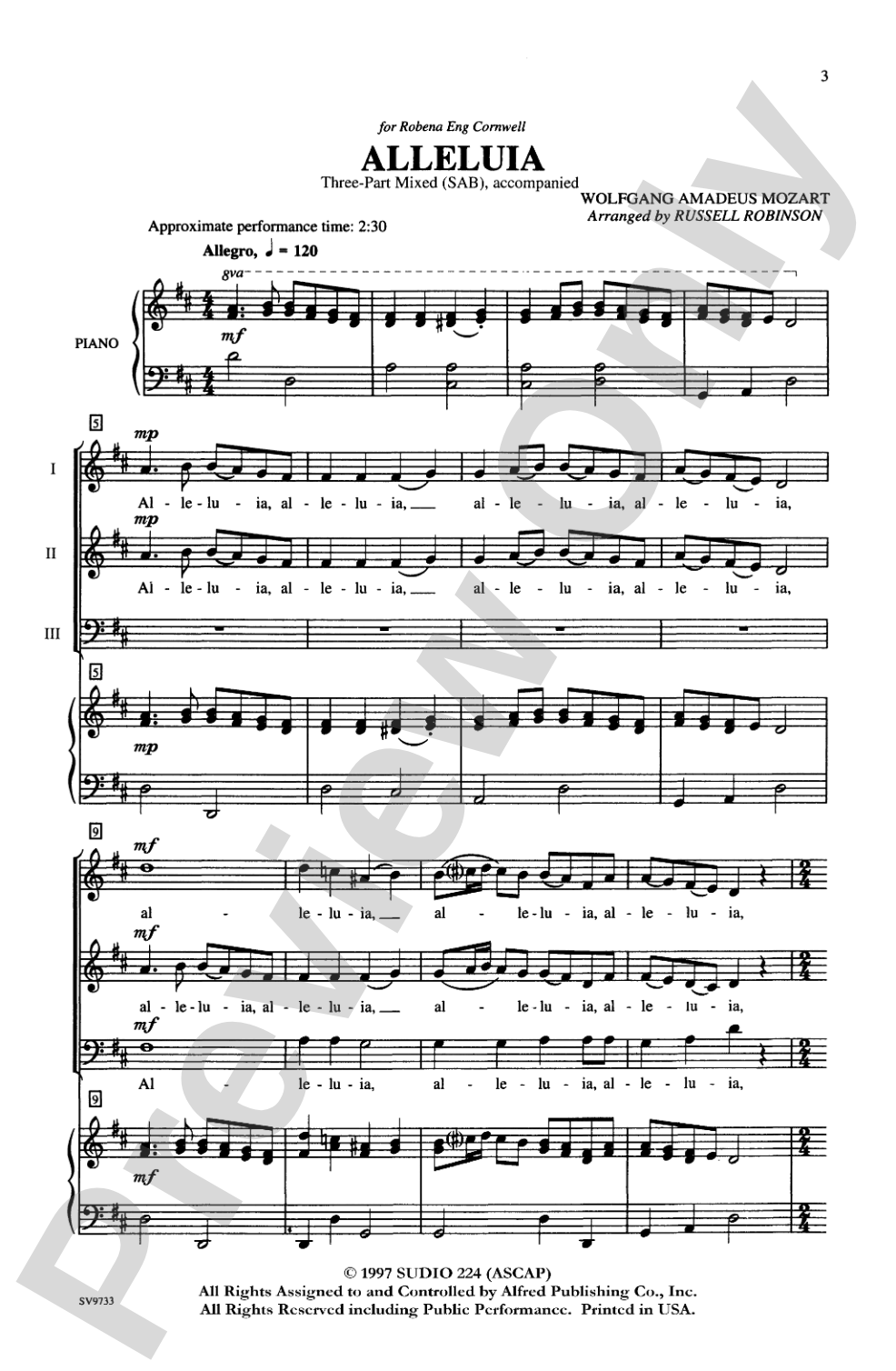

Alleluia: SAB Choral Octavo
Music by Wolfgang Amadeus Mozart / arr. Russell Robinson
Item: 00-PO-0002762
$2.25
Minimum order quantity: 20 copies
Pickup currently not available
Description
From the Mozart motet Exsultate Justi (K. 165), this world-famous melody is given new glory in a simply gorgeous setting by Russ Robinson. The technical demands have been eliminated to assure that choirs at all levels can experience the music of Mozart at its best. Choose this wonderful addition to the choral repertoire.


Alleluia: SAB Choral Octavo isn't in MakeMusic Cloud just yet...but it could be. Let us know you'd like to see it, and you'll help shape what comes next. In the meantime, start a free trial and dive into thousands of interactive titles your students can play along with today.
Request This Title
Tell us you want it.
Start Your Free Trial
Explore everything that's ready to play right now.
Sample Audio
No sample audio found.
Sample Video
No sample videos found.
Additional Details
Series:
Alfred Archive Edition: Belwin Festival Series
Publisher:
Alfred Music
Page Count:
8
SKU:
00-PO-0002762
More about this title
About the Composer: Wolfgang Amadeus Mozart
Wolfgang Amadeus Mozart (1756-1791) composed across every major genre of his era with a facility and inventiveness that remain unmatched. His sacred works span from masses and requiems to motets, each demonstrating an ability to balance liturgical function with profound musical expression. The Exsultate Justi motet, from which this Alleluia is drawn, showcases Mozart's gift for writing music that feels both intellectually rigorous and emotionally direct.
For choral directors, Mozart's sacred music offers a gateway to the classical vocal tradition. His melodies are singable without being simplistic, and his harmonic language remains fresh across centuries of performance. This particular motet has earned its place in the standard choral repertoire precisely because the Alleluia melody transcends its original context and speaks across styles and skill levels.
Why we love this
Russ Robinson's arrangement strips away complexity without sacrificing elegance, letting the magnificent Mozart melody shine through. The SAB voicing opens this masterwork to choirs that might otherwise lack the resources for a four-part setting, yet the three-part texture retains harmonic substance. Directors can confidently program this at festivals and concerts knowing that even developing choirs will sound polished and purposeful.
What to expect
The Alleluia carries both spiritual weight and musical grace. The melody unfolds with the clarity of a bell, supported by warm harmonies that feel inevitable without being obvious. Singers experience the reward of performing Mozart's actual music, not a simplified reduction; the phrase shapes and harmonic movement belong to the master himself, reimagined for accessible forces.
Who it's for
Any choir seeking a meaningful sacred work that doesn't demand advanced vocal techniques or extensive four-part writing experience. This arrangement works equally well for youth choirs, community ensembles, adult singers new to Mozart, and school choirs preparing for festival competition.
How to get the most out of it
- Shape the melodic line with gentle dynamic contour rather than uniformity. Mozart's melody has a natural arc that responds to phrase breathing and will sound more alive than a straight mezzo-forte approach.
- Balance clarity between the parts by having altos support but not overshadow the soprano line. The arrangement depends on hearing the primary melody while feeling the harmonic foundation beneath it.
- Consider the text as a guide to tempo and character. "Alleluia" is joyful but not frantic; a moderate tempo that allows the text to be understood cleanly will serve the music better than rushing.
- Use the recorded accompaniment to lock ensemble entrances, especially if your singers have limited exposure to classical style. Familiarity with the harmonic progression will deepen intonation across rehearsals.
How to use it
Program this as a centerpiece in a sacred music concert, pairing it with other classical choral works or using it as a bridge between Renaissance polyphony and romantic-era pieces. The Alleluia also serves as a strong festival entry in the choral octavo category, offering judges recognizable Mozart craftsmanship in a fresh, contemporary-feeling arrangement.
Skills your students will build
- Singing classical phrasing with clear melodic direction
- Balancing part independence in a three-part texture
- Performing a major classical work with confidence regardless of experience level
- Sustaining pitch and tone quality in longer, supported phrases