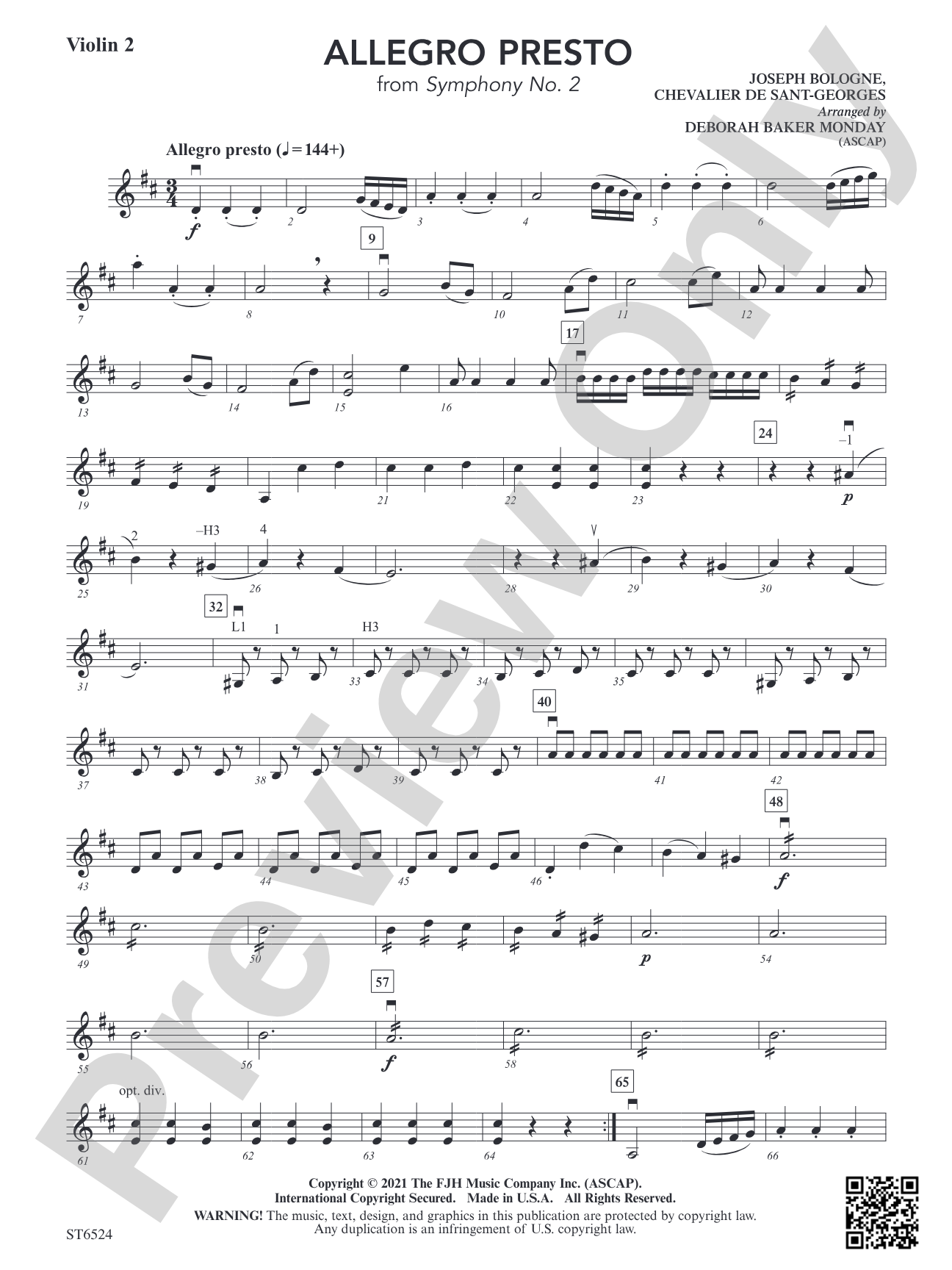
Allegro Presto (From Symphony No. 2): Violin 2 Sheet Music Preview

Allegro Presto (From Symphony No. 2): Violin 2

From Symphony No. 2

By Joseph Bologne, Chevalier de Saint-Georges / arr. Deborah Baker Monday

Grade: 2.5;3

Item: 98-PC-DST6524_VN2

Digital Download
$7.00
Description
Spotlight one of the first known classical composers of African ancestry with this incredible arrangement showcasing the music of De Saint-Georges, a Black contemporary of Mozart. Born the son of a slave and white plantation owner, he became a master fencer, violin virtuoso, conductor and composer. This vibrant and energetic movement from his second symphony is an amazing choice for any program! (4:00)

Don't just read it, hear it, play along with it, and watch your students grow with it. In MakeMusic Cloud, Allegro Presto (From Symphony No. 2): Violin 2 comes alive with professional accompaniment, adjustable tempo, and built-in practice tools that turn solo practice into real progress.

Sample Audio
0:00
0:00
Sample Video
Additional Details
Series: FJH Developing Strings
Publisher: The FJH Music Company, Inc.
SKU: 98-PC-DST6524_VN2

More about this title

About the Composer: Joseph Bologne

Joseph Bologne, Chevalier de Saint-Georges (1745-1799), stands as one of the most accomplished and influential musicians of the late 18th century. Born in Guadeloupe to a French plantation owner and an enslaved African woman, he rose to prominence in Paris as a virtuoso violinist, master swordsman, and respected conductor who led major orchestras during the Classical era.

Saint-Georges composed prolifically across genres: symphonies, concertos, string quartets, and operas that showcased his command of form and orchestration. His works embody the elegance and structural rigor of his era while bearing the distinctive voice of a composer navigating a world that simultaneously celebrated his artistry and denied him full recognition. Rediscovering his music remains essential to understanding the true landscape of Classical composition.

Why we love this

This arrangement brings a major compositional voice into the rehearsal room and concert hall at an achievable grade level. The writing remains faithful to the original's spirited character while sitting comfortably for developing string orchestras, making it an intelligent choice for programs seeking to expand the classical canon beyond the usual suspects.

What to expect

Buoyant, graceful, and propulsive. The movement pulses with Classical elegance and rhythmic vitality, offering moments of lyrical beauty alongside passages that sparkle with virtuosic flair. There is genuine joy in the writing, a confidence that invites performers to play with both precision and personality.

Who it's for

This arrangement suits string orchestras at the intermediate level (Grades 2.5-3) seeking repertoire with both historical significance and musical substance. Directors building culturally inclusive concert programs will find this movement essential, and students benefit from engaging with a voice that has been largely absent from standard curricula.

How to get the most out of it

  • Keep the opening phrases light and articulate; the energy comes from rhythmic precision, not weight.
  • Balance the dialogue between sections carefully so upper strings and lower strings stay audible throughout the rapid passagework.
  • Maintain a steady pulse through the faster runs; resist the urge to drag when ensemble intonation feels uncertain.
  • Shape the dynamics with intention even in energetic passages; conversations between parts become clearer when volume relationships are clear.

How to use it

Program this as a confident centerpiece on a concert celebrating diverse composers, or pair it with other Classical-era chamber works to build an all-string program with depth. At four minutes, it functions equally well as a concert opener that establishes energy or as a substantive mid-program selection that showcases your ensemble's technical development.

Skills your students will build

  • Articulation and rhythmic clarity in fast, scalar passages
  • Ensemble balance and intonation in rapid ensemble figures
  • Stylistic interpretation within Classical forms
  • Part independence and sectional confidence in dialogue-driven writing

You May Also Like