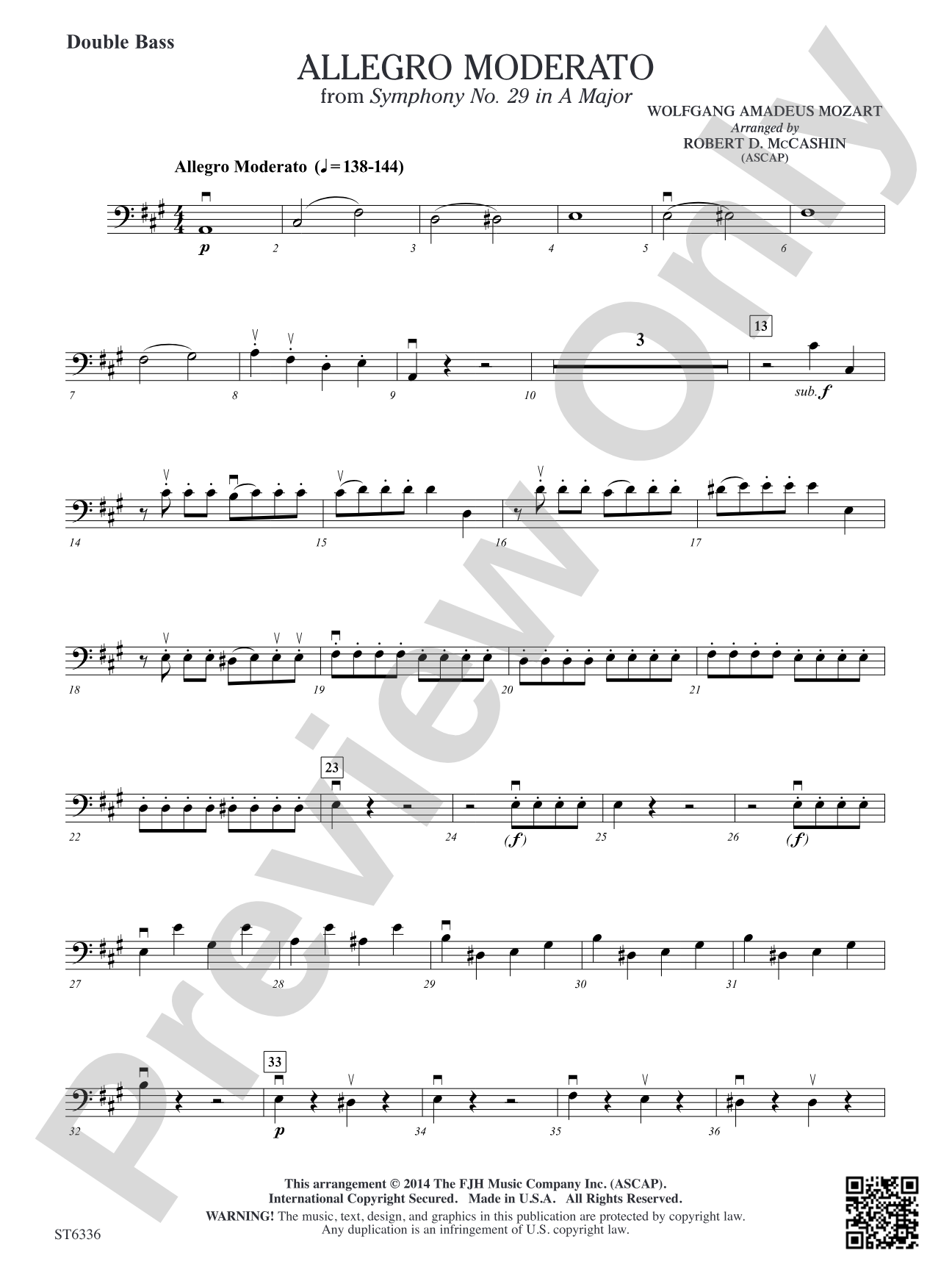
Allegro Moderato: Double Bass Sheet Music Preview

Allegro Moderato: Double Bass

By Wolfgang Amadeus Mozart / arr. Robert D. McCashin

Grade: 4

Item: 98-PC-DST6336_SB

Digital Download
$7.00
Description
The Allegro Moderato (first movement) from Mozart's Symphony No. 29 contains that delicate balance between his graceful lyricism and his signature tempestuous energy. This shockingly authentic arrangement allows your string students to experience all the intensity of the original without having to bring in wind players.

Don't just read it, hear it, play along with it, and watch your students grow with it. In MakeMusic Cloud, Allegro Moderato: Double Bass comes alive with professional accompaniment, adjustable tempo, and built-in practice tools that turn solo practice into real progress.

Sample Audio
0:00
0:00
Sample Video
Additional Details
Series: FJH String Orchestra
Publisher: The FJH Music Company, Inc.
SKU: 98-PC-DST6336_SB

More about this title

About the Composer: Wolfgang Amadeus Mozart

Wolfgang Amadeus Mozart (1756-1791) composed his 41 symphonies across a career that spanned from childhood prodigy performances to his final years in Vienna. His ability to write idiomatically for every instrument while maintaining crystalline formal architecture made him the gold standard for generations of composers and remains central to orchestral pedagogy today.

For string students, Mozart's symphonies offer a masterclass in balanced writing. Every section has essential material; no player is ever padding a texture. His melodies are memorable enough to sustain interest yet structurally sophisticated enough to reward close listening.

Why we love this

McCashin's arrangement strips away the wind section without sacrificing a single moment of Mozart's dramatic arc, making this first movement accessible to string orchestras while preserving the work's genuine symphonic weight. The Grade 4 scoring gives advanced students a chance to own a genuine masterwork rather than a simplified etude.

What to expect

Elegant and propulsive at once. The opening theme arrives with grace but builds quickly into a passage of genuine tension and forward motion. There are moments of breathless sweetness interrupted by sudden urgency, all wrapped in Mozart's characteristic clarity and control.

Who it's for

String orchestras at the advanced high school and early college level, particularly those preparing for festival play or seeking substantial concert repertoire with symphonic credibility. Directors who want their students to experience Mozart's structural mastery without the logistical complexity of adding wind players.

How to get the most out of it

  • Shape each phrase with clear direction toward the cadence. Mozart's lyricism depends on the strings singing through to the final note of each idea, not stopping short at the barline.
  • Balance the texture so that first violins lead but never overwhelm the violas and cellos. This movement thrives on the interplay between the sections, and a solitary top line flattens the writing.
  • Keep the opening theme light and flowing rather than heavy. Mozart marks it Allegro Moderato; the tempo should breathe, not march.
  • Articulate the rhythmic figures clearly without making them sound staccato. Mozart's rhythms dance; they don't bounce.

How to use it

Program this as the centerpiece of a classical or Viennese masters concert, pairing it with other string-friendly works from the era. It also functions beautifully as a contest selection, offering both the technical polish judges expect and the musical substance required for serious competition play.

Skills your students will build

  • Classical phrase architecture and harmonic progression
  • Ensemble balance between first and second violins, violas, and cellos
  • Sustained lyricism within a brisk tempo
  • Stylistically informed articulation and dynamics in the Classical idiom
  • Reading a four-part string texture with independent viola and cello lines

You May Also Like