Allegro Giocoso (From Symphony No. 4): 1st Violin Sheet Music Preview

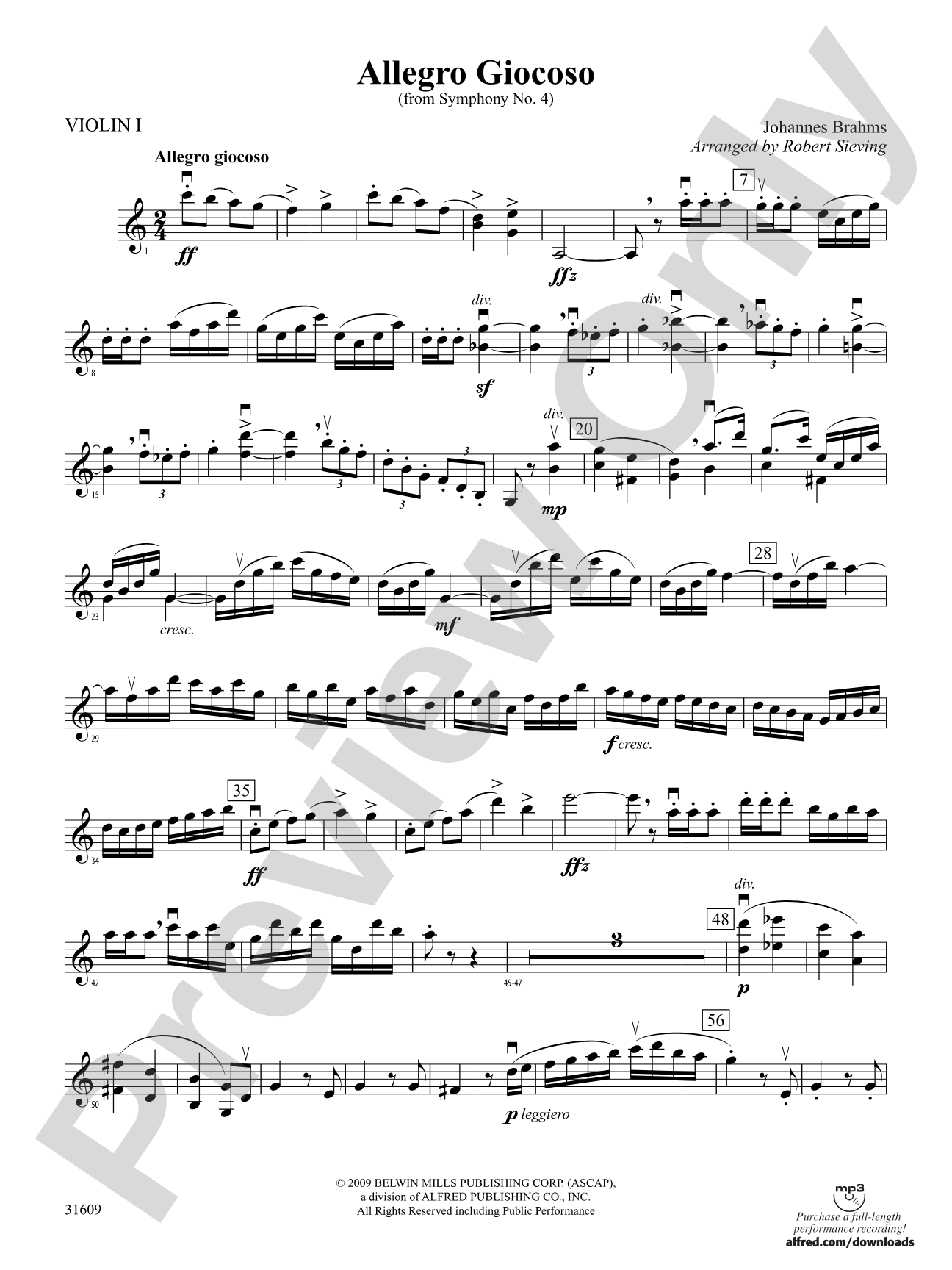
Allegro Giocoso (From Symphony No. 4): 1st Violin

By Johannes Brahms / arr. Robert Sieving

Grade: 4

Item: 00-PC-0014850_VN1

Digital Download
$5.99
Description
The sturdy gaiety of this piece will endear students and audience alike! Carefully crafted to preserve the essence of the original, this arrangement retains the core of the string parts with the necessary substance of the winds. (3:00) This title is available in MakeMusic Cloud.

Don't just read it, hear it, play along with it, and watch your students grow with it. In MakeMusic Cloud, Allegro Giocoso (From Symphony No. 4): 1st Violin comes alive with professional accompaniment, adjustable tempo, and built-in practice tools that turn solo practice into real progress.

Sample Audio
0:00
0:00
Sample Video
Additional Details
Series: Highland/Etling String Orchestra
Publisher: Alfred Music
Page Count: 124
SKU: 00-PC-0014850_VN1

More about this title

About the Composer: Johannes Brahms

Johannes Brahms (1833-1897) stands as one of the Romantic era's most rigorous symphonists, bridging the classical traditions of Beethoven with the expressive depths of his own time. His four symphonies remain cornerstones of the orchestral repertoire, each one carefully constructed to balance formal architecture with emotional authenticity. For young musicians, Brahms offers the rare gift of music that demands technical precision while rewarding listeners with melodies of genuine warmth and substance.

Why we love this

This arrangement captures the infectious rhythmic vitality of Brahms without sacrificing the musical logic that made the original endure. Robert Sieving's orchestration respects the string writing while adding wind support that clarifies texture rather than cluttering it—a model of how to adapt symphonic music for student ensembles. At Grade 4, students encounter real compositional craft, not a simplified facsimile.

What to expect

Buoyant and graceful, this movement sparkles with the kind of joy that doesn't rely on saccharine sentiment. The interplay between rhythmic vitality and lyrical counterpoint creates momentum without breathlessness, inviting players to find both precision and expressiveness in the same passage.

Who it's for

Intermediate to advanced string orchestras ready to tackle Romantic-era symphonic writing with real structural demands. This is ideal for programs preparing ensembles for festival competition or students who have moved beyond arrangements of folk tunes and lighter Baroque material.

How to get the most out of it

  • Shape the opening gesture with clear articulation in the violins; the bounce of the rhythm depends on light bow contact and precise rhythmic placement across the section.
  • Balance the second violin and viola lines as harmonic partners—they deserve attention equal to the first violin melody, especially where they carry inner melodic motion.
  • Maintain forward momentum through the development section by resisting the urge to slow during harmonic shifts; trust Brahms's metrical clarity to guide the ensemble.
  • Mark entrances carefully in parts where winds join strings; clarity in these moments prevents the arrangement from becoming muddy and preserves the transparency Sieving intended.

How to use it

Program this as a bridge between lighter classical repertoire and heavier symphonic works in a concert progression. Its three-minute span fits naturally in festival programs or pops concerts where you want to represent the symphonic tradition without demanding excessive rehearsal time.

Skills your students will build

  • Balancing multiple melodic lines occurring simultaneously across the ensemble
  • Responding to harmonic rhythm and voice-leading in Romantic-era construction
  • Maintaining rhythmic precision during syncopated figures across section divides
  • Reading and executing wind-string doublings and cross-cuing in an orchestral context
  • Sustaining musical line through sectional transitions and development variations

You May Also Like