
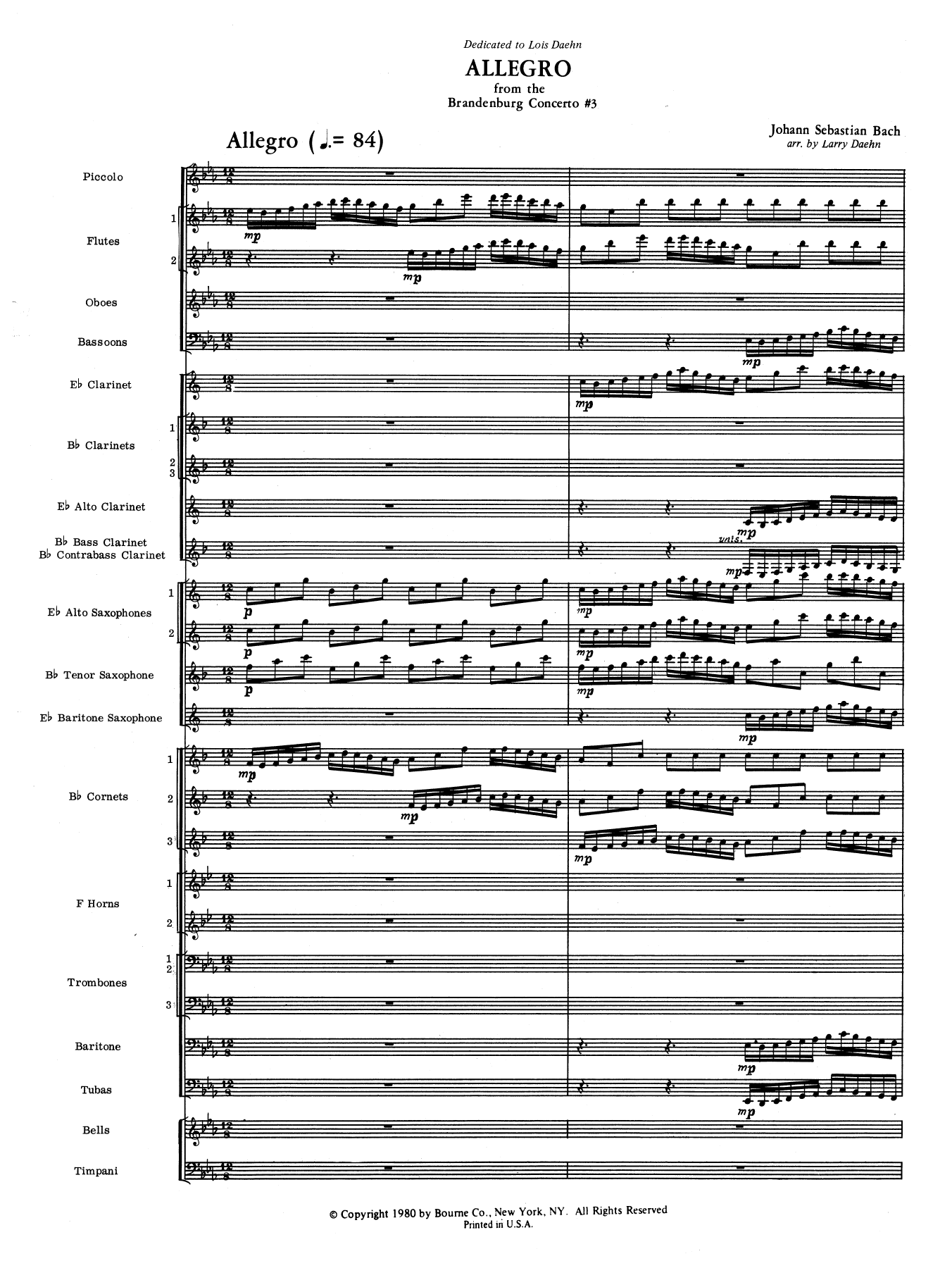

Allegro from Brandenburg Concerto No. 3: Concert Band Conductor Score & Parts
By Johann Sebastian Bach / Arranged by Larry Daehn
Grade: 6
Item: 35-PK00313174
$95.00
Pickup currently not available
Buy Extra Parts (Digital PDF Download)
Parts Added to Cart!
Description
Allegro from Brandenburg Concerto No. 3


Allegro from Brandenburg Concerto No. 3: Concert Band Conductor Score & Parts isn't in MakeMusic Cloud just yet...but it could be. Let us know you'd like to see it, and you'll help shape what comes next. In the meantime, start a free trial and dive into thousands of interactive titles your students can play along with today.
Request This Title
Tell us you want it.
Start Your Free Trial
Explore everything that's ready to play right now.
Sample Audio
No sample audio found.
Sample Video
No sample videos found.
Additional Details
Publisher:
Hal Leonard
SKU:
35-PK00313174
More about this title
About the Composer: Johann Sebastian Bach
Johann Sebastian Bach (1685-1750) stands as the foundation of Western music pedagogy. His systematic approach to composition, harmonic clarity, and structural logic have made his works essential teaching tools for centuries. Bach's ability to weave multiple independent lines into coherent wholes demonstrates fundamental principles that student musicians encounter across every level.
Why we love this
Daehn's transcription brings the brilliant counterpoint and rhythmic vitality of the Brandenburg original into the concert band medium without sacrificing Bach's architectural precision. A Grade 6 assignment that sounds genuinely sophisticated, this piece proves your students can handle real musical substance alongside technical growth. The scoring creates satisfying roles for nearly every section, making it equally rewarding for strong players and developing musicians.
What to expect
Spirited and conversational, with multiple voices entering and exiting in dialogue. The energy feels forward-moving without being rushed, driven by the characteristic baroque figured bass patterns and the playful interweaving of melodic lines that trade ideas among the sections.
Who it's for
Concert bands at the Grade 6 level looking for substantive repertoire that develops musicianship alongside technique. Ensembles comfortable with independent voices and baroque harmonic language will find this both accessible and rewarding.
How to get the most out of it
- Shape each phrase as a singer would. The Baroque style depends on breathing between ideas and avoiding metronomic rigidity; allow the rhythm section to support gentle rubato from the melodic voices.
- Balance the inner voices carefully during the contrapuntal passages. These lines carry harmonic meaning, and burying them under the solo instruments obscures Bach's construction.
- Articulation consistency across like instruments matters enormously here. If your first violins use slurred pairs while seconds use short tonguing, the texture fragments; decide on a uniform approach before rehearsal one.
- Let the harmonic progressions guide tempo choices. Bach's harmonic rhythm creates natural momentum; resist the temptation to push through slower harmonic changes.
How to use it
Position this in a concert exploring baroque forms or as evidence of stylistic range alongside your contemporary or romantic selections. Its moderate length makes it an ideal opener, establishing both musical sophistication and ensemble cohesion from the first piece onward.
Skills your students will build
- Following independent melodic lines while maintaining harmonic awareness
- Baroque articulation and phrasing conventions
- Balance and blend in polyphonic textures
- Understanding harmonic function and figured bass principles
- Part independence and inner voice awareness