Allegro (Encore Plus, Book 4) Sheet Music Preview

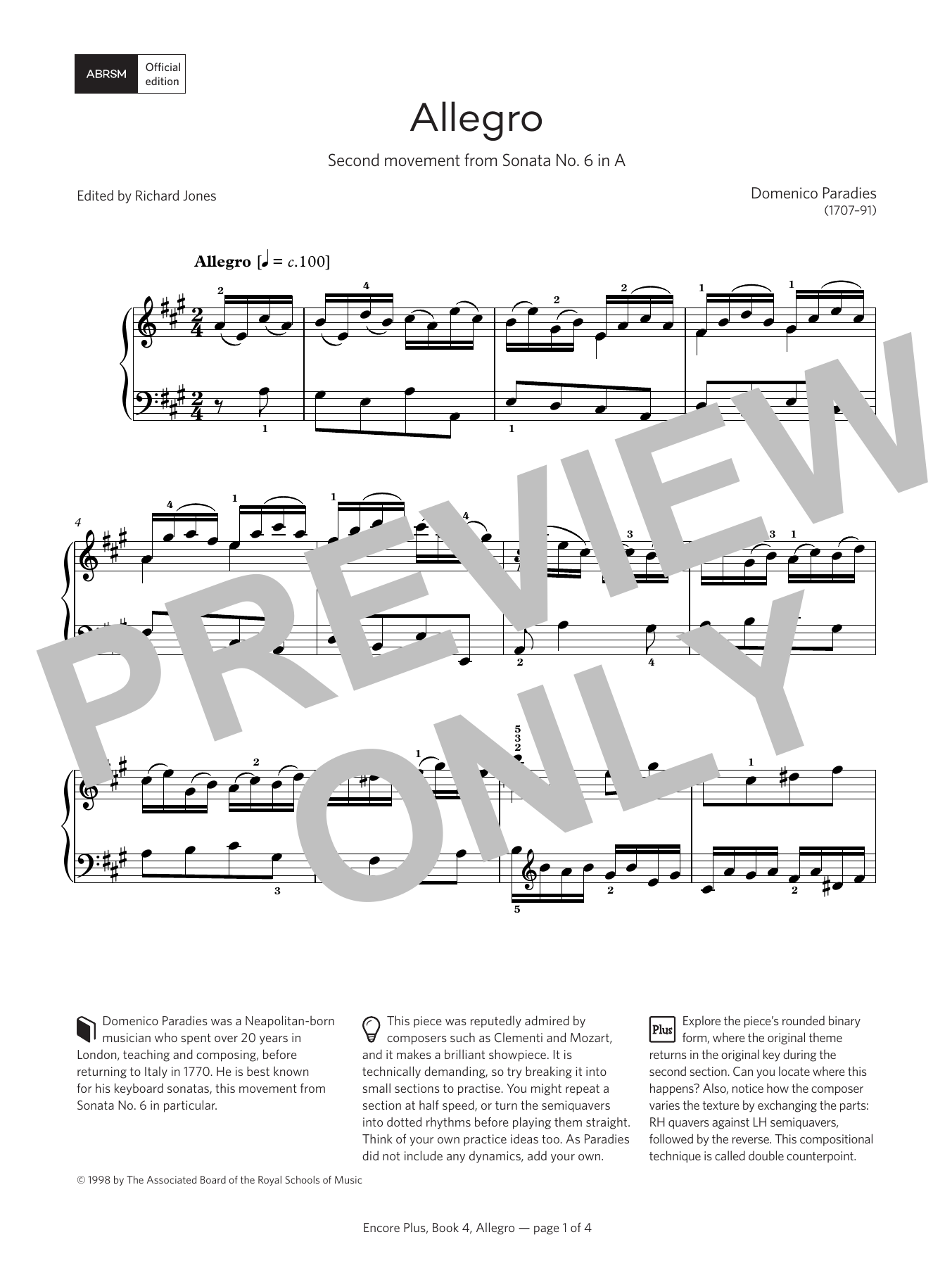
Allegro (Encore Plus, Book 4): Piano Solo

By Domenico Paradies

Grade: 7

Item: 35-DS01989535

Digital Download
$4.99
Description

Discover MakeMusic Cloud: thousands of interactive titles your students can play along with today.

Sample Audio
No sample audio found.
Sample Video
Additional Details
Publisher: Hal Leonard
Page Count: 4
SKU: 35-DS01989535

More about this title

About the Composer: Domenico Paradies

Domenico Paradies (1707-1791) was an Italian keyboard composer and pedagogue whose works became staples of 18th-century music education. Active in both Venice and London, he wrote prolifically for harpsichord and organ, crafting pieces that balance technical demands with genuine musical substance. His compositions remain valuable teaching tools for intermediate pianists navigating the Classical style.

Paradies's keyboard works exemplify the galant aesthetic: clear textures, balanced phrase structures, and ornamental figuration that rewards careful attention to articulation and voice leading. His legacy in music education rests on pieces that develop student musicianship without sacrificing artistic integrity.

Why we love this

This Allegro sits at that sweet spot where students have genuine interpretive choices without drowning in technical complications. The writing is transparent enough to let a student's musical growth be audible, yet the Classical idiom and ornamentation demand precision and stylistic awareness. It's the kind of piece that sounds better every time a student performs it, rewarding invested practice.

What to expect

Bright and purposeful, moving with the buoyant confidence of the galant style. The piece invites the performer to dance through Classical phrases while maintaining elegant restraint. There's brightness without bombast, ornament without excess.

Who it's for

Advanced intermediate pianists ready to engage seriously with Classical keyboard style. This works well for students preparing for competitions, exams, or recitals who need a short, rewarding solo that demonstrates musicianship and technical control.

How to get the most out of it

  • Shape the phrases with subtle dynamic variation rather than obvious crescendos and diminuendos. Let the harmonic progression and melodic contour guide the listener's ear.
  • Distinguish between structural ornaments (those that define the melody) and decorative ones (those that fill space). This clarity keeps the piece from feeling ornate or fussy.
  • Keep the tempo steady but allow rubato to emerge naturally from phrase endings and ornamental passages. Avoid the trap of rushing through fast figuration.
  • Articulate the accompaniment with clean, even touch so the right hand melody stays in focus. Precision here creates space for expressive playing above.

How to use it

Pair this with other Classical keyboard works at a student recital to showcase a student's stylistic range. At four pages, it fits naturally into any program and provides a strong standalone solo or effective encore when the performance calendar calls for something refined and direct.

Skills your students will build

  • Execution of Classical ornaments (trills, turns, mordents) with stylistic accuracy
  • Voicing of Alberti bass and other accompanimental patterns with clarity and independence
  • Phrasing and shaping within an eight-bar and sixteen-bar formal structure
  • Sustaining musical momentum across repeated harmonic patterns without monotony
  • Balance between melody and accompaniment in transparent two-part texture

You May Also Like