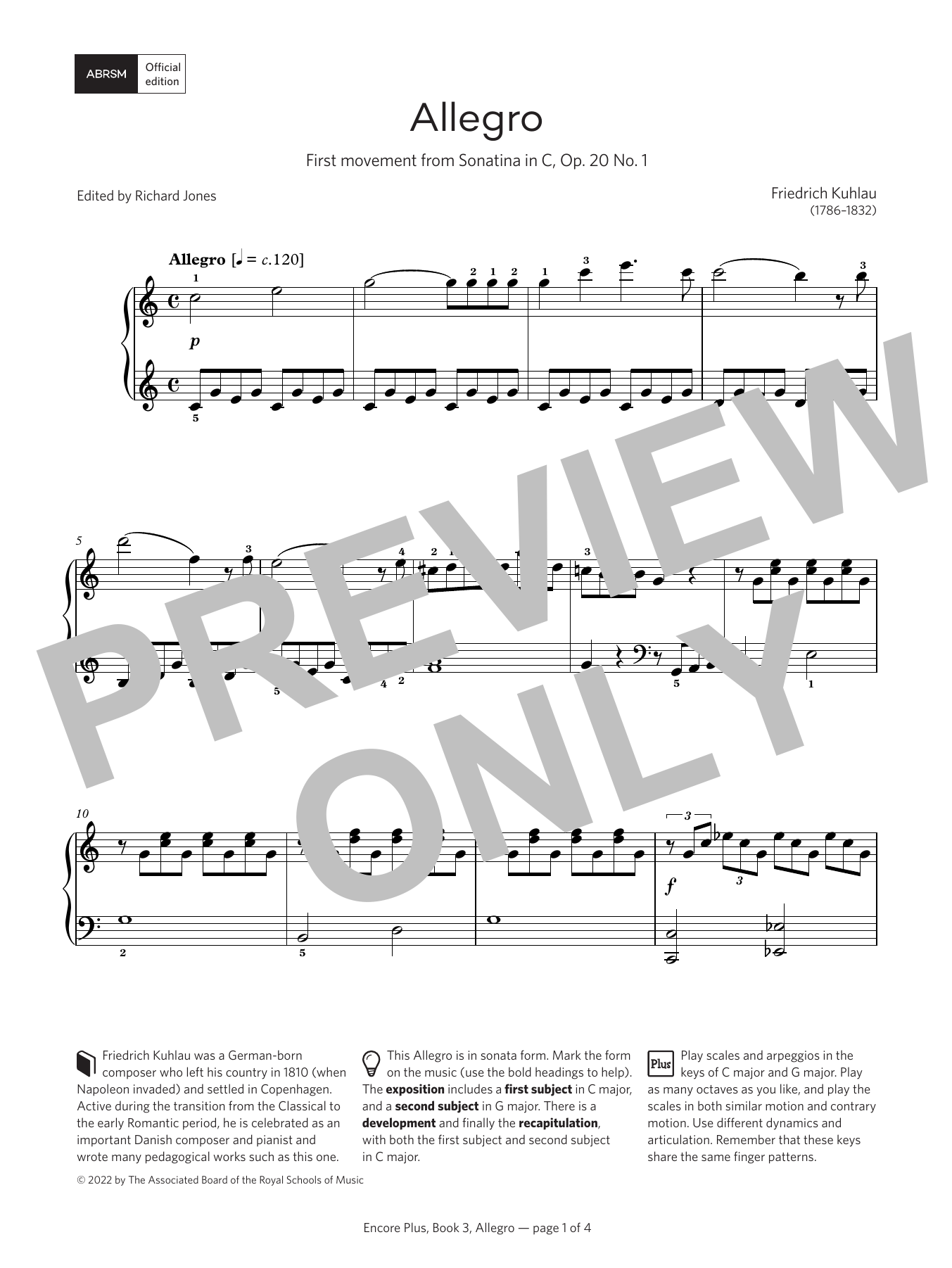
Friedrich Kuhlau (1786–1835) was a German-Danish composer whose prolific output shaped Romantic piano pedagogy. His sonatinas and character pieces became foundational teaching works, prized for their elegant writing and musical substance that never talks down to young players.
Why we love this
This Allegro sits at that sweet spot where intermediate pianists encounter genuine compositional craft rather than exercises dressed up as music. The piece rewards careful attention to voice independence and phrase shaping without requiring virtuosic technique, making it both satisfying to work on and genuinely enjoyable to hear.
What to expect
Brisk and purposeful, with a forward momentum that never feels breathless. The harmonic language unfolds with Kuhlau's characteristic transparency, creating a sense of clarity and order that feels both intellectually satisfying and genuinely musical.
Who it's for
Grade 6 pianists ready to balance technical competence with interpretive thinking. This works equally well for students approaching their first Classical form studies or as a recital piece for players seeking material with real musical substance.
How to get the most out of it
Separate the lyrical melody from the accompanying figures by listening to dynamic layers; the accompaniment should recede even when it moves faster than the top line.
Shape the phrase endings with deliberate harmonic awareness rather than slowing mechanically, letting the cadence emerge naturally from voice leading.
Establish a steady pulse in your practice before adding expressive timing; rushing through the Allegro undermines its Classical proportion.
How to use it
Pair this with other Kuhlau sonatinas for a thematic recital exploring early Romantic pedagogy, or place it alongside contemporary works to show how Classical principles persist in later repertoire. It also serves as an ideal transition piece for students moving from early intermediate to mid-level material.
Skills your students will build
Sustaining an independent melodic line while managing accompaniment textures
Identifying and executing Classical phrase structure
Managing Allegro tempo without rushing or losing shape
Balancing lyrical playing with technical passage work
Recognizing harmonic cadences and using them architecturally
You May Also Like
Scan to Complete Your Purchase
Use your phone's camera to scan the code below
You'll log in on your phone and the order will be added to your account