Allegro Sheet Music Preview

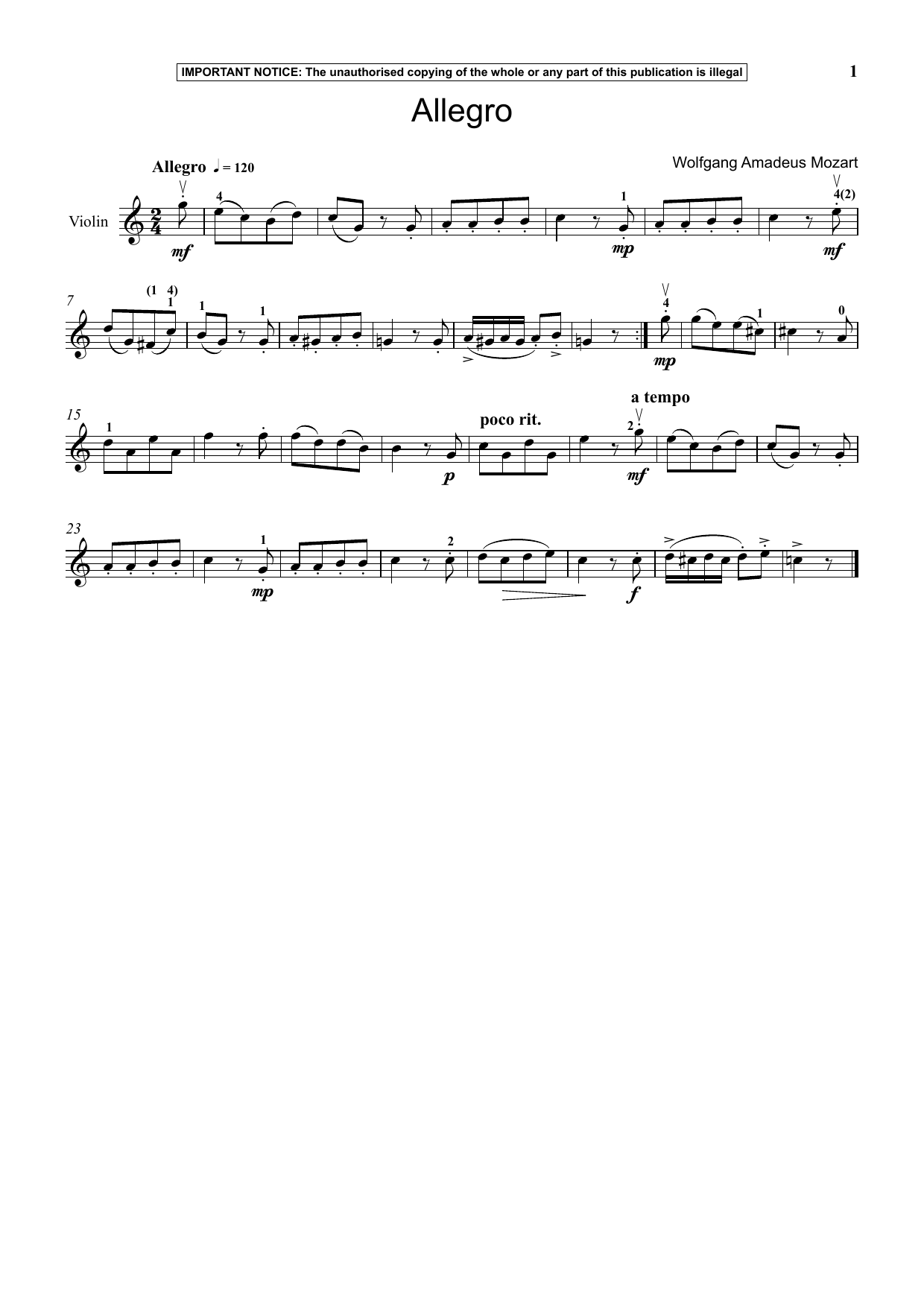
Allegro: Instrumental Solo

As performed by Wolfgang Amadeus Mozart

Item: 35-DS00239089

Digital Download
$3.99
One moment…
Description

Discover MakeMusic Cloud: thousands of interactive titles your students can play along with today.

Sample Audio
No sample audio found.
Sample Video
Additional Details
Publisher: Hal Leonard
Page Count: 2
SKU: 35-DS00239089

More about this title

About the Artist: Wolfgang Amadeus Mozart

Mozart composed across every major genre of his era, from symphonies and concertos to operas and chamber music, often establishing conventions that composers followed for generations. His output spans roughly 600 works created in just 35 years, making him one of the most prolific and influential figures in Western classical music. For educators, Mozart's writing stands apart for its clarity of line, balanced phrasing, and the way it rewards both careful practice and spontaneous interpretation.

Why we love this

Mozart's allegros balance technical brilliance with genuine musicality in a way that keeps students engaged rather than overwhelmed. This two-page piece offers the classical hallmarks your ensemble needs to hear: transparent orchestration, clear harmonic movement, and the kind of spirited character that audiences respond to immediately.

What to expect

Bright and propulsive, with the kind of forward momentum that feels effortless when the phrasing sits correctly. There is warmth beneath the Classical reserve, a sense of conversation between the lines rather than mere ornament.

Who it's for

Solo performers at the early intermediate to intermediate level, or ensemble musicians working on classical style. The compact length makes it accessible for students building confidence with period-appropriate interpretation.

How to get the most out of it

  • Shape the melodic line with attention to Mozart's natural phrase arc rather than playing every note at a uniform dynamic level.
  • Let the harmonic rhythm guide tempo flexibility; Mozart's accompaniment patterns often suggest subtle breathing points that prevent the piece from feeling mechanical.
  • Distinguish between primary material and accompanying figures through careful voice balancing so the architecture remains audible.

How to use it

Pair this with other Mozart selections for a focused classical exploration, or use it as a palette cleanser between weightier Romantic or contemporary works. The two-page format works well as a concert opener or as part of a mixed genre program where you want to remind listeners of classical principles before moving elsewhere.

Skills your students will build

  • Classical phrase architecture and symmetrical phrasing
  • Articulation appropriate to the Allegro tempo marking
  • Voice independence within a homophonic texture
  • Ornamentation and embellishment as integral to melody rather than decoration

You May Also Like