
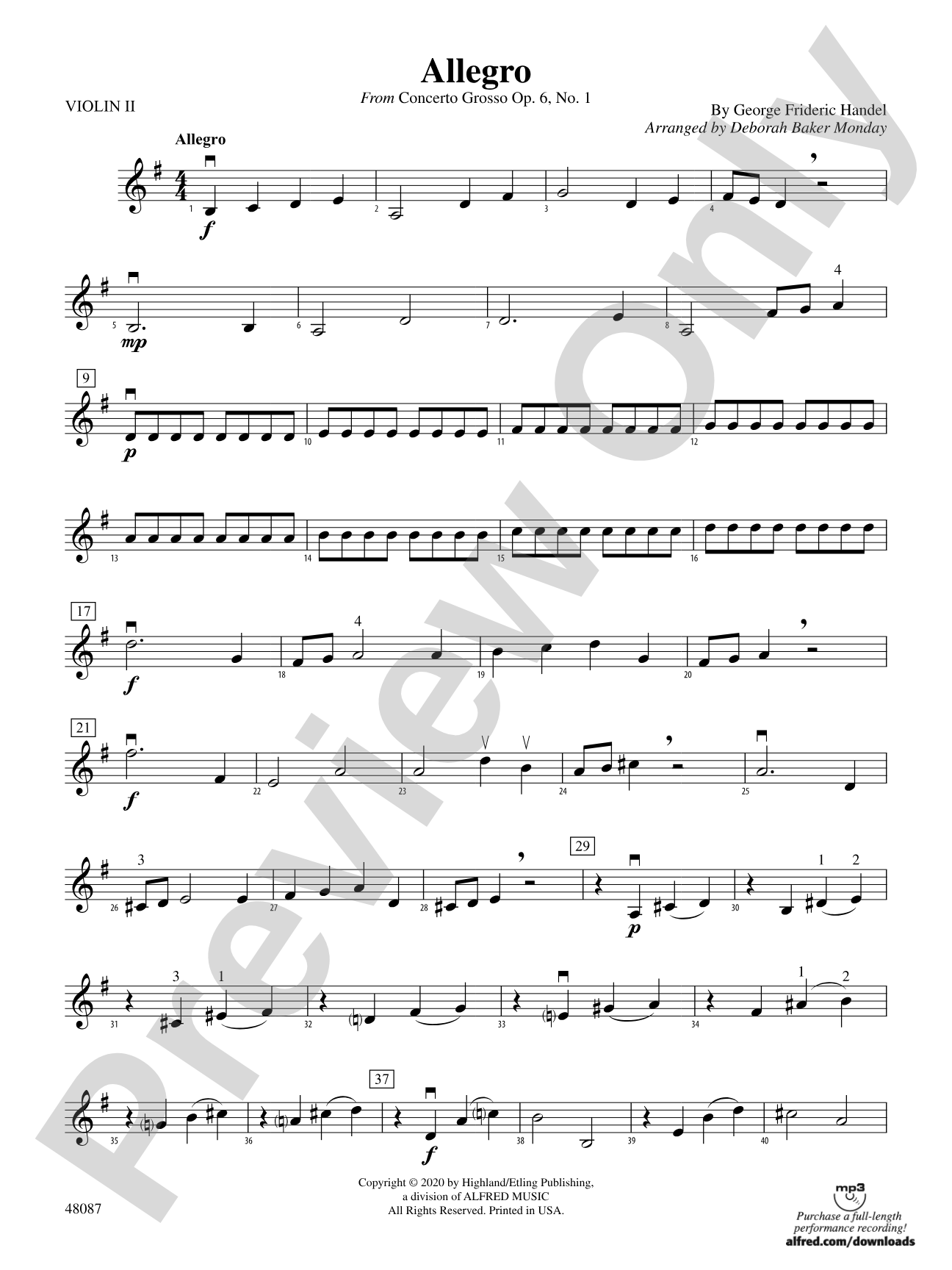

Allegro: 2nd Violin
From Concerto Grosso, Op. 6, No. 1
By George Frideric Handel / arr. Deborah Baker Monday
Grade: 2.5
Item: 00-PC-0018522_VN2
$3.00
Pickup currently not available
Description
Some of the most exuberant music from the Baroque period comes to us from George Frideric Handel, composer of Messiah, among many other masterpieces. Handel's "Allegro" from Concerto Grosso, Op. 6, No. 1, arranged by Deborah Baker Monday, is a perfect example of his most joyous music and is an excellent choice for concert or festival. The four-measure melodic theme in G major occurs throughout the piece and is passed among all instruments. A half step figure is also a common motive with easily accessible fingerings provided. This piece features simple quarter and eighth-note rhythms. The accompanying parts are interrelated, and rhythmic independence is limited. (2:00) This title is available in MakeMusic Cloud.


Don't just read it, hear it, play along with it, and watch your students grow with it. In MakeMusic Cloud, Allegro: 2nd Violin comes alive with professional accompaniment, adjustable tempo, and built-in practice tools that turn solo practice into real progress.
Open in the Player
Jump straight in and assign it today.
Start Your Free Trial
Open this title and explore the full library in minutes.
Sample Audio
1
Audio File
--:--
0:00
0:00
Sample Video
Additional Details
Series:
Highland/Etling String Orchestra
Publisher:
Alfred Music
Page Count:
124
SKU:
00-PC-0018522_VN2
More about this title
About the Composer: George Frideric Handel
George Frideric Handel (1685-1759) was a German-born composer who spent most of his creative life in England, where he became the defining figure of the Baroque era. His output spans operas, oratorios, concertos, and instrumental works, all marked by memorable melodies, dramatic sweep, and masterful orchestration. Handel's music remains central to string orchestra repertoire because it combines technical accessibility with expressive depth, making it equally rewarding for developing ensembles and experienced musicians.
His Concerti Grossi, Op. 6, stand among the most performed and beloved works of the Baroque period. Written late in his life, these twelve concertos showcase Handel's gift for writing music that sounds effortless and joyous while maintaining structural clarity and harmonic interest. Teachers and conductors return to these works repeatedly because they teach young players how to shape melodic lines, balance ensemble texture, and communicate musical intention through rhythmic precision.
Why we love this
This arrangement captures the infectious energy of authentic Baroque melody without requiring advanced technique from your ensemble. The four-measure theme that circulates through all voices creates immediate clarity for developing players while the half-step motive offers enough motivic work to build musicianship. At Grade 2.5, it strikes the rare balance of being genuinely rewarding to perform while remaining totally accessible to players who are still building foundational skills.
What to expect
Handel's Allegro radiates pure joy through uncomplicated means. The repeating theme feels almost like a musical conversation passing from one voice to another, creating moments of unity and gentle interplay without demanding virtuosity. The whole piece has the lightness and buoyancy of court music, inviting players and audiences alike into the world of 18th-century elegance.
Who it's for
This score and parts are designed for conductors leading Grade 2-3 string orchestras in schools, community ensembles, or festival settings. The arrangement works equally well for conductors developing young players' ability to follow independent parts and for those seeking dependable Baroque material that fits comfortably into a developing ensemble's abilities.
How to get the most out of it
- Bring out the four-measure melodic theme each time it passes to a new section. Have players identify where their instrument carries it so they understand the piece's architecture and commit to shaping that phrase with intention.
- Keep the quarter and eighth-note rhythms crisp and even. Baroque music depends on clear articulation to separate one note from the next, so encourage your strings to tongue (for winds) or bow clearly without rushing the faster rhythms.
- Balance the half-step motive carefully when it appears in accompanying parts. These figures support the main theme, so they should be present but never overshadow the primary melody.
- Use the two-minute duration to your advantage in rehearsal. Run it straight through multiple times to build ensemble confidence and let players experience the cumulative effect of the joyous material.
How to use it
Program this as an opener or lighter moment on a concert that otherwise features heavier or more dramatic repertoire. It pairs beautifully with other Baroque concertos or as a bridge between contemporary works and classical-era pieces. Its clean, recognizable character and manageable two-minute runtime also make it an excellent choice for festival competitions where you want to showcase your ensemble's clarity and ensemble balance.
Skills your students will build
- Following a melodic theme as it passes among different instrumental voices
- Performing clear quarter and eighth-note rhythms with consistent articulation
- Recognizing and interpreting a repeated half-step motive across the ensemble
- Balancing melodic and accompanying parts within a homogeneous string texture
- Responding to harmonic movement centered in G major with secure intonation