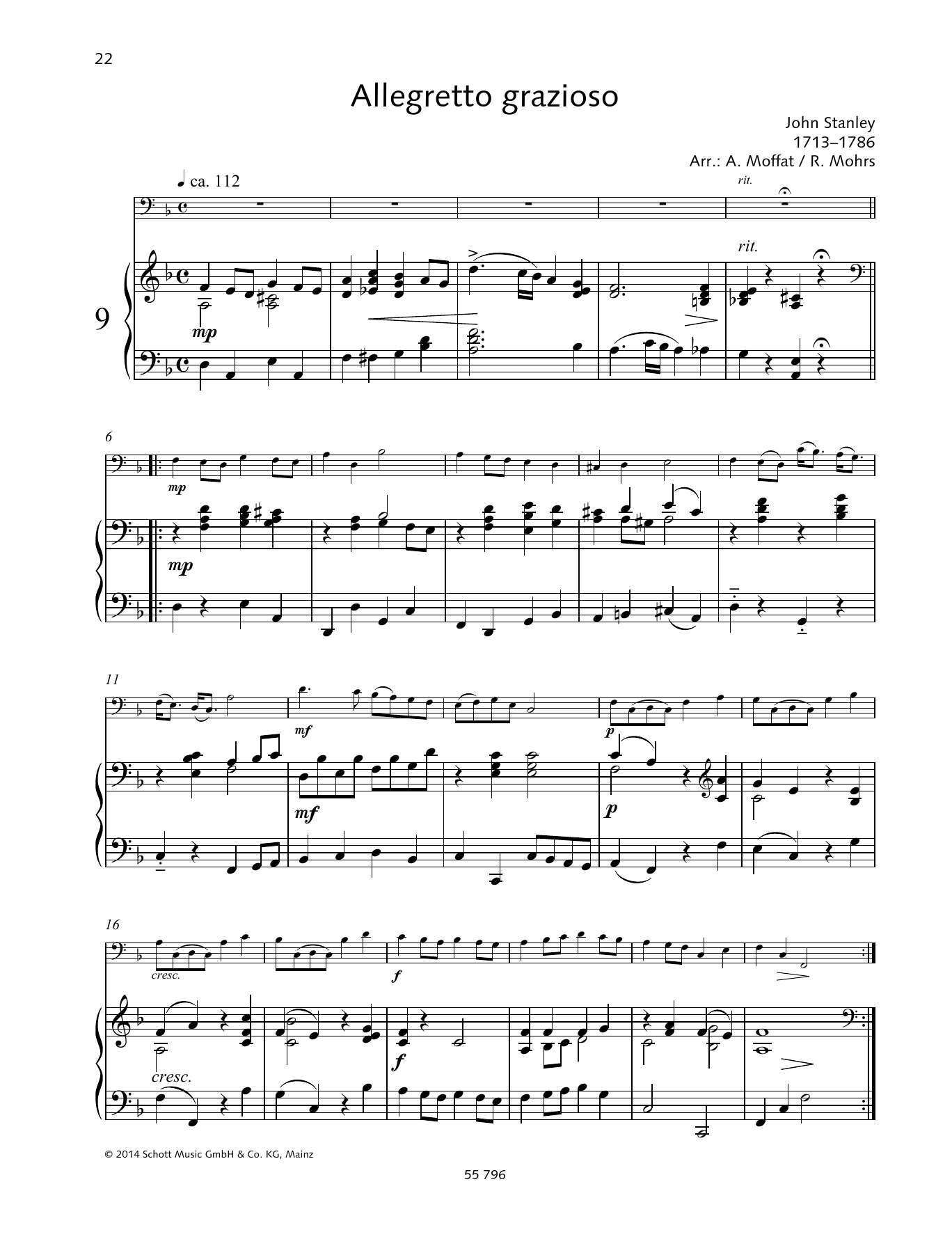
Allegretto Grazioso Sheet Music Preview

Allegretto Grazioso: Cello and Piano

By John Stanley / Edited by Rainer Mohrs / Edited by Alfred Moffat; Rainer Mohrs

Item: 35-DS00371967

Digital Download
$2.99
Description

Discover MakeMusic Cloud: thousands of interactive titles your students can play along with today.

Sample Audio
No sample audio found.
Sample Video
Additional Details
Publisher: Hal Leonard
Page Count: 3
SKU: 35-DS00371967

More about this title

About the Composer: John Stanley

John Stanley (1713-1786) was an English organist and composer whose prolific output shaped the English musical landscape of the mid-18th century. He served as organist at the Chapel Royal and St. Andrew's Church in Plymouth, positions that gave him both the technical mastery and the compositional breadth to write across genres—from grand organ works to intimate chamber pieces. Stanley's music bridges the Baroque and early Classical styles, offering students a window into how composers of his era balanced contrapuntal tradition with emerging Classical clarity.

Stanley's chamber works remain essential teaching repertoire because they demand musicality without requiring virtuosity beyond reach. His writing for strings and keyboard reveals a composer who understood how to create satisfying textures for student ensembles while maintaining genuine musical substance.

Why we love this

Stanley's melodic gift shines in this piece without requiring orchestral forces or extended ranges. The balance of cello and piano creates natural opportunities for collaborative learning, and the Allegretto Grazioso tempo marking gives students permission to shape phrases without rushing—a crucial lesson in itself.

What to expect

Graceful and unrushed, with the poise of a well-bred melody that invites the listener in rather than demanding attention. The writing has room for rubato and expression, allowing cello and piano to converse with genuine warmth.

Who it's for

Intermediate to early advanced cello students paired with an accomplished pianist. The piece suits studio lessons, chamber recitals, or student ensemble concerts where intimate musicianship matters more than volume or technical display.

How to get the most out of it

  • Shape the opening phrase as a complete gesture. Resist the impulse to articulate every note equally; the 'grazioso' character emerges when cello and piano breathe together at natural phrase breaks.
  • Listen to the harmonic rhythm beneath the melody. Knowing whether the piano is providing forward motion or harmonic weight helps the cello player commit to the right character in each section.
  • Test the balance between instruments in the space where you'll perform. A sensitive piece like this reveals acoustic truths that louder repertoire masks.

How to use it

Program this on a chamber music concert or student recital where you want to shift the ear toward refinement after heavier pieces. It also works as a rehearsal piece for duet coaching when you need students to practice collaborative listening without the demands of a full ensemble.

Skills your students will build

  • Phrasing and breath control in long melodic lines
  • Balance and blend in duet texture
  • Responding to harmonic language typical of 18th-century English keyboard writing
  • Collaborative rehearsal skills with a keyboard partner

You May Also Like