
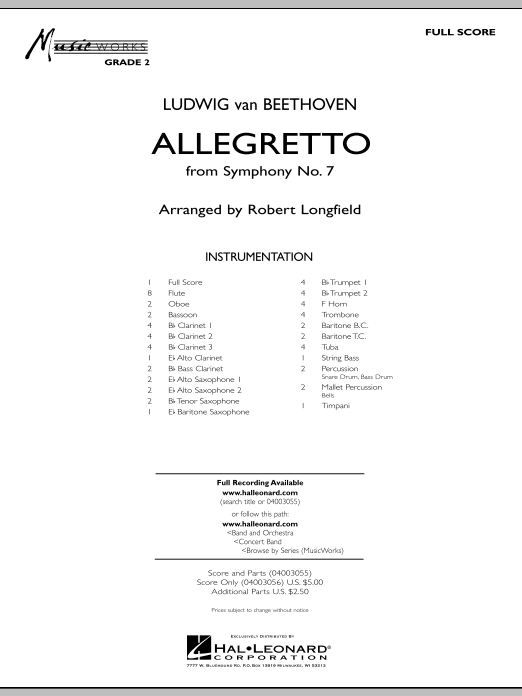

Allegretto (from Symphony No. 7): Concert Band Conductor Score & Parts
By Ludwig Van Beethoven / Arranged by Robert Longfield
Grade: 2-2.5
Item: 35-PK00179103
$65.00
Pickup currently not available
Buy Extra Parts (Digital PDF Download)
Parts Added to Cart!
Description
From Beethoven's "Symphony No. 7", this movement is one of the master's most recognizable and performed themes. Recently featured in the Oscar-winning film "The King's Speech", here is a skilled and effective adaptation for young bands by Robert Longfield. A great way to showcase the classical period of musical history on any program. Dur: 2:45


Allegretto (from Symphony No. 7): Concert Band Conductor Score & Parts isn't in MakeMusic Cloud just yet...but it could be. Let us know you'd like to see it, and you'll help shape what comes next. In the meantime, start a free trial and dive into thousands of interactive titles your students can play along with today.
Request This Title
Tell us you want it.
Start Your Free Trial
Explore everything that's ready to play right now.
Sample Audio
No sample audio found.
Sample Video
No sample videos found.
Additional Details
Publisher:
Hal Leonard
SKU:
35-PK00179103
More about this title
About the Composer: Ludwig Van Beethoven
Beethoven's symphonies stand as the foundation of the concert band repertoire, and his structural innovations reshaped how composers thought about form and orchestration. His ability to build massive emotional arcs from simple melodic gestures makes his work endlessly rewarding for students to study and perform, offering clear models of development and thematic transformation.
Why we love this
Longfield's arrangement captures the stately, almost dance-like character of the original without oversimplifying the harmonic sophistication that makes this movement memorable. Young bands gain immediate access to one of classical music's most beloved themes while engaging with genuine Beethoven voice leading, not a watered-down approximation. The Grade 2-2.5 scoring balances accessibility with musical substance.
What to expect
Aristocratic and unhurried, this movement carries the poise of a classical minuet despite its symphonic origins. There is dignity in the melodic line and a gentle inevitability to how the harmonies unfold, creating an atmosphere that feels both ceremonial and intimate.
Who it's for
Concert bands in the Grade 2 to early Grade 3 range who want solid classical repertoire with educational value. Directors preparing a program that needs recognizable, high-quality music that doesn't talk down to young musicians.
How to get the most out of it
- Shape the melody with gentle dynamic waves rather than playing it uniformly; the opening phrase benefits from a slight rise and fall that mirrors vocal phrasing.
- Keep the accompaniment figures light and rhythmically precise. The steady pulse underneath needs to feel supportive, not plodding.
- Work sectionally on intonation in the sustained harmony passages. This movement exposes tuning issues more than faster textures do.
- Allow the piece to breathe at phrase endings; resist the urge to push forward. Beethoven's architecture depends on clear structural punctuation.
How to use it
Pair this with other classical period works to build a thematic concert on the symphonic tradition, or slot it into a pops or ceremony program as an elevated standalone piece. At 2:45, it fills a meaningful slot without demanding extended rehearsal time, making it ideal for mid-season when you need something polished quickly.
Skills your students will build
- Sustaining long phrase lines with consistent air support
- Balance between melody and harmonic accompaniment
- Intonation in sustained chords
- Reading classical period articulation and style conventions
- Sectional awareness and ensemble alignment across multiple voice parts