
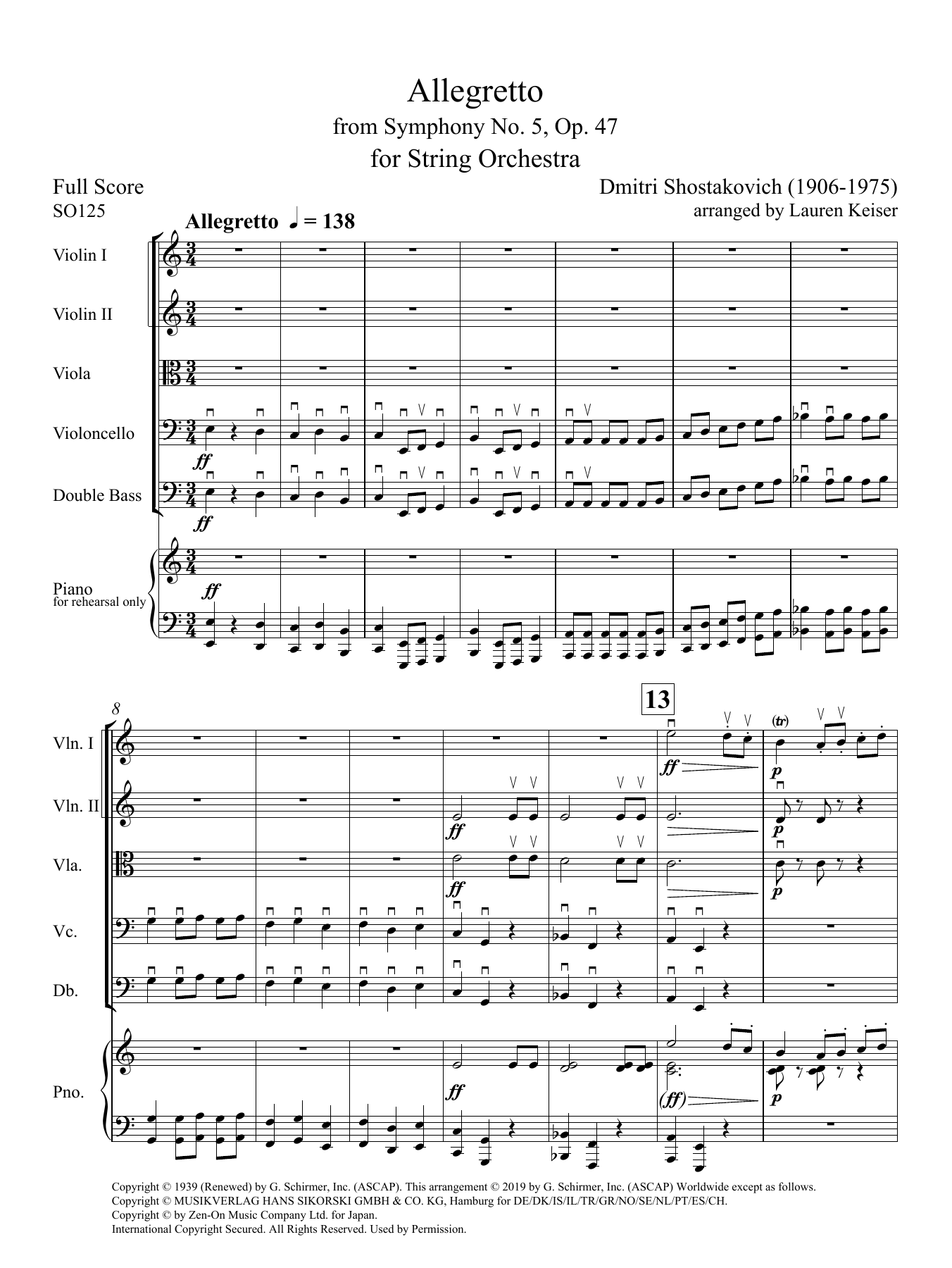

Allegretto: from Symphony No. 5, Mvt. 2: String Orchestra Conductor Score & Parts
By Dmitri Shostakovich / Arranged by Lauren Keiser
Grade: 2.5
Item: 35-PK01466676
$55.00
Pickup currently not available
Buy Extra Parts (Digital PDF Download)
Parts Added to Cart!
Description
Shostakovichs Fifth Symphony was written in 1937 and premiered that year in Leningrad (St. Petersburg). It was a major success with an ovation lasting over 30 minutes. The symphony is approximately 45 minutes in length and has four movements. Allegretto is the second movement. It is a scherzo in form with a vein of humor that approaches grotesqueness. The work is a waltz parody with marcato sections of intense contrast.


Allegretto: from Symphony No. 5, Mvt. 2: String Orchestra Conductor Score & Parts isn't in MakeMusic Cloud just yet...but it could be. Let us know you'd like to see it, and you'll help shape what comes next. In the meantime, start a free trial and dive into thousands of interactive titles your students can play along with today.
Request This Title
Tell us you want it.
Start Your Free Trial
Explore everything that's ready to play right now.
Sample Audio
No sample audio found.
Sample Video
No sample videos found.
Additional Details
Publisher:
Hal Leonard
SKU:
35-PK01466676
More about this title
About the Composer: Dmitri Shostakovich
Dmitri Shostakovich (1906–1975) stands as one of the twentieth century's most significant symphonists, a composer who navigated the treacherous intersection of artistic integrity and political pressure in Soviet Russia. His fifteen symphonies represent a sustained meditation on human suffering, resilience, and dark humor, making them cornerstones of the orchestral repertoire that conductors and students return to throughout their careers.
The Fifth Symphony, completed in 1937, marked a turning point in Shostakovich's public standing. Written during Stalin's Great Purge, it achieved immediate and overwhelming success, its blend of accessible melody with sophisticated orchestration and sarcastic wit speaking to audiences while satisfying the regime's demands for comprehensible art. For music educators, Shostakovich's orchestrations remain models of clarity and instrumental color, demonstrating how to write idiomatically for strings while maintaining structural and emotional complexity.
Why we love this
The Allegretto cuts through with muscular scherzo energy and that unmistakable Shostakovich bite. A waltz that refuses sentimentality, it pairs melodic generosity with marcato passages that demand precision and character from your strings, making it an ideal choice for ensembles ready to move beyond straightforward Romantic writing.
What to expect
A waltz wearing a mischievous mask. Lyricism dances alongside satire, and beneath the surface elegance lies an edge of menace conveyed through sharp marcato articulations and rhythmic clarity. It feels modern without sacrificing melodic warmth, playful without becoming trivial.
Who it's for
String orchestras at the intermediate level seeking repertoire that combines accessibility with genuine compositional sophistication. Directors looking to introduce students to twentieth century idioms and the distinctive voice of a major symphonist will find this movement a perfect entry point.
How to get the most out of it
- Treat the marcato sections as rhythmic punctuation rather than mere articulation. Let them snap cleanly without losing the underlying waltz pulse.
- Balance the grotesque humor carefully. The contrast between lyrical passages and harsh marcato works only when both extremes are committed and exaggerated.
- Lock the rhythmic precision in the viola and cello parts first. Their accuracy directly determines how sharply the ensemble's attacks land.
- Explore the tempo strategically. Slight flexibility within the Allegretto marking can heighten the parody quality without disrupting the movement's essential momentum.
How to use it
This excerpt stands effectively as an intermission piece or a sharp contrast within a concert of Romantic or contemporary works. Pair it with a heavier Brahms or Dvořák movement to showcase the range of your orchestra, or program it alongside other twentieth century chamber works to create thematic coherence around innovation and satirical reimagining of classical forms.
Skills your students will build
- Precision in rhythmic articulation and marcato execution across ensemble sections
- Stylistic balance between lyrical passages and harsh, dissonant contrasts
- Leadership and response in scherzo form with frequent textural changes
- Attention to Shostakovich's orchestration principles and twentieth century string writing techniques