Allegretto (Encore Plus, Book 1) Sheet Music Preview

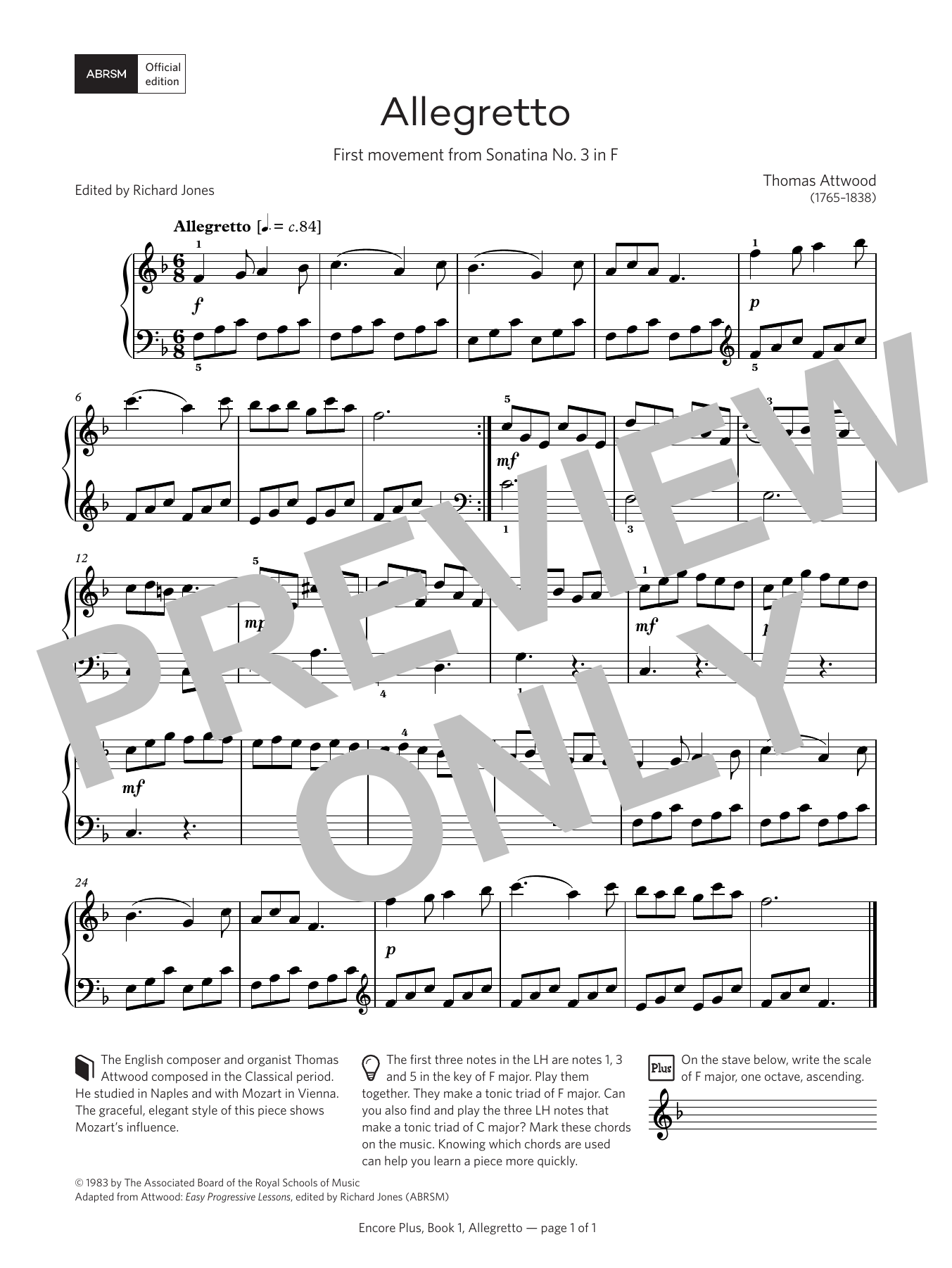
Allegretto (Encore Plus, Book 1): Piano Solo

By Thomas Attwood

Grade: 2

Item: 35-DS01989434

Digital Download
$3.99
Description

Discover MakeMusic Cloud: thousands of interactive titles your students can play along with today.

Sample Audio
No sample audio found.
Sample Video
Additional Details
Publisher: Hal Leonard
Page Count: 1
SKU: 35-DS01989434

More about this title

About the Composer: Thomas Attwood

Thomas Attwood (1765-1838) served as organist at St. Paul's Cathedral in London and became one of the most prolific composers of keyboard music in Regency England. He studied under Mozart in Vienna, an experience that shaped his elegant, straightforward compositional voice and made him a bridge between Classical and early Romantic keyboard writing.

Attwood's output included symphonies, chamber works, and vocal music, but his keyboard compositions remain his most enduring legacy in music education. His pieces for developing pianists balance technical clarity with genuine musical substance, never talking down to young players while remaining accessible to hands still building their range and independence.

Why we love this

Attwood writes with a composer's ear for voice leading and harmonic progression, never sacrificing musicality for pedagogical convenience. This Allegretto rewards careful attention to phrasing and dynamic shaping, giving early Grade 2 students real interpretive work without technical overwhelm.

What to expect

Bright and conversational, with the unhurried charm of a drawing room miniature. The piece moves with gentle purpose, inviting the performer to discover the courtesy and refinement in Attwood's melodic turns.

Who it's for

Grade 2 pianists ready to work with Classical phrasing and hand independence in a single-page format. It suits students who need repertoire that sits squarely at their level without feeling juvenile or purely technical.

How to get the most out of it

  • Shape each phrase as a complete musical thought rather than measure-by-measure. Identify where the melody peaks and breathe gently before the next phrase begins.
  • Balance hand independence by giving the accompanying hand a consistent dynamic level; let the melody sing above it without your left hand pulling attention.
  • Maintain the Allegretto tempo steadily. Early pianists often rush this character, which collapses the elegance Attwood built into the harmonic rhythm.

How to use it

Pair this with other single-page Classical pieces in a recital or studio class showcase. Its compact scope makes it ideal for students preparing multiple works or for demonstrating stylistic contrast on a student recital.

Skills your students will build

  • Sustaining a steady Allegretto tempo through harmonic changes
  • Independence between melody and accompaniment layers
  • Phrasing within an eight-bar Classical structure
  • Listening for voice leading in the harmony

You May Also Like