
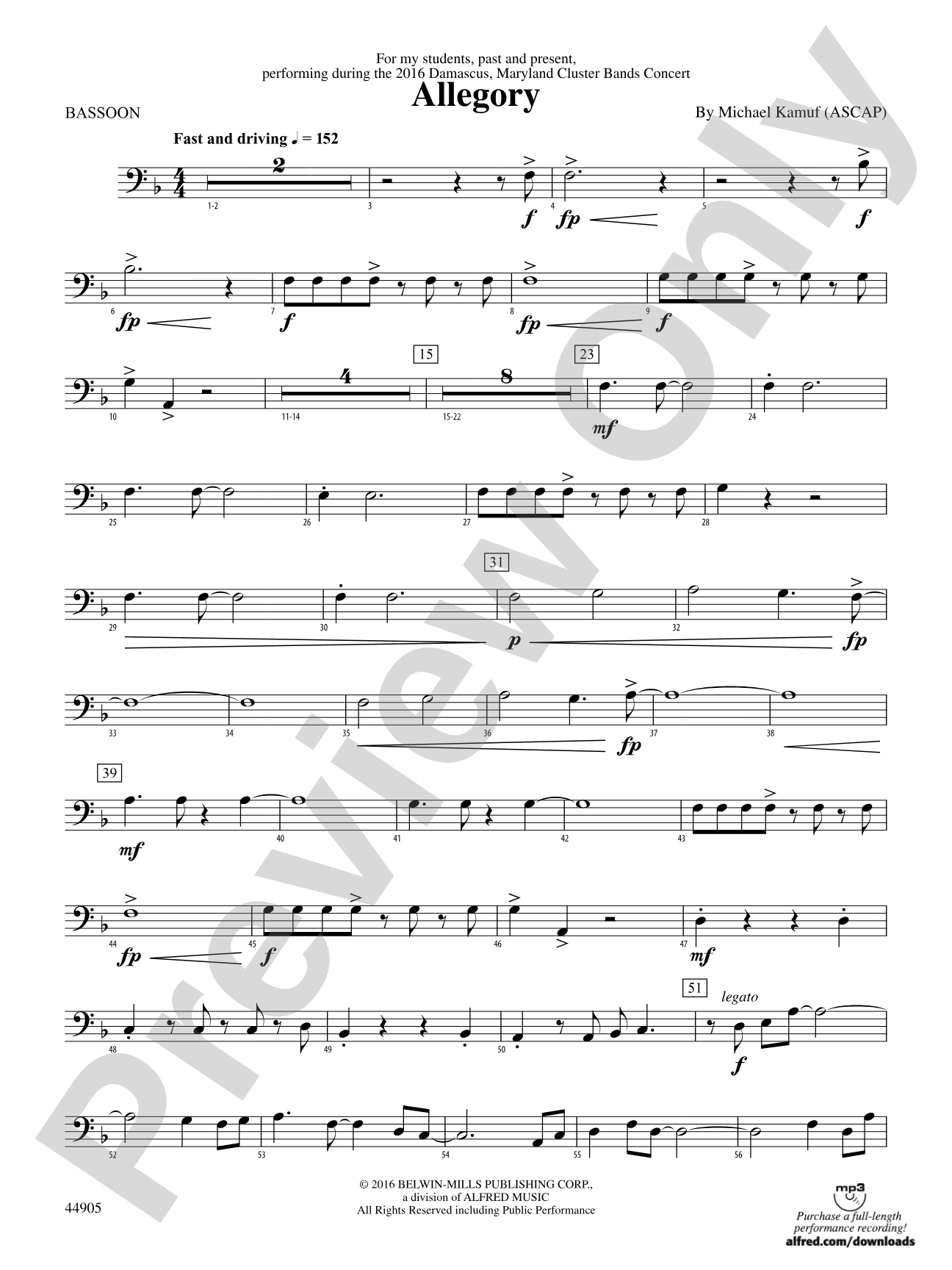

Allegory: Bassoon
By Michael Kamuf
Grade: 2 (Easy)
Item: 00-PC-0017396_B1
$3.00
Pickup currently not available
Description
An allegory is a representation of an abstract meaning through concrete or material forms. Majestic melodies, bold harmonies, energetic rhythmic elements, and a strong percussion component all come seamlessly together in this driving work for developing bands. Perfect as an opening or closing selection for concerts or festivals. (3:00)


Don't just read it, hear it, play along with it, and watch your students grow with it. In MakeMusic Cloud, Allegory: Bassoon comes alive with professional accompaniment, adjustable tempo, and built-in practice tools that turn solo practice into real progress.
Open in the Player
Jump straight in and assign it today.
Start Your Free Trial
Open this title and explore the full library in minutes.
Sample Audio
1
Audio File
--:--
0:00
0:00
Sample Video
Additional Details
Series:
Belwin Young Band
Publisher:
Alfred Music
Page Count:
252
SKU:
00-PC-0017396_B1
More about this title
About the Composer: Michael Kamuf

Michael Kamuf earned Bachelor of Music degrees in Jazz Performance and Music Education from the Dana School of Music at Youngstown State University, followed by a Master of Arts in Instrumental Conducting from George Mason University. His compositions and arrangements have been performed by prestigious ensembles including the Woody Herman and Glenn Miller Orchestras, the USAF Airmen of Note, the US Navy Commodores, and soloists such as James Moody, Eddie Daniels, and Sean Jones. He has recorded as a member of the Alan Baylock Jazz Orchestra and served as assistant principal trumpet of the Youngstown Symphony Orchestra.
Kamuf is an exclusive writer for the Belwin Division of Alfred Music Publishing and has published works with UNC Jazz Press, Neil A. Kjos Music, and FJH Music Company. Over 100 of his compositions and arrangements are in print, with many becoming standard literature for young jazz ensembles. He taught instrumental music in Montgomery County, Maryland Public Schools for thirty years, serving as Director of Bands and Orchestras and Music Department Chairperson at John T. Baker Middle School in Damascus, Maryland for twenty-seven of those years. His ensembles consistently achieved high ratings at music festivals and commissioned several works for young concert bands. Currently, he leads the Mike Kamuf Little Big Band, a jazz octet based in the Baltimore and Washington, DC area.
Why we love this
Kamuf writes with the developing band in mind, and "Allegory" proves it. The piece layers accessible parts with genuine musical weight, delivering majestic melodies and bold harmonies without overwhelming younger musicians. Its natural energy and substantial percussion writing make it rewarding to teach and exciting to perform, making it an excellent anchor for your concert program.
What to expect
Majestic and driven, "Allegory" unfolds through bold harmonic color and energetic momentum. The strong percussion component anchors the piece with propulsive rhythms while soaring melodies give it lift and grandeur, creating a work that feels important without demanding virtuosity.
Who it's for
Developing concert bands working at the Grade 2 level will find this piece accessible yet musically substantial. It works equally well for bands early in their season or those preparing festival and contest programs without overextending their technical range.
How to get the most out of it
- Balance the majestic melody line across your ensemble so it sings above the supporting voices; avoid letting harmony parts overpower the top voice.
- Shape the energetic rhythmic sections with clear articulation and consistent pulse; lock your percussion foundation early in rehearsals to establish the driving feel.
- Emphasize the bold harmonic moments by bringing out inner voice movement; this gives depth to the piece and keeps all sections engaged.
- Allow the piece to breathe at phrase endings; resist rushing through the transitions between sections, which gives the majestic character room to land.
How to use it
Open or close your concert with this piece; its three-minute length and substantial presence make it ideal bookend material for festivals or evening performances. It also fits naturally into contest setlists where you need a work that demonstrates musicianship across the full band while remaining grade-appropriate.
Skills your students will build
- Balancing melodic and harmonic voices within a full ensemble
- Maintaining consistent pulse through driving rhythmic passages
- Responding to and interpreting bold harmonic progressions
- Ensemble precision with complex percussion parts
- Phrasing and shaping majestic thematic material