All Too Soon: Piano Digital Sheet Music

All Too Soon: Piano Digital Sheet Music

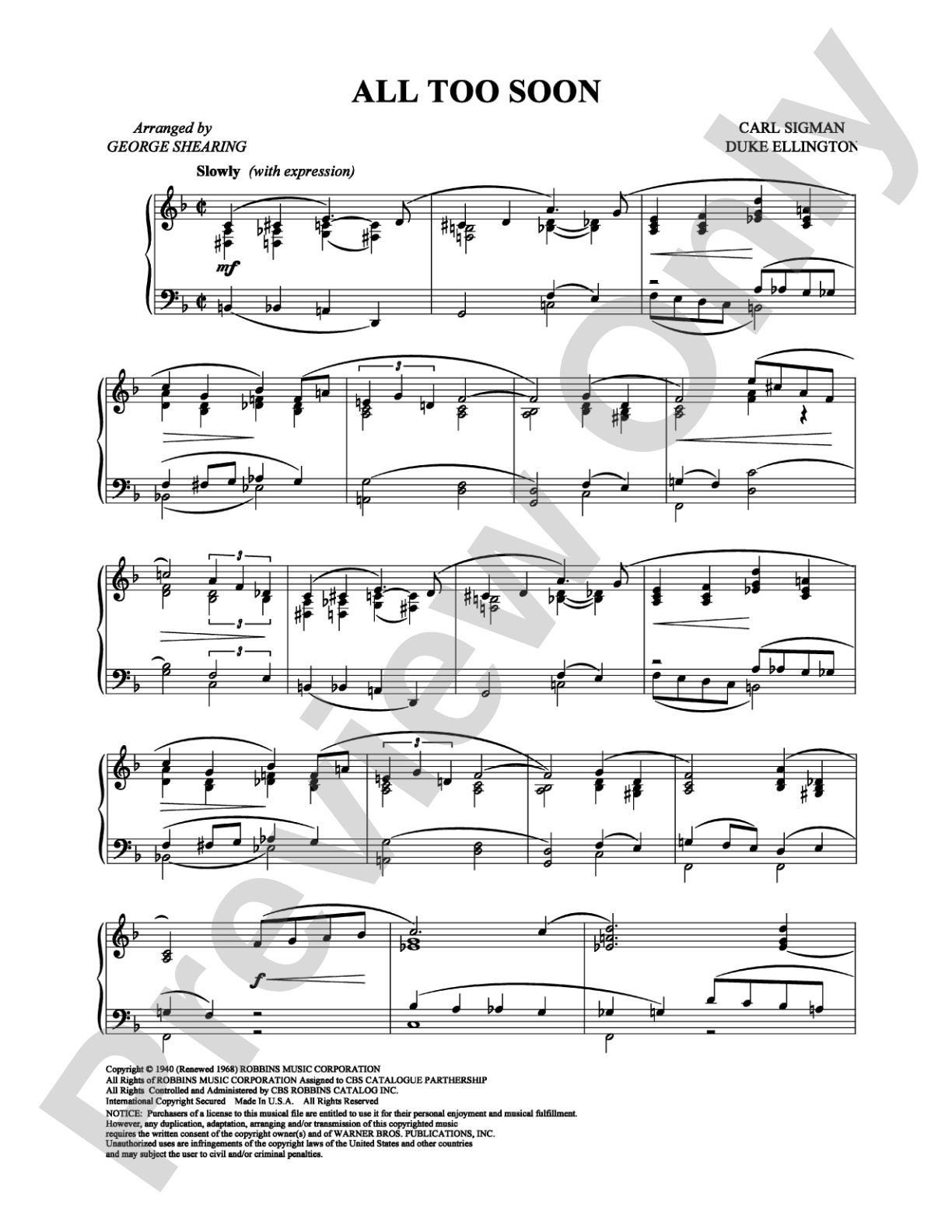
Duke Ellington, Carl Sigman, George Shearing

Item: 00-PS-0007184

Digital Download
$3.99
Description

All Too Soon: Piano Digital Sheet Music isn't in MakeMusic Cloud just yet...but it could be. Let us know you'd like to see it, and you'll help shape what comes next. In the meantime, start a free trial and dive into thousands of interactive titles your students can play along with today.

Sample Audio
No sample audio found.
Sample Video
Additional Details
SKU: 00-PS-0007184

More about this title

About the Artist: George Shearing

George Shearing (1919-2011) was a British jazz pianist and composer whose sophisticated harmonic approach and lush voicings shaped the sound of 1950s jazz. Blind from birth, he developed an extraordinary ear and went on to lead one of the most commercially successful jazz groups of his era, the George Shearing Quintet. His compositions and arrangements are staples of the jazz repertoire, valued for their harmonic richness and accessibility to musicians at multiple levels.

Why we love this

Shearing's piano writing balances harmonic sophistication with melodic clarity, making this standard a satisfying study in jazz voicing and comping. The piece rewards both careful listening and personal interpretation, offering pianists a chance to explore how subtle harmonic choices shape a lyrical ballad.

What to expect

A tender, introspective moment captured at the piano. The harmonies are sophisticated yet warm, unfolding with the intimacy of a late-night session. There's a sense of melancholy tinged with hope, the kind of emotional directness that makes a standard endure.

Who it's for

Jazz pianists exploring the Great American Songbook and intermediate-to-advanced players looking to deepen their understanding of jazz harmony. This piece is equally suited to students studying Shearing's influential approach to comping and arrangement.

How to get the most out of it

  • Listen closely to how Shearing voices the chords; his characteristic block chord approach creates warmth without muddiness. Experiment with pedal placement to maintain clarity while capturing that full sound.
  • Honor the rubato inherent in the melody without losing the underlying pulse. Let the harmony breathe, especially in transitional passages.
  • Pay attention to dynamics and touch. This ballad benefits from a singing, vocal quality rather than percussive attack; imagine accompanying a vocalist to guide your phrasing.

How to use it

Feature this as a solo jazz recital piece or pair it with other Shearing compositions to highlight his compositional voice. It works well in a concert exploring the intersection of swing-era sophistication and bebop-era harmonic language.

Skills your students will build

  • Jazz voicing and block chord harmony
  • Comping and rhythmic independence between hands
  • Rubato and expressive phrasing in ballad contexts
  • Interpreting lead sheet notation with harmonic depth

You May Also Like