
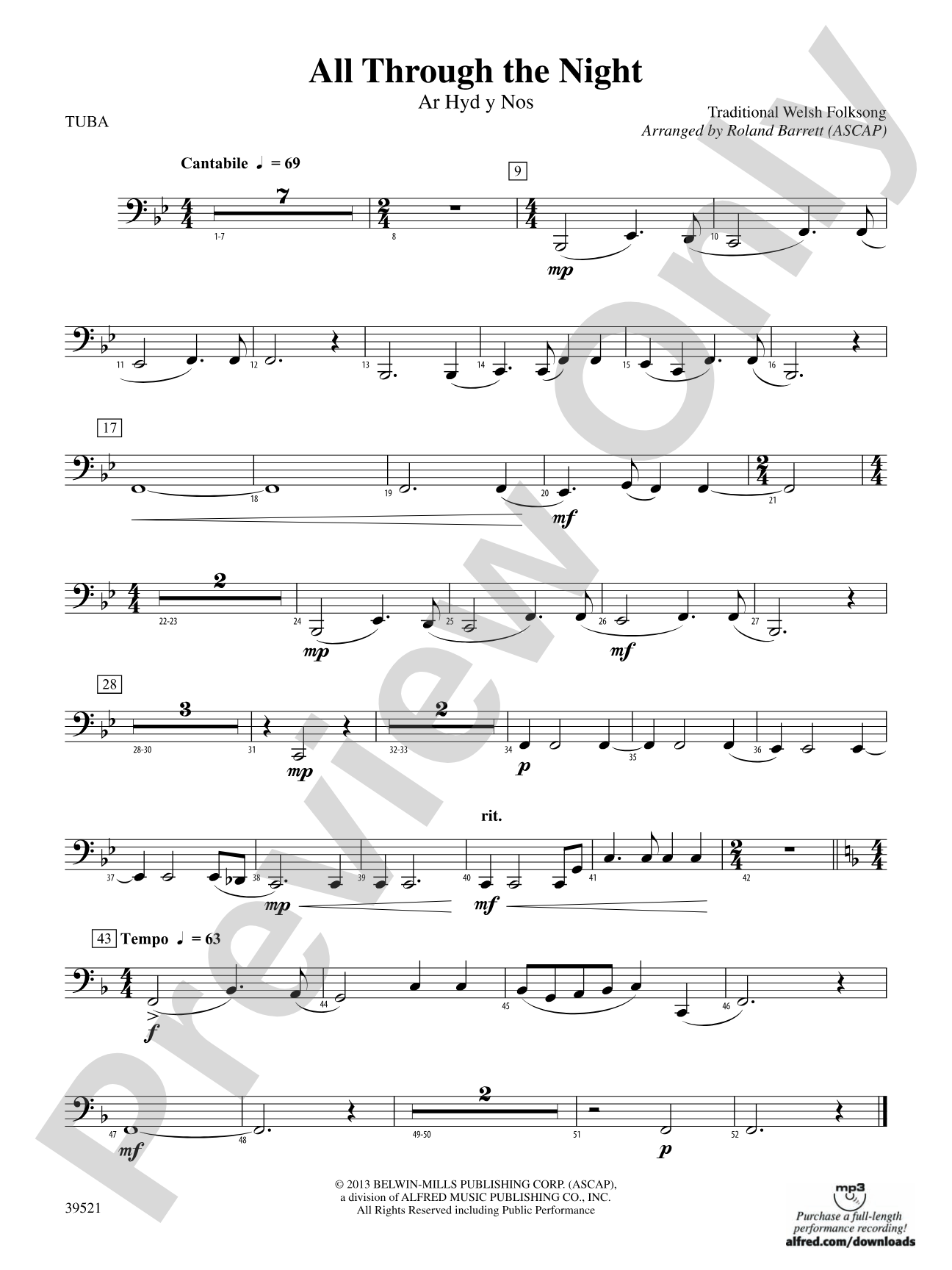

All Through the Night: Tuba
Ar Hyd y Nos
Traditional Welsh Folk Song / arr. Roland Barrett
Grade: 2 (Easy)
Item: 00-PC-0015836_TB1
$3.00
Pickup currently not available
Description
Although considered by many to be a traditional Christmas carol, this traditional Welsh folksong, known as "Ar Hyd y Nos," has been translated to numerous languages worldwide, but remains popular with Welsh male choirs. Delightfully voiced with rich harmonic textures, this fresh arrangement reinforces unhurried and well-supported smooth, flowing phrases. Enchanting and musical! (3:00) This title is available in MakeMusic Cloud.


Don't just read it, hear it, play along with it, and watch your students grow with it. In MakeMusic Cloud, All Through the Night: Tuba comes alive with professional accompaniment, adjustable tempo, and built-in practice tools that turn solo practice into real progress.
Open in the Player
Jump straight in and assign it today.
Start Your Free Trial
Open this title and explore the full library in minutes.
Sample Audio
1
Audio File
--:--
0:00
0:00
Sample Video
No sample videos found.
Additional Details
Series:
Belwin Young Band
Publisher:
Alfred Music
Page Count:
128
SKU:
00-PC-0015836_TB1
More about this title
About the Arranger: Roland Barrett

Roland Barrett brings twenty years of experience in instrumental music education and composition to his work at the University of Oklahoma, where he joined the faculty in 2001. His responsibilities encompass theory and composition instruction at both undergraduate and graduate levels, with particular focus on twentieth-century music. Beyond his academic role, Barrett has maintained an active career as composer and arranger, producing over two hundred published works for symphonic band, chamber groups, and marching ensembles.
Barrett's compositions and arrangements have reached national audiences through performances by the Dallas Wind Symphony, numerous All-State and All-Region honor bands, and broadcasts on NPR and cable television. His work has been featured at the Midwest Band and Orchestra Convention, the National Trumpet Competition, and the International Trumpet Guild convention. He is a multiple recipient of the ASCAP Plus award and holds a former Michael Hennagin Memorial Scholarship in Composition from the University of Oklahoma.
Why we love this
Barrett's setting captures the gentle, contemplative quality of this Welsh folksong while writing accessibly for Grade 2 ensembles. The harmonic language is sophisticated without demanding advanced technical skills, giving young conductors a chance to shape musically mature phrasing and balance. A three-minute piece that reads freshly every time you conduct it.
What to expect
Unhurried and contemplative. The arrangement unfolds with the quiet confidence of music that trusts silence and space as much as sound. Rich harmonic textures create a sense of warmth and depth, inviting the listener into an intimate musical moment rather than demanding attention through volume or virtuosity.
Who it's for
Beginning to intermediate concert bands seeking repertoire that sounds more mature than its technical difficulty suggests. This Grade 2 setting works particularly well for bands with developing musicianship or mixed instrumentation that benefits from straightforward part writing.
How to get the most out of it
- Shape the phrase architecture gently but deliberately. Guide students away from treating each measure as a separate unit; the melody should breathe in natural groups of four or eight measures.
- Pay attention to the balance between melody carriers and supporting voices. Rich harmonic textures only sing when the ensemble hears itself as an integrated sound, not as competing lines.
- Allow time for the sound to bloom in rehearsal. Because the piece emphasizes sustained writing and smooth voicing, students need to hear their own intonation adjustments clearly before performance tempos feel secure.
- Consider the emotional temperature carefully. This arrangement invites restraint and warmth rather than dramatic interpretation; younger players often respond well to this kind of musical clarity.
How to use it
Program this as the opening work on a concert devoted to folk traditions from around the world, or pair it with other accessible arrangements of British Isles material. Its reflective character also serves well as a concert closer or as a bridge between contrasting pieces that demand more technical energy from the ensemble.
Skills your students will build
- Sustaining smooth, connected phrases across multiple measures
- Listening to harmonic texture and balancing inner voices
- Reading straightforward concert band voicing at Grade 2 level
- Responding to subtle conducting gestures in unhurried tempos
- Intonation adjustments in sustained, slower harmonic progressions