
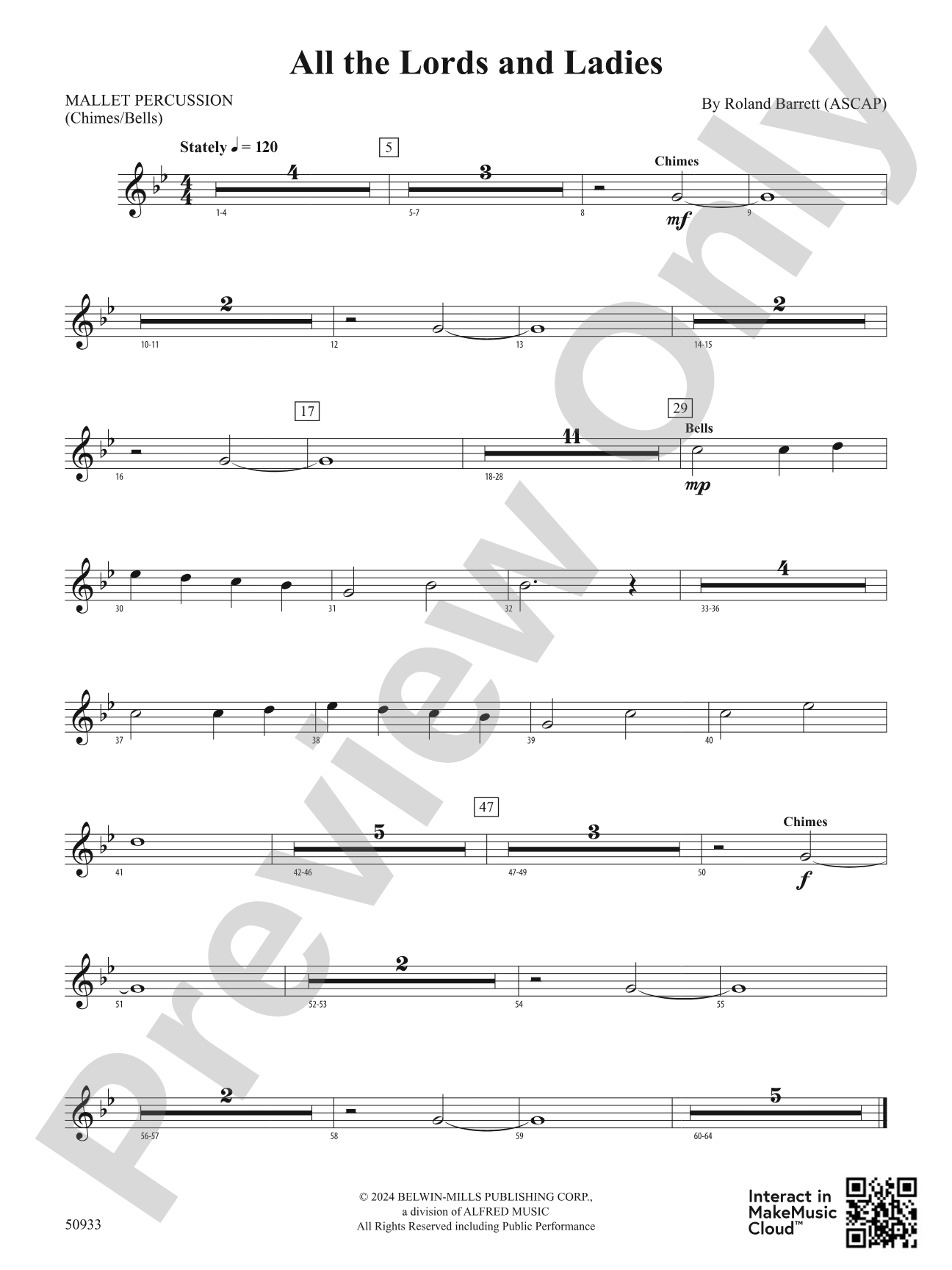

All the Lords and Ladies: Mallets
By Roland Barrett
Grade: 1
Item: 00-PC-0019344_M1
$3.00
Pickup currently not available
Description
Depicting a medieval summer fair, All the Lords and Ladies by veteran band composer Roland Barrett evokes imagery of the villagers' stately processional as they slowly gather in the meadow for the annual celebration. An introduction with regal percussion and low winds, tuneful melodies, and solid scoring throughout make this an outstanding teaching piece for your students. (2:10)
The PerformancePlus+ series is an innovative addition to the ever-expanding MakeMusic Cloud interactive library. These engaging selections are presented with educational resources designed to enrich the rehearsal process and create outstanding performances. Including:


The PerformancePlus+ series is an innovative addition to the ever-expanding MakeMusic Cloud interactive library. These engaging selections are presented with educational resources designed to enrich the rehearsal process and create outstanding performances. Including:
- Assignment, recording, and assessment tools within MakeMusic Cloud
- Piece-specific exercises focused on skills and techniques
- Educational tips and suggestions to support learning
Available in print and digital formats.
Don't just read it, hear it, play along with it, and watch your students grow with it. In MakeMusic Cloud, All the Lords and Ladies: Mallets comes alive with professional accompaniment, adjustable tempo, and built-in practice tools that turn solo practice into real progress.
Open in the Player
Jump straight in and assign it today.
Start Your Free Trial
Open this title and explore the full library in minutes.
Sample Audio
1
Audio File
--:--
0:00
0:00
Sample Video
Additional Details
Series:
Belwin Concert Band - PerformancePlus+
Publisher:
Alfred Music
SKU:
00-PC-0019344_M1
More about this title
About the Composer: Roland Barrett

Roland Barrett brings twenty years of university-level teaching and professional arranging to his role as composer. Since joining the University of Oklahoma's faculty in 2001, he has developed a deep expertise in 20th-century music theory and composition while maintaining his position as musical arranger for the Pride of Oklahoma marching band.
Barrett's output spans over two hundred published works across symphonic band, chamber ensembles, and marching contexts. His pieces have earned performances by the Dallas Wind Symphony, countless All-State and All-Region honor bands, and national recognition through NPR, the Midwest Band & Orchestra Convention, and multiple ASCAP awards. His work consistently balances accessibility with musical substance, making him a trusted voice in band repertoire.
Why we love this
This piece handles something Grade 1 bands don't always find: genuine musical storytelling without oversimplification. Barrett's use of regal percussion colors and low-wind foundation gives even developing players real textural work to accomplish, and the tuneful melodies reward your section leaders while keeping everyone engaged.
What to expect
The opening unfolds like sunlight breaking through a castle gate. Medieval pageantry flows across your stage through stately melodies and warm harmonic colors, evoking the unhurried gathering of villagers in a summer meadow. The piece breathes with ceremony and celebration without ever demanding virtuosity.
Who it's for
Grade 1 concert bands seeking a piece with narrative substance and tasteful orchestration. Directors programming contest or festival events will appreciate the two-minute-ten-second duration and the immediate accessibility paired with genuine musical merit.
How to get the most out of it
- Shape the processional carefully by using the recorded accompaniment as a reference, but encourage your band to find their own tempo within the marked range so the piece breathes with your ensemble's character rather than feeling locked to a track.
- Balance the opening regal percussion with low winds intentionally; these two colors should feel equally present rather than allowing the percussion to dominate the introduction.
- Mark phrase endings clearly in the parts and rehearse how the band releases notes together, since lyrical lines at this level often suffer from staggered cutoffs that blur the musical shape.
- Use the PerformancePlus+ exercises to isolate any rhythmic or technical passages in isolation before running full sections, which accelerates learning without breaking ensemble momentum.
How to use it
Program this as an opener or as a palate-cleanser between contrasting works; its programmatic clarity and festive character anchor a concert thematically without overstaying its welcome. At Grade 1, it also serves well as a confidence-builder early in the season when your band is still cohering, since the musical storytelling carries pieces that might otherwise feel thin on technical demands.
Skills your students will build
- Shaping long melodic lines with intentional phrasing
- Balancing multiple simultaneous colors (regal percussion, low winds, melodic voices)
- Ensemble release and cutoff precision
- Interpreting programmatic imagery through musical choices