
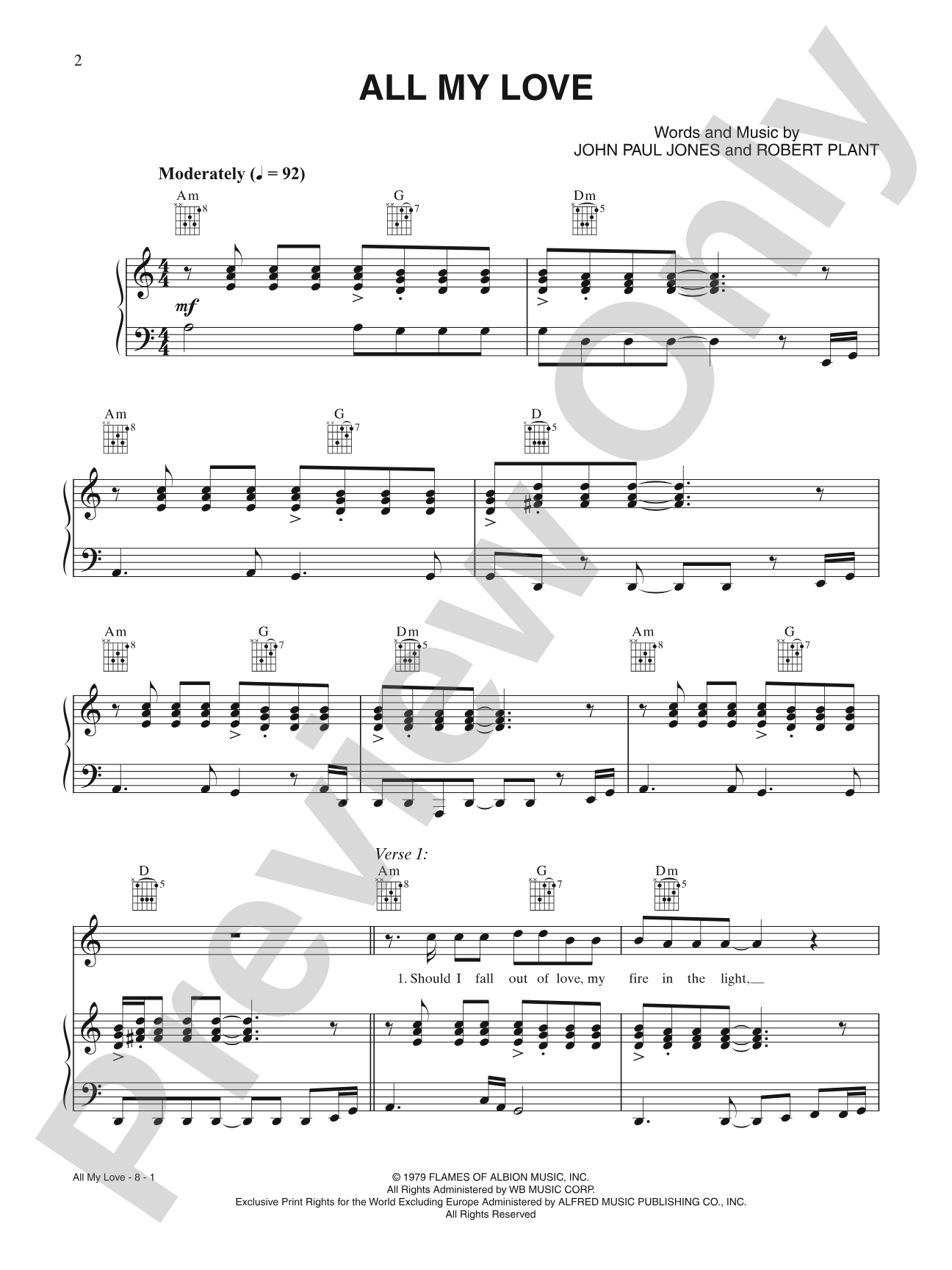
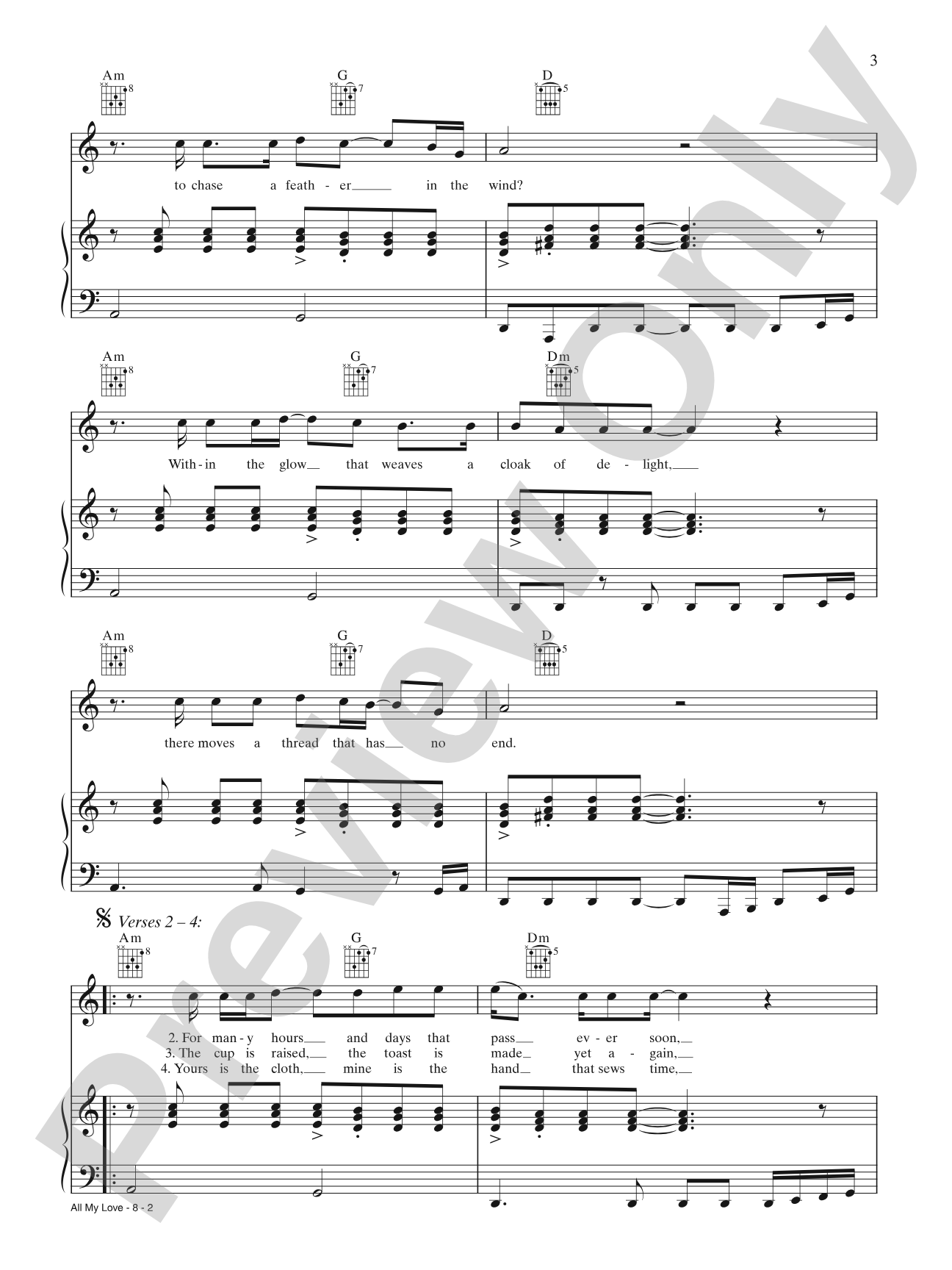

All My Love: Piano/Vocal/Chords
Led Zeppelin
Item: 00-PS-0015510
$5.99
Pickup currently not available
Related Items
Heartbreaker: Piano/Vocal/Chords |
$5.99
|
View | |
No Quarter: Piano/Vocal/Chords |
$5.99
|
View | |
The Ocean: Piano/Vocal/Chords |
$4.99
|
View | |
The Rain Song: Piano/Vocal/Chords |
$9.99
|
View | |
Since I've Been Loving You: Piano/Vocal/Chords |
$5.99
|
View | |
Thank You: Piano/Vocal/Chords |
$5.99
|
View | |
Carouselambra: Piano/Vocal/Chords |
$9.99
|
View | |
Fool in the Rain: Piano/Vocal/Chords |
$9.99
|
View | |
Trampled Under Foot: Piano/Vocal/Chords |
$5.99
|
View | |
Led Zeppelin: Piano Sheet Music Anthology: Piano/Vocal/Guitar Book |
$29.99
|
View |
Description
Led Zeppelin fans who play the piano know that certain songs by the legendary band are particularly well-suited to be played on keyboard instruments. Some of these are "All My Love," "No Quarter," "Stairway to Heaven," "Your Time Is Gonna Come," and more---and they're all here in this collectible sheet music anthology. Also included are a variety of the band's most popular songs from seven of their albums. This collection of 20 arrangements is the ultimate vehicle for pianists to explore the music of the greatest rock band of all time! Titles: All My Love * The Battle of Evermore * Black Dog * Carouselambra * The Crunge * Fool in the Rain * Going to California * Good Times Bad Times * Heartbreaker * Kashmir * No Quarter * The Ocean * The Rain Song * Rock and Roll * Since I've Been Loving You * Stairway to Heaven * Thank You * Trampled Under Foot * You Shook Me * Your Time Is Gonna Come.


All My Love: Piano/Vocal/Chords isn't in MakeMusic Cloud just yet...but it could be. Let us know you'd like to see it, and you'll help shape what comes next. In the meantime, start a free trial and dive into thousands of interactive titles your students can play along with today.
Request This Title
Tell us you want it.
Start Your Free Trial
Explore everything that's ready to play right now.
Sample Audio
No sample audio found.
Sample Video
No sample videos found.
Additional Details
Series:
Sheet Music Anthology
Publisher:
Alfred Music
Page Count:
164
SKU:
00-PS-0015510
More about this title
About the Composer: John Paul Jones
John Paul Jones served as the multi-instrumentalist and bassist for Led Zeppelin, and his compositional contributions shaped some of the band's most enduring works. Beyond his role as performer, Jones brought sophisticated arranging sensibilities to the group, particularly in crafting keyboard parts that became iconic elements of their sound. His work on tracks like "No Quarter" and "The Rain Song" demonstrates a composer's ear for texture, harmonic depth, and the marriage of rock idiom with classical compositional technique.
Jones's influence on rock music extends beyond his performance career into his later work as a composer and producer, where he continued to explore the intersection of orchestral and popular music. For music educators, his arrangements and compositions serve as models for how to build musical sophistication within rock contexts, proving that popular music need not be simplistic.
Why we love this
This anthology gives pianists genuine access to Led Zeppelin's catalog in forms that actually work on keyboard, rather than stripped-down approximations. The collection captures how these songs translate to piano and voice, revealing harmonic complexity and melodic beauty that often gets buried under the original arrangements. Pianists get to inhabit songs that shaped rock history while developing interpretive skills across a range of styles and textures.
What to expect
These arrangements unlock the architectural clarity of Led Zeppelin's songwriting, revealing the harmonic sophistication and melodic strength that underpins their arrangements. Playing through this collection is an experience in discovering how rock's greatest songs hold up when stripped to their essentials: voice, piano, and chord progression.
Who it's for
This collection serves pianists and keyboardists who want to perform Led Zeppelin material in solo recital or ensemble contexts, as well as singers looking for piano accompaniment to iconic rock vocals. It also appeals to musicians studying how rock music translates across instruments and to educators seeking substantial popular music repertoire that rewards serious musical engagement.
How to get the most out of it
- Study the chord voicings carefully; Jones's piano work often uses jazz-inflected harmonic extensions that differ significantly from standard triadic accompaniment. These voicings shape the emotional character of each song.
- Use the vocal melody as an anchor for phrasing and dynamics, particularly in ballads like 'The Rain Song' and 'Going to California,' where the piano's role shifts between accompanist and soloist.
- Attend to the rhythmic feel beneath each arrangement. Songs like 'Black Dog' and 'Trampled Under Foot' demand precision in the keyboard groove, even when notated simply.
- Consider the historical context of each piece when programming; songs from later albums often display more elaborate arrangements than early tracks, which affects rehearsal sequencing.
How to use it
Program selections from this anthology in recitals alongside classical or contemporary art song to demonstrate the harmonic and melodic legitimacy of rock composition, or use them in educational contexts to teach students how popular music functions across different instrumental and vocal arrangements. The variety of styles and moods across the 20 songs makes it possible to construct a program arc that tells a narrative, whether chronological or thematic.
Skills your students will build
- Reading and interpreting jazz-influenced chord voicings in a popular music context
- Balancing accompaniment and melodic line as a pianist in vocal chamber settings
- Understanding how songs function across different instrumental and vocal arrangements
- Developing rhythmic precision in groove-based material while maintaining musicality
- Interpreting dynamics and phrasing in arrangements that blend rock and classical sensibilities