
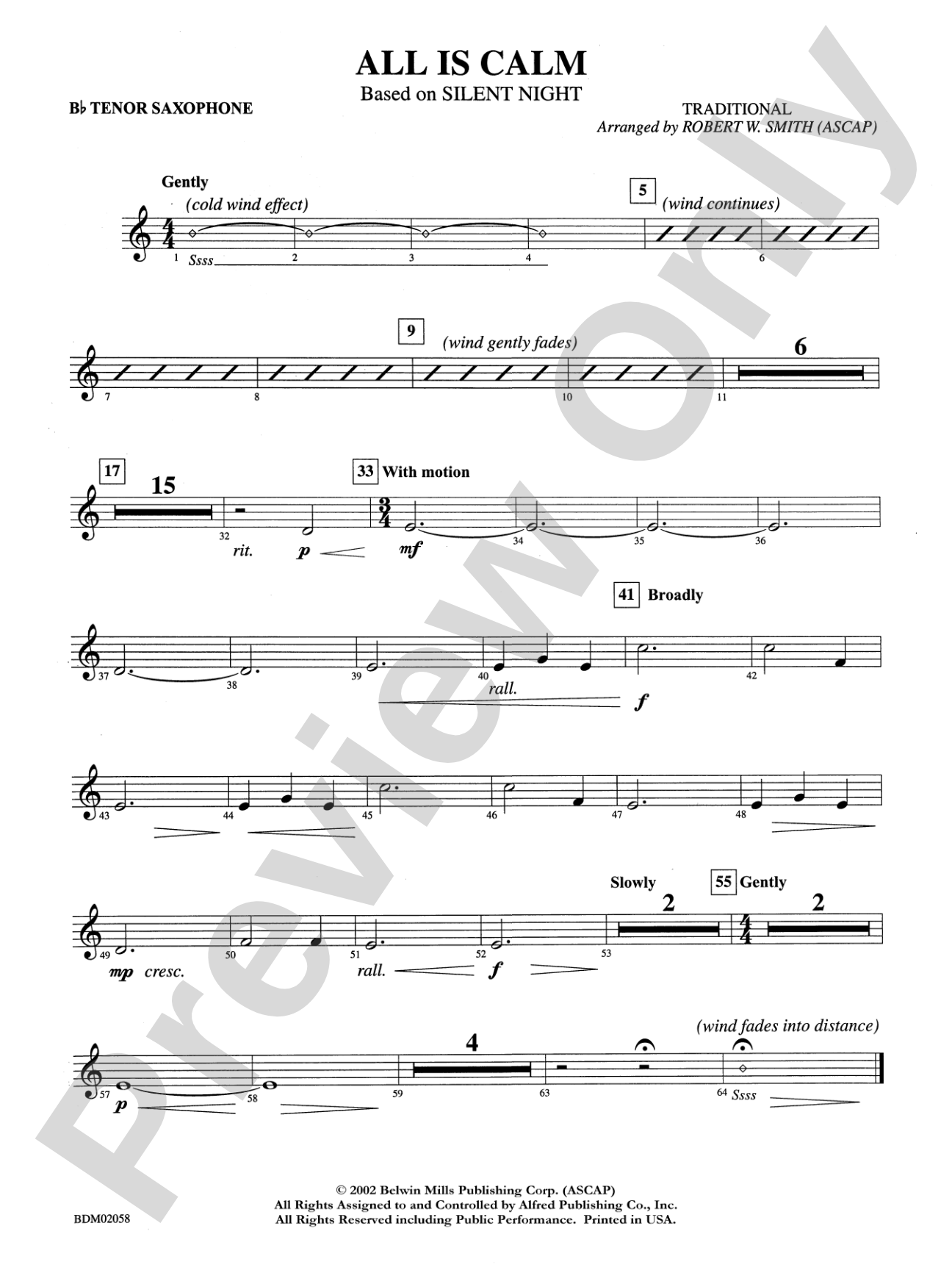

All Is Calm (based on Silent Night): B-flat Tenor Saxophone
Traditional / arr. Robert W. Smith
Grade: 2 (Easy)
Item: 00-PC-0002177_TX1
$5.99
Pickup currently not available
Description
Here's a moving holiday work based on "Silent Night." Incorporating his technique for providing a soloist experience for any member of the ensemble (or a combination of players), Robert W. Smith has staged a master work for young band. This very touching arrangement will be a holiday classic you can use from year to year. (3:09)


Don't just read it, hear it, play along with it, and watch your students grow with it. In MakeMusic Cloud, All Is Calm (based on Silent Night): B-flat Tenor Saxophone comes alive with professional accompaniment, adjustable tempo, and built-in practice tools that turn solo practice into real progress.
Open in the Player
Jump straight in and assign it today.
Start Your Free Trial
Open this title and explore the full library in minutes.
Sample Audio
1
Audio File
--:--
0:00
0:00
Sample Video
Additional Details
Series:
Belwin Young Band
Publisher:
Alfred Music
Page Count:
296
SKU:
00-PC-0002177_TX1
More about this title
About the Arranger: Robert W. Smith

Robert W. Smith stands among America's most prolific composers and arrangers for concert band and orchestra, with over 400 publications in circulation. His education includes a Bachelor of Music Education from Troy State University and a Master of Music from the University of Miami. Smith's original compositions and arrangements have traveled globally, from European concert halls to the opening ceremonies of the Olympic Games, and have been featured on major television broadcasts including the Macy's Thanksgiving Day Parade.
As both composer and clinician, Smith has conducted and taught across North America, Japan, Australia, and Europe. His symphonic works for developing ensembles, including The Tempest and The Odyssey, remain foundational repertoire in band programs. His gift lies in crafting music that challenges growing musicians while remaining immediately engaging for audiences.
Why we love this
Smith structures this arrangement so that nearly every player gets a genuine solo moment, not as a section highlight but as a featured line. At Grade 2, the balance between accessibility and musical substance is exceptional; young players feel they're performing something with real depth, not a simplified version. The transparent orchestration means even modest bands sound polished and professional.
What to expect
Intimate and reflective, with the quiet dignity of a winter night rather than the bustle of holiday pageantry. Each instrumental voice emerges briefly like a soloist stepping into candlelight, then recedes into the soft texture of the ensemble. The familiar melody becomes almost meditative through Smith's careful orchestration.
Who it's for
Grade 2 concert bands seeking a substantial holiday work that gives every player—not just the strongest musicians—a moment in the spotlight. Directors looking for repertoire that sounds considerably more sophisticated than its easy grade would suggest, while remaining fully accessible to developing musicians.
How to get the most out of it
- Balance the featured soloist against the ensemble by bringing the supporting voices slightly under pitch during solo passages; this lifts the solo without requiring the featured player to oversing.
- Shape the phrasing in two-measure units rather than waiting for obvious cadences, which keeps the familiar melody sounding fresh and prevents it from becoming sentimental.
- Rotate which players take the solo passages during rehearsal; this builds ownership across the section and keeps everyone engaged even when not featured.
- Let the arrangement breathe in the quieter moments. The power of this piece comes from restraint, not volume.
How to use it
Place this as a centerpiece of a holiday concert, perhaps opening the second half to create a contemplative moment between more energetic pieces. It also serves as an excellent choice for smaller indoor venues or community performances where the transparency of the scoring can shine without competition from larger acoustic spaces.
Skills your students will build
- Balancing solo lines with ensemble accompaniment
- Shaping longer phrases through dynamic control rather than tempo change
- Responding to conductor cues for ensemble breathing and articulation shifts
- Playing confidently as a featured soloist within an ensemble context