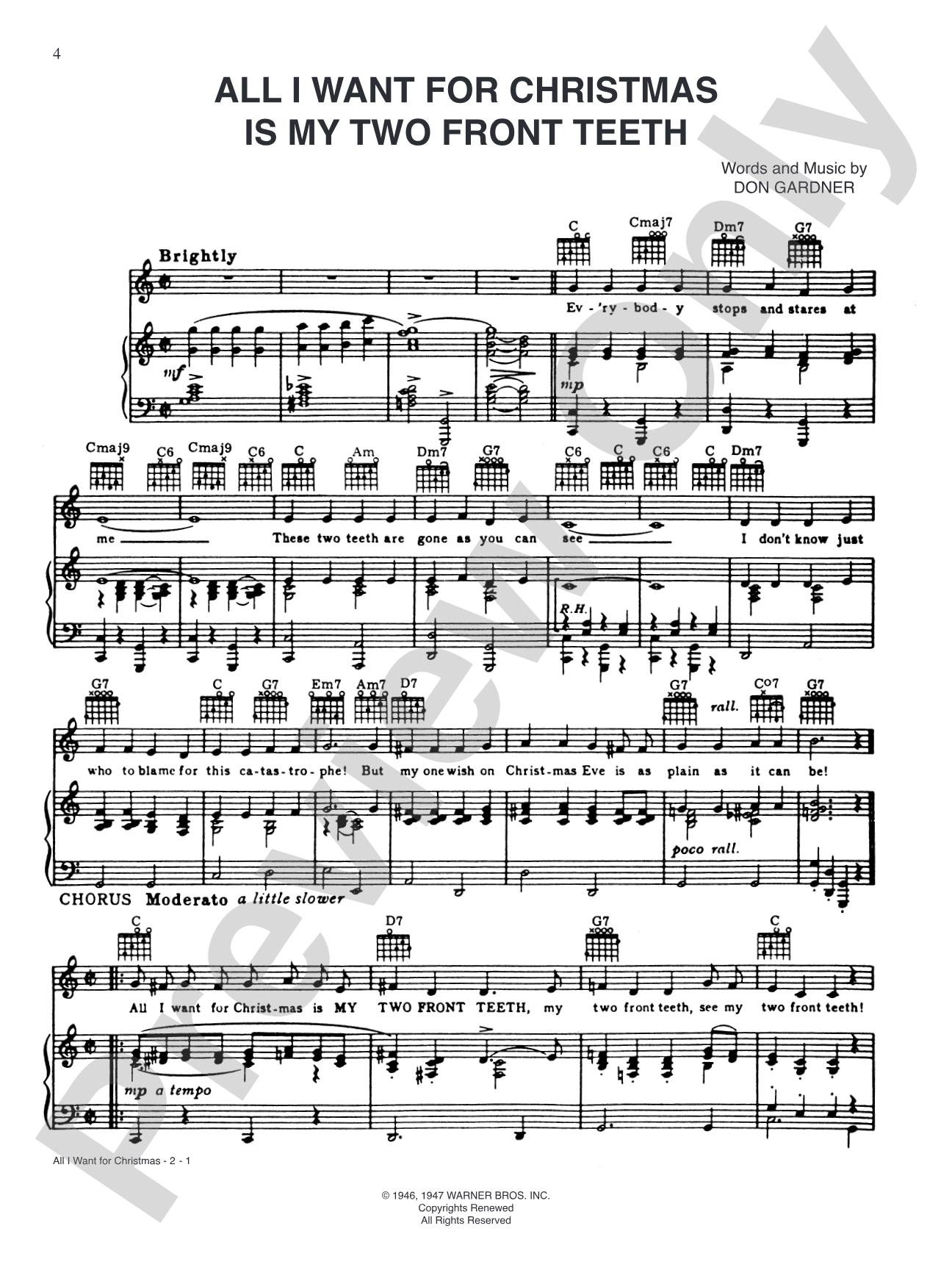
All I Want for Christmas Is My Two Front Teeth Sheet Music Preview

All I Want for Christmas Is My Two Front Teeth: Piano/Vocal/Chords

Words and music by Don Gardner

Item: 00-PIP-000084

Digital Download
$3.99

One moment…

Description

All I Want for Christmas Is My Two Front Teeth: Piano/Vocal/Chords isn't in MakeMusic Cloud just yet...but it could be. Let us know you'd like to see it, and you'll help shape what comes next. In the meantime, start a free trial and dive into thousands of interactive titles your students can play along with today.

Sample Audio
No sample audio found.
Sample Video
Additional Details
Publisher: Alfred Music
Page Count: 4
SKU: 00-PIP-000084

More about this title

About the Composer: Don Gardner

Don Gardner composed "All I Want for Christmas Is My Two Front Teeth" in 1946, and the song became one of the most enduring novelty Christmas recordings in American popular music. Originally performed by Spike Jones and his City Slickers, the piece captures the playful spirit of mid-century holiday entertainment with its whimsical lyrics and charming melody. Gardner's ability to craft a piece that appeals equally to children and adults made this a perennial favorite in holiday programs and radio rotations for generations.

Why we love this

This novelty standard captures genuine charm without relying on cynicism. The melody sits naturally for singers of all ranges, and the piano voicings are accessible enough for community ensembles while remaining musically satisfying.

What to expect

Cheerful and guileless. The melody hums along with infectious simplicity, carrying a child's perspective that feels honest rather than cloying. Piano and voice trade spaces naturally, creating an intimate holiday moment.

Who it's for

Singers preparing holiday recitals, cabaret numbers, or family performances who want material that entertains without gimmickry. Pianists looking for accessible accompaniment that works in solo recitals or as a duet partner.

How to get the most out of it

  • Nail the rhythmic precision of the vocal melody. The humor lands only when the diction is crisp and the phrasing is rhythmically secure.
  • Use the chord symbols to experiment with accompaniment styles. A stride piano approach reads completely differently than a jazzy comping style.
  • Let the pianist shape the dynamic arc with the vocalist rather than staying locked in one texture throughout. The song benefits from subtle ebb and flow.

How to use it

Perfect as an opening number to establish a warm, approachable tone at holiday concerts. The four-page length makes it ideal for programming between longer works or as part of a themed set of seasonal favorites.

Skills your students will build

  • Reading chord symbols and interpreting harmonic accompaniment choices
  • Vocal line security in a melody-driven song with straightforward harmonic support
  • Balancing ensemble texture between piano and voice

You May Also Like