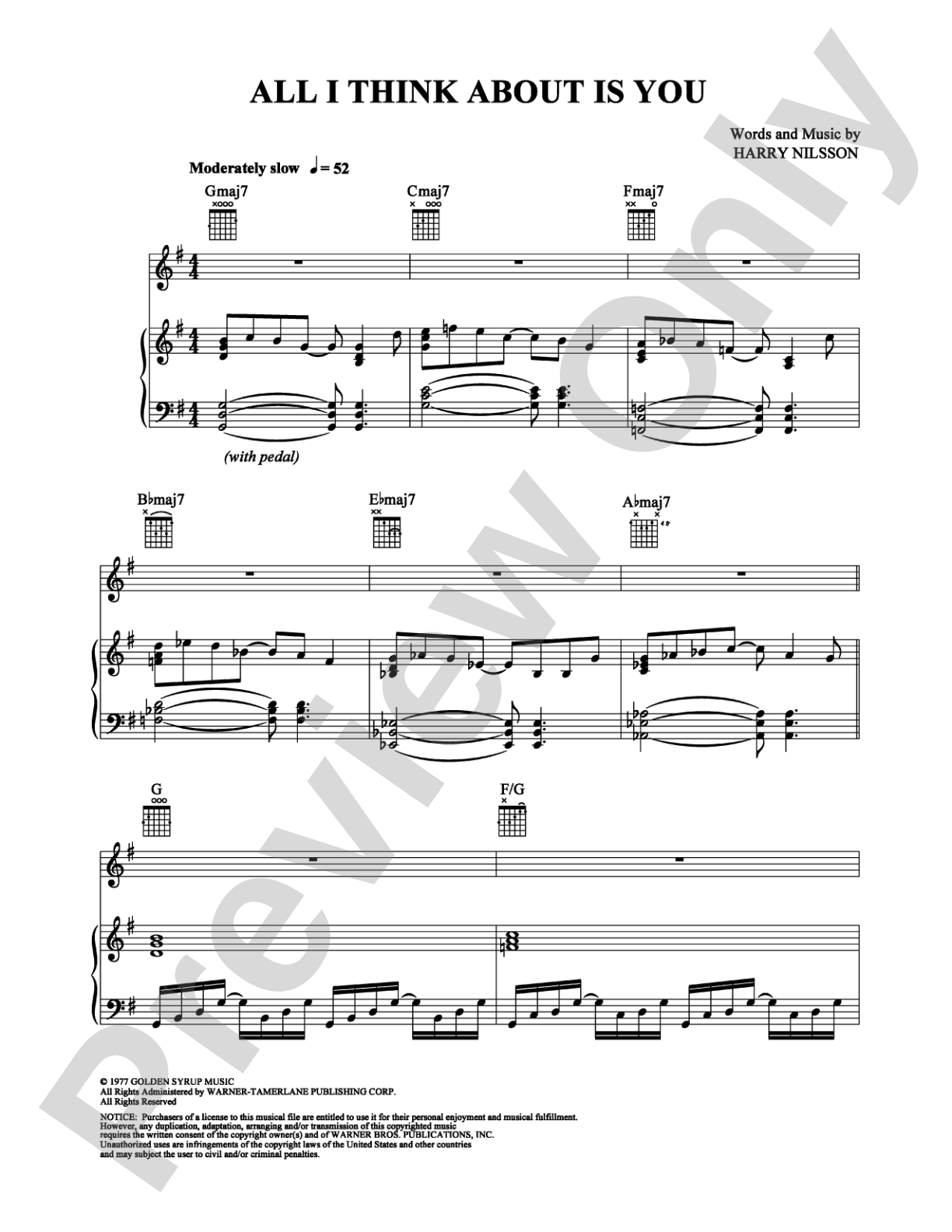
All I Think About is You: Piano/Vocal/Chords Digital Sheet Music

All I Think About is You: Piano/Vocal/Chords Digital Sheet Music

Harry Nilsson, Nilsson

Item: 00-PS-0004828

Digital Download
$3.99
Description

All I Think About is You: Piano/Vocal/Chords Digital Sheet Music isn't in MakeMusic Cloud just yet...but it could be. Let us know you'd like to see it, and you'll help shape what comes next. In the meantime, start a free trial and dive into thousands of interactive titles your students can play along with today.

Sample Audio
No sample audio found.
Sample Video
Additional Details
SKU: 00-PS-0004828

More about this title

About the Artist: Nilsson

Harry Nilsson (1941, 1994) was a singer-songwriter and composer who built his reputation on inventive arrangements, absurdist humor, and vocal versatility. His work spanned pop, rock, and experimental territory, earning him respect from peers across genres and a devoted following among musicians who valued his refusal to follow formula.

Why we love this

This song's conversational melody and straightforward emotional directness make it immediately engaging for students while the chord progressions offer real substance for pianists learning contemporary harmonic movement. The piano-vocal-chords format gives singers and accompanists immediate flexibility to interpret the arrangement themselves rather than following a prescriptive orchestration.

What to expect

Intimate and direct, with a confessional quality that feels both earnest and slightly understated. The song has the warmth of a conversation overheard in a late-night setting, supported by piano that's thoughtful without being intrusive.

Who it's for

Singers developing their interpretation of contemporary pop-rock song and pianists building skill with comping and improvisation around song forms. This works equally well in voice lesson settings, jazz combo rehearsals, or as a recital encore for students seeking material beyond the classical canon.

How to get the most out of it

  • Balance the vocal line so it floats easily over the piano part without oversinging; Nilsson's style depends on conversational phrasing rather than belting.
  • Use the chord symbols to guide reharmonization or comping choices, especially if performing with a trio or band setting where the piano becomes an interactive instrument rather than a literal transcription.
  • Pay attention to where the melody sits in the vocalist's range and adjust the key if needed; this song rewards customization to each singer's strengths.

How to use it

Include this in a concert exploring American popular song from the 1960s-70s, or use it as a bridge piece between classical and contemporary music programming. It also serves as an excellent encore that showcases a vocalist's ability to connect emotionally with an audience without vocal pyrotechnics.

Skills your students will build

  • Interpreting lead sheet notation and making performance choices based on chord symbols
  • Singing with conversational phrasing and emotional restraint in popular music
  • Accompanying flexibly, using chord progressions to comp rather than read literal notation
  • Transposing and customizing arrangement to fit a singer's range and style

You May Also Like