
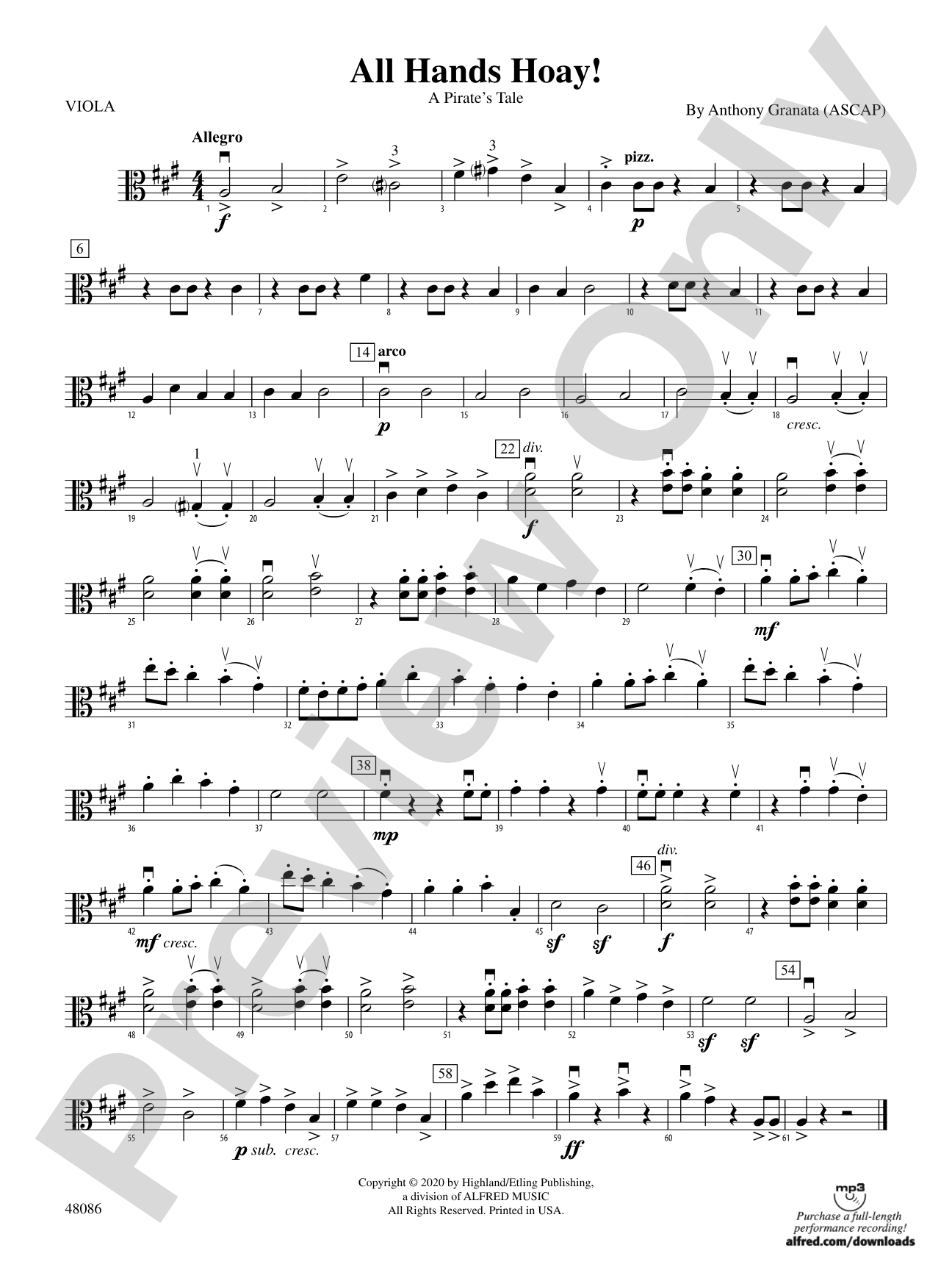

All Hands Hoay!: Viola
A Pirate's Tale
By Anthony Granata
Grade: 2.5
Item: 00-PC-0018521_VA1
$3.00
Pickup currently not available
Description
Not to be confused with the nautical term "Ahoy!," the phrase "All hands hoay!" actually means all hands on deck for some serious work! In other words, string players, it's time to get those fingers moving with this simple, rugged, and modal seafaring melody. Written in the often-inaccessible key of F-sharp natural minor, this fun musical pirate's tale will have your students' little fingers stretching nonstop. The melody is evenly passed around, with a middle section featuring your violas and a jaunty contrapuntal ending. Younger orchestras will have a blast with this exciting original, All Hands Hoay! by Anthony Granata, as they get right down to work! (1:40) This title is available in MakeMusic Cloud.


Don't just read it, hear it, play along with it, and watch your students grow with it. In MakeMusic Cloud, All Hands Hoay!: Viola comes alive with professional accompaniment, adjustable tempo, and built-in practice tools that turn solo practice into real progress.
Open in the Player
Jump straight in and assign it today.
Start Your Free Trial
Open this title and explore the full library in minutes.
Sample Audio
1
Audio File
--:--
0:00
0:00
Sample Video
Additional Details
Series:
Highland/Etling String Orchestra
Publisher:
Alfred Music
Page Count:
62
SKU:
00-PC-0018521_VA1
More about this title
About the Composer: Anthony Granata

Anthony Granata teaches middle school orchestra in Westport, Connecticut, and is an accomplished violist who performs regularly. He studied at Western Connecticut State University and has spent his career teaching across elementary, middle, and high school levels, working with beginning band, chorus, and orchestra students. Granata began composing at age twelve and returned to writing music after focusing on his teaching career, deliberately crafting pieces that address pedagogical challenges his young string players face. An advocate for public school music programs, he received his own early string training through the Norwalk public schools' music program and is currently pursuing a degree in school administration.
Why we love this
Granata writes with genuine understanding of what works in the middle school orchestra rehearsal. The F-sharp natural minor tonality presents real technical stretch without feeling arbitrary; students leave this piece with expanded left-hand reach and comfort in an unfamiliar key. The melody passing around the ensemble keeps every section engaged and invested in the storytelling, while the viola-featured middle section gives those players a genuine spotlight moment that most Grade 2.5 repertoire reserves for violins.
What to expect
Rugged and salty, with a sense of purposeful labor and camaraderie. The F-sharp natural minor tonality gives the melody a minor-key grit that feels both nautical and urgent, while the even distribution of melodic material keeps the piece moving forward with collective energy. The contrapuntal ending brings a jaunty, almost celebratory feeling to the work accomplished.
Who it's for
Grade 2.5 string orchestras that are ready to tackle unfamiliar key signatures and want a piece that combines genuine musical challenge with the playfulness that keeps young players engaged. This works especially well for middle school orchestras building stamina and technical range in their left hands.
How to get the most out of it
- Build left-hand flexibility deliberately during rehearsals by having students practice the F-sharp scale in various positions before tackling the full piece. This prevents the stretch from feeling like punishment and makes the melody easier to execute musically.
- Keep the seafaring character grounded and rhythmically secure rather than rushing the tempo. The contrapuntal ending needs precision from all sections, which requires a steady hand from the podium.
- Feature your violas prominently during the middle section and let them hear their musical importance. Middle schoolers often underestimate their own part's value; making this section sing helps build viola confidence.
- Bring out the dialogue between sections when the melody passes around the orchestra. This isn't background accompaniment; each section takes ownership of the narrative.
How to use it
Program this early in a concert where the audience benefits from hearing your orchestra's technical growth. The narrative clarity and seafaring theme make it an effective opener that establishes personality and energy without demanding the interpretive maturity needed for more subtle pieces. It also pairs well alongside other light concert works that emphasize ensemble blend and section balance.
Skills your students will build
- Playing in F-sharp natural minor with secure intonation and left-hand stretch
- Passing melodic material between sections while maintaining phrase continuity
- Reading and executing contrapuntal passages where multiple sections move independently
- Ensemble balance and coordination when the viola section carries primary melodic material
- Rhythmic precision and sectional independence in the jaunty contrapuntal ending