
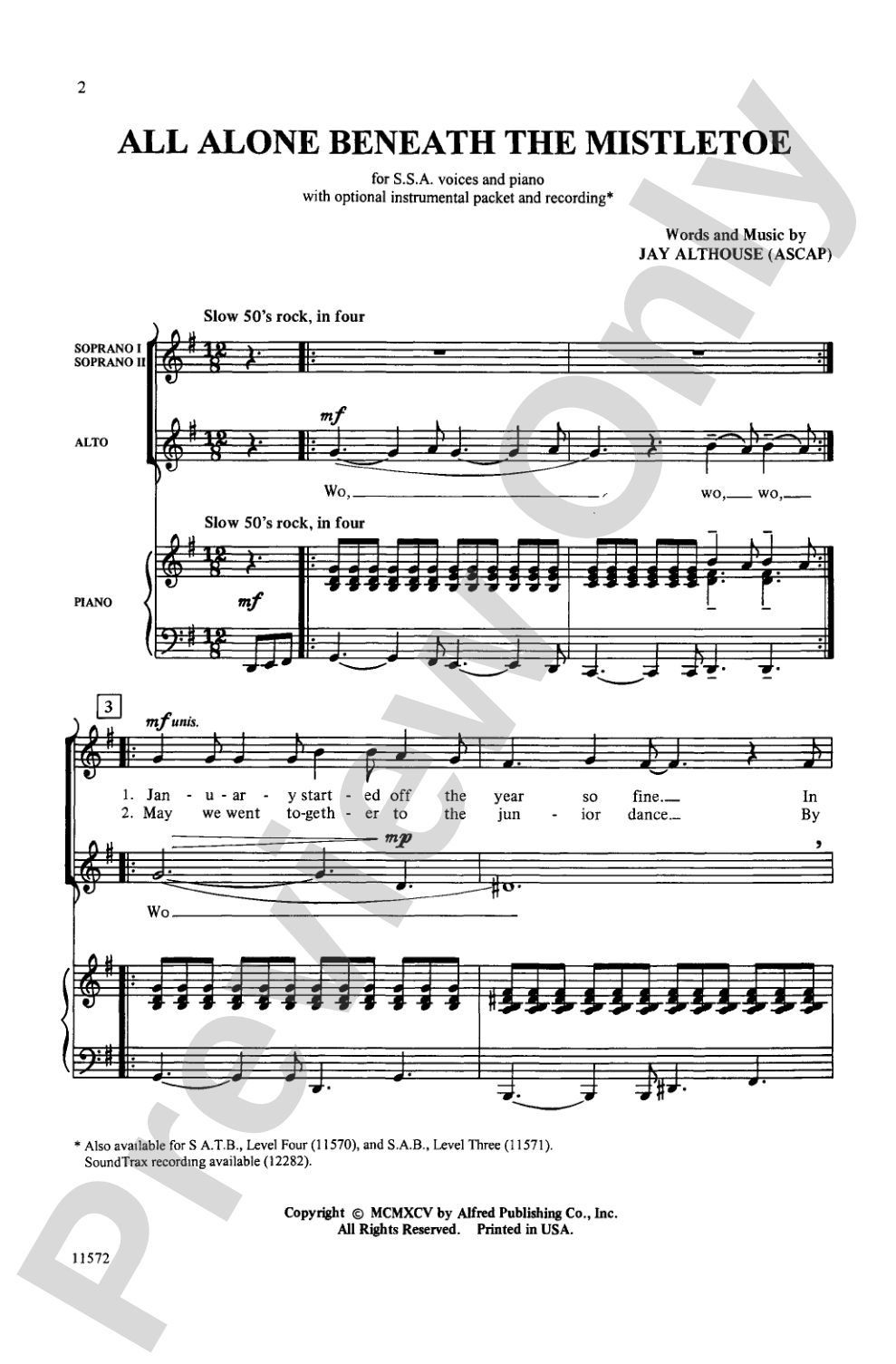
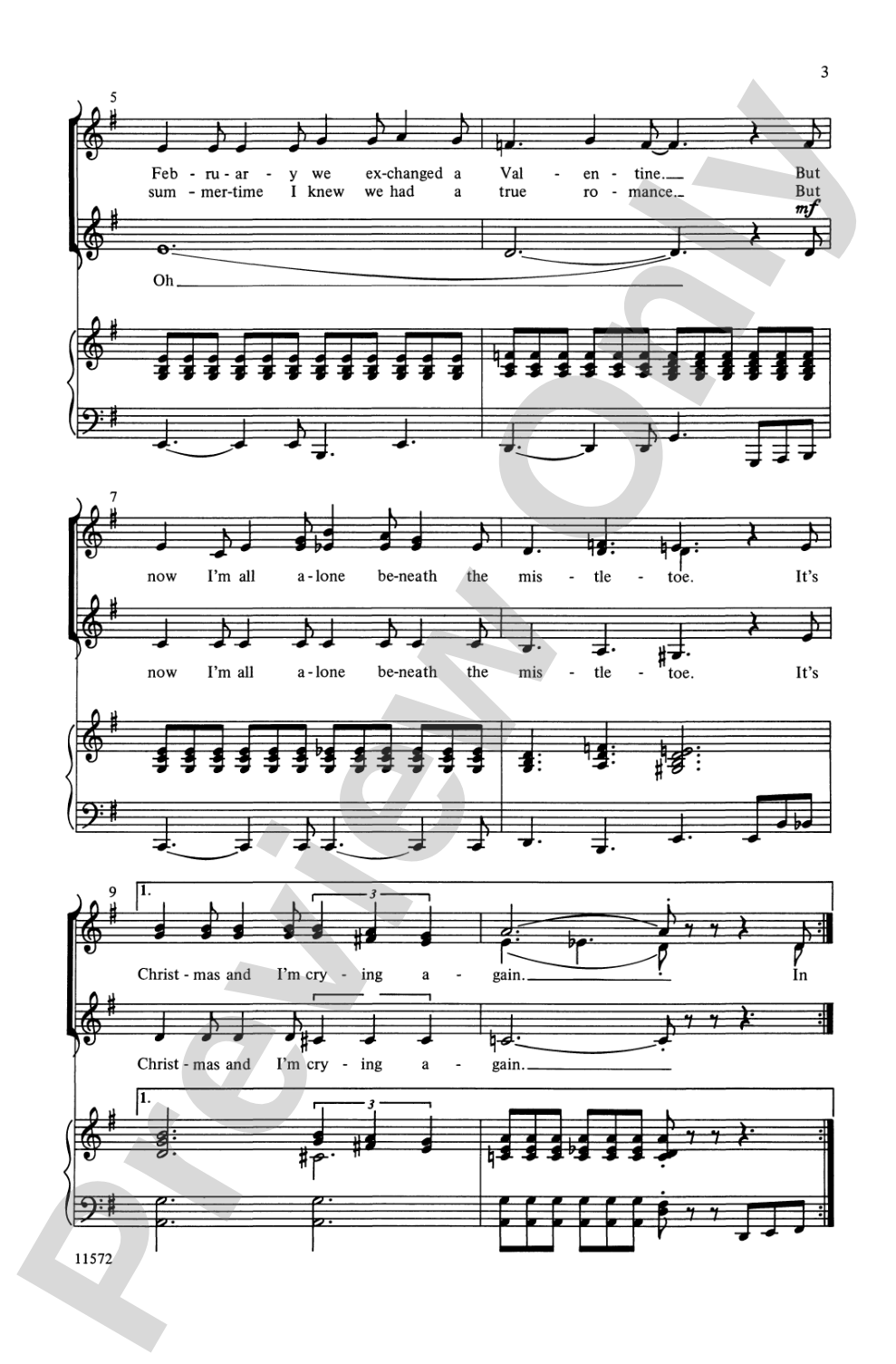

All Alone Beneath the Mistletoe: SSA Choral Octavo
Music by Jay Althouse
Item: 00-PO-0003861
$2.25
Minimum order quantity: 20 copies
Pickup currently not available
Related Items
All Alone Beneath the Mistletoe: SATB Choral Octavo |
$2.25
|
View |
Description
Turn back the clock with this fun-filled, slow-rockin' 50's style piece which spoofs a holiday off-again, on-again romance and ends with the singers not alone beneath the mistletoe. The SoundTrax Cassette features an authentic 50's sound complete with baritone sax. Add staging to make it a real show-stopper. InstruPax includes: director's score, 2 alto sax, tenor sax, baritone sax, rhythm.


All Alone Beneath the Mistletoe: SSA Choral Octavo isn't in MakeMusic Cloud just yet...but it could be. Let us know you'd like to see it, and you'll help shape what comes next. In the meantime, start a free trial and dive into thousands of interactive titles your students can play along with today.
Request This Title
Tell us you want it.
Start Your Free Trial
Explore everything that's ready to play right now.
Sample Audio
No sample audio found.
Sample Video
No sample videos found.
Additional Details
Series:
Alfred Archive Edition: Alfred Choral Designs
Publisher:
Alfred Music
Page Count:
8
SKU:
00-PO-0003861
More about this title
About the Composer: Jay Althouse

Jay Althouse holds degrees in Music Education and Music from Indiana University of Pennsylvania, where he was recognized as a Distinguished Alumni. His career spans both the publishing industry, where he spent eight years in rights and licensing administration and served on the Executive Board of the Music Publishers Association of America, and composition. With more than 800 choral works in print across all difficulty levels, his music reaches ensembles throughout English-speaking countries.
Althouse is an ASCAP member and frequent recipient of the ASCAP Special Award. Beyond composition, he has co-authored children's musicals with Sally K. Albrecht, curated vocal solo collections including Folk Songs for Solo Singers, and written influential educational texts such as The Complete Choral Warm-up Book and Accent on Composers. His collaborative work with Albrecht, I Hear America Singing, was performed by the San Francisco Girls and Boys Choirs at President Obama's 2009 Inauguration. He serves on the National Advisory Board of the Folk Art Society of America and resides in Wake Forest, North Carolina.
Why we love this
Althouse captures the playful energy of 1950s rock and roll while crafting a narrative that actually resolves—no cliffhanger here, just a satisfying romantic conclusion. The combination of period-authentic arranging (complete with baritone sax coloring), SSA voicing that sits comfortably across middle school and high school ranges, and the deliberate staging cues make this a piece that works equally well as a concert closer or as a full theatrical moment.
What to expect
Imagine stepping into a high school gymnasium in 1956 where a doo-wop group is playfully working through the ups and downs of holiday romance. The music bounces with good humor, the harmonies are warm and accessible, and the ending resolves with genuine charm rather than irony. It's a piece that makes singers smile during rehearsal and audiences genuinely entertained in performance.
Who it's for
Middle school and high school choirs with at least 20-30 singers who enjoy contemporary choral arranging with a theatrical bent. The piece works especially well for ensembles comfortable with period styling and interested in repertoire beyond traditional holiday fare.
How to get the most out of it
- Lean into the swing feel. The rhythmic lilt is central to nailing the 50's authenticity, so have singers listen to the recorded accompaniment multiple times to absorb the groove before digging into the score.
- Balance the sax section carefully in rehearsal. The baritone sax in particular carries the character; it should support the melody without overwhelming the voices.
- Build the staging gradually. Start with simple blocking that emphasizes the romantic comedy of the text, then layer in movement cues that feel natural to your ensemble rather than imposed.
How to use it
This works brilliantly as a concert finale or as the centerpiece of a winter concert that blends traditional and contemporary holiday music. The theatrical staging possibilities mean it also functions as a stand-alone entertainment piece at assemblies or informal performances.
Skills your students will build
- Swing rhythm interpretation (syncopation and swing feel in a 50's style context)
- Blend and balance with small jazz ensemble (working as a vocal section alongside saxophones)
- Interpretation of comedic text and character storytelling through vocal performance
- Basic stage movement and awareness of staging notation in the score