
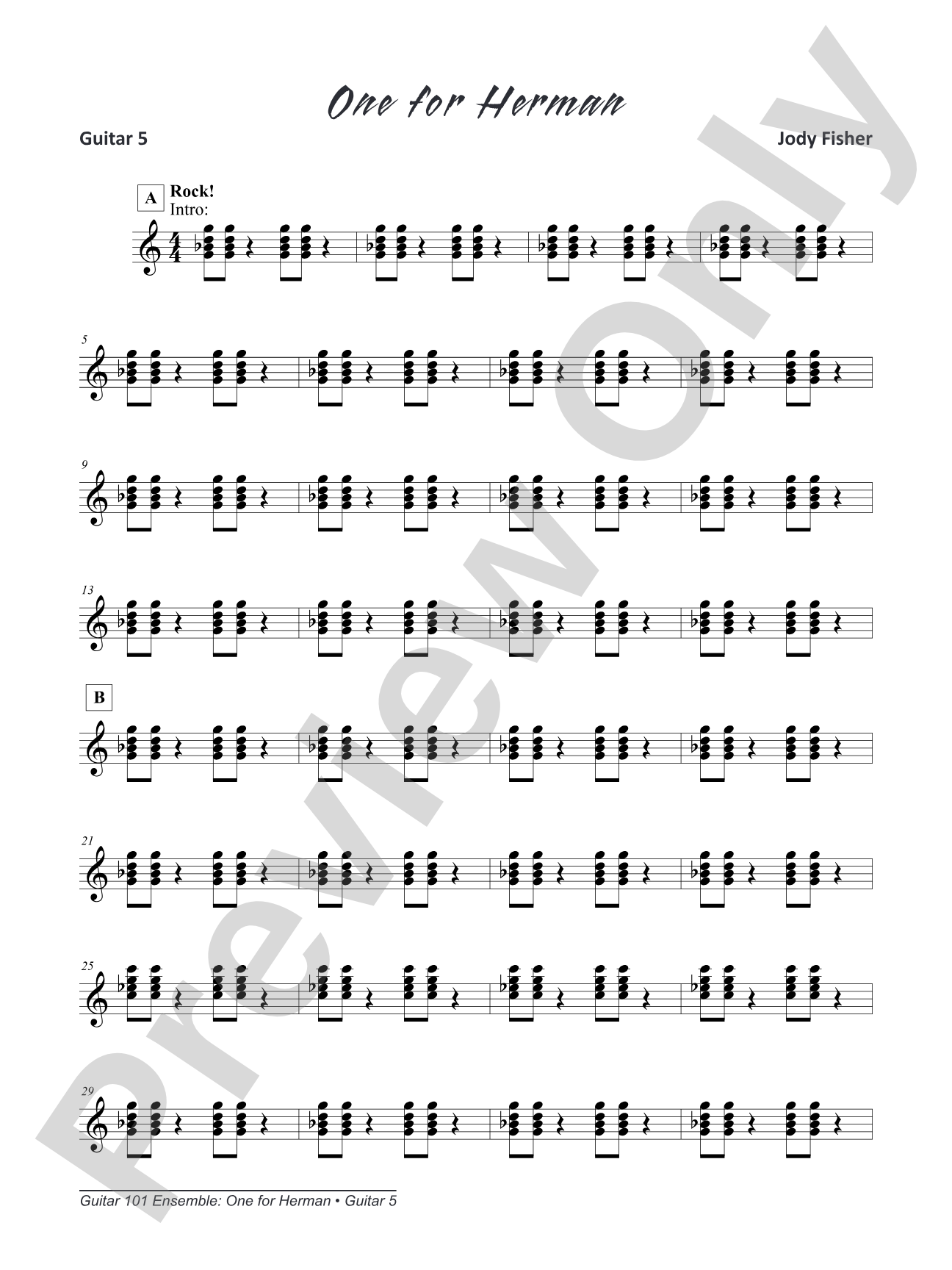

Alfred's Guitar 101, Ensemble: One for Herman: Guitar 5
By Jody Fisher
Item: 00-PC-0016720_G5
$3.00
Pickup currently not available
Description
Alfred's Guitar 101, Ensemble makes a great supplement to any class guitar program. Your students will enjoy rehearsing and performing great-sounding pieces using the skills and concepts they have learned in Alfred's Guitar 101. This flexible guitar ensemble is written for five guitars, but it can easily be adapted for as few as two or as many as eight guitars. A creative teacher can find many ways to use Alfred's Guitar 101, Ensemble: add a bass player, percussion, or other melodic or harmonic instruments---whatever fills the needs of your students and program.
One For Herman is an Alfred's Guitar 101 Ensembles piece that features a classic rock oriented, straight eighth note feel. Since the song is layered, students will learn to concentrate on their own part, while other parts enter at different times. Guitar 1 plays the melody while Guitars 2 and 3 provide accompaniment and some melodic fills. Guitar 4 gives students a chance to learn to play a repeating riff in the bass, along with other variations that give this song its character.


One For Herman is an Alfred's Guitar 101 Ensembles piece that features a classic rock oriented, straight eighth note feel. Since the song is layered, students will learn to concentrate on their own part, while other parts enter at different times. Guitar 1 plays the melody while Guitars 2 and 3 provide accompaniment and some melodic fills. Guitar 4 gives students a chance to learn to play a repeating riff in the bass, along with other variations that give this song its character.
Don't just read it, hear it, play along with it, and watch your students grow with it. In MakeMusic Cloud, Alfred's Guitar 101, Ensemble: One for Herman: Guitar 5 comes alive with professional accompaniment, adjustable tempo, and built-in practice tools that turn solo practice into real progress.
Open in the Player
Jump straight in and assign it today.
Start Your Free Trial
Open this title and explore the full library in minutes.
Sample Audio
1
One_For_Herman
--:--
One_For_Herman
0:00
0:00
Sample Video
No sample videos found.
Additional Details
Series:
101 Series
Publisher:
Alfred Music
Page Count:
20
SKU:
00-PC-0016720_G5
More about this title
About the Composer: Jody Fisher
Jody Fisher has built a career writing accessible, engaging music for student musicians across multiple instruments. Her work in the Alfred's 101 series demonstrates a gift for scaffolding ensemble concepts through pieces that sound polished while remaining technically manageable.
Why we love this
This piece nails the balance between accessibility and ensemble sophistication. Students stay engaged because they're not just strumming chords; Guitar 1 carries a real melody while the lower voices build texture through riffs and fills, so every part feels essential. The rock feel makes it instantly gratifying to perform, which keeps motivation high in group guitar classes.
What to expect
Straightforward and energetic. The classic rock vibe with steady eighth notes gives the piece momentum, while the layered parts create a full sound that feels bigger than the number of players on stage. Students experience the satisfaction of contributing to a groove.
Who it's for
Class guitar students who have completed Alfred's Guitar 101 and are ready to play in ensemble settings. This piece works for groups of two to eight guitarists, making it flexible for different class sizes and skill combinations.
How to get the most out of it
- Have Guitars 1 and 4 lock in together first. The melody and bass riff are the spine of the arrangement, so once those two parts establish the groove, the accompaniment parts (Guitars 2 and 3) will fall into place more naturally.
- Emphasize the straight eighth note feel consistently across the ensemble. A metronome or backing track helps everyone avoid drifting into a swing feel, which would undermine the classic rock character.
- Rotate students through different parts in rehearsal and performance. A student comfortable with the melody can grow by tackling Guitar 4's riff, and vice versa, which deepens their understanding of how the piece fits together.
How to use it
Program this as a concert opener to showcase your class guitar program with something that resonates with student musicians and audiences alike. It also serves as a capstone performance after students finish the Alfred's Guitar 101 curriculum, celebrating what they've learned while keeping the focus on ensemble musicianship rather than solo difficulty.
Skills your students will build
- Playing repeating riffs and ostinatos with consistency
- Balancing melody awareness with part independence
- Maintaining steady rhythm in a rock-oriented context
- Coordinating ensemble entries and transitions
- Adapting to different ensemble sizes by doubling or omitting parts