
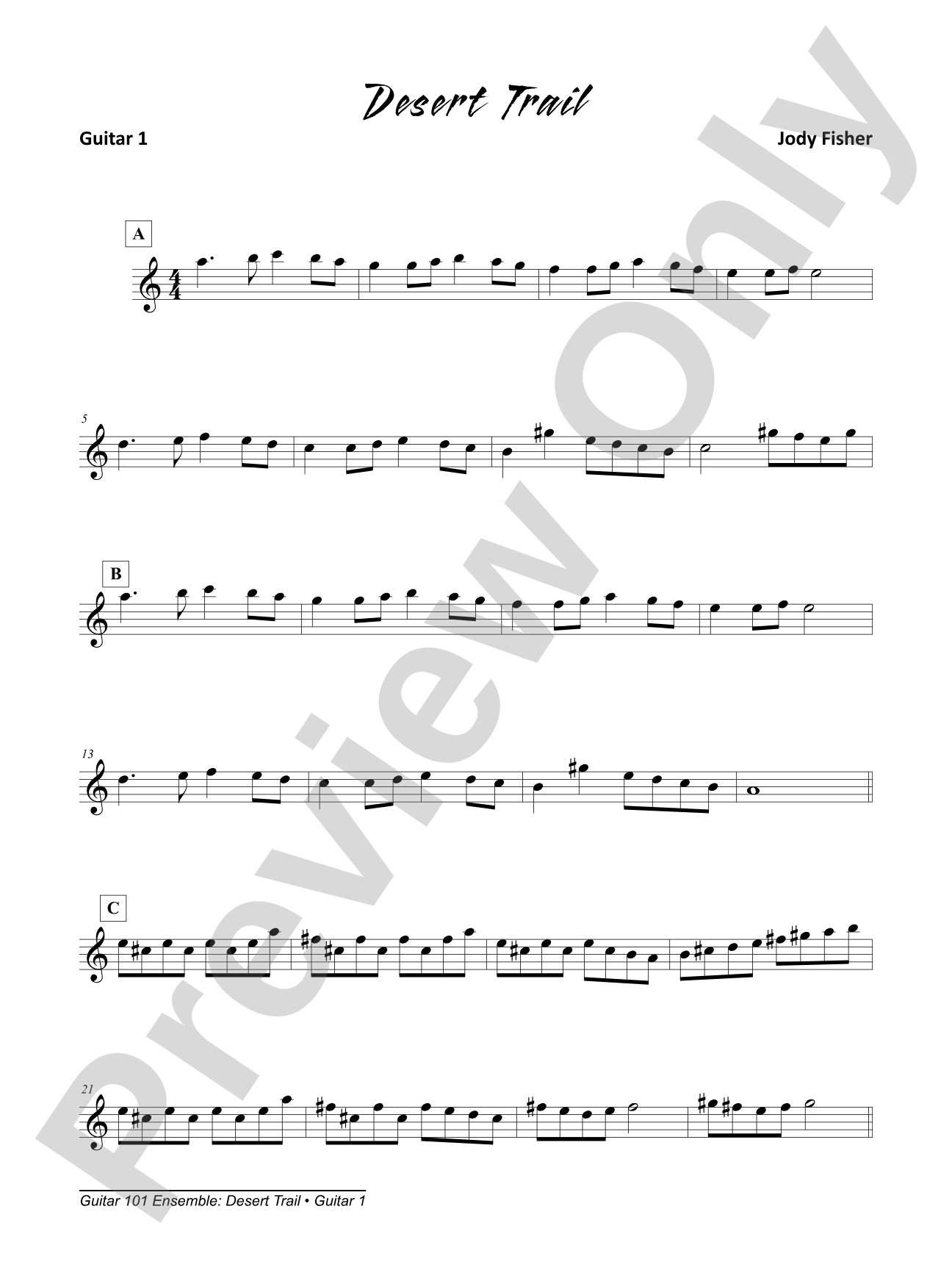

Alfred's Guitar 101, Ensemble: Desert Trail: Guitar 1
By Jody Fisher
Item: 00-PC-0016718_G1
$3.00
Pickup currently not available
Description
Alfred's Guitar 101, Ensemble makes a great supplement to any class guitar program. Your students will enjoy rehearsing and performing great-sounding pieces using the skills and concepts they have learned in Alfred's Guitar 101. This flexible guitar ensemble is written for five guitars, but it can easily be adapted for as few as two or as many as eight guitars. A creative teacher can find many ways to use Alfred's Guitar 101, Ensemble: add a bass player, percussion, or other melodic or harmonic instruments---whatever fills the needs of your students and program.
Desert Trail is a guitar ensemble piece in 4/4 time that switches alternately back and forth from a minor tonality to a major tonality. Since Guitar parts 1-4 all contain eighth notes, students will have a chance to develop their picking and fingerstyle. The Guitar 5 part will help students learn to change chords in a variety of rhythmic situations.


Desert Trail is a guitar ensemble piece in 4/4 time that switches alternately back and forth from a minor tonality to a major tonality. Since Guitar parts 1-4 all contain eighth notes, students will have a chance to develop their picking and fingerstyle. The Guitar 5 part will help students learn to change chords in a variety of rhythmic situations.
Don't just read it, hear it, play along with it, and watch your students grow with it. In MakeMusic Cloud, Alfred's Guitar 101, Ensemble: Desert Trail: Guitar 1 comes alive with professional accompaniment, adjustable tempo, and built-in practice tools that turn solo practice into real progress.
Open in the Player
Jump straight in and assign it today.
Start Your Free Trial
Open this title and explore the full library in minutes.
Sample Audio
1
Desert_Trail
--:--
Desert_Trail
0:00
0:00
Sample Video
No sample videos found.
Additional Details
Series:
101 Series
Publisher:
Alfred Music
Page Count:
20
SKU:
00-PC-0016718_G1
More about this title
Why we love this
Desert Trail gives your ensemble students genuine performance material that rewards the picking and fingerstyle work they've been developing in their method books. The alternating minor-to-major harmonic movement creates interest without overwhelming ensemble coordination, and the flexibility to perform with 2-8 guitars means you can use this piece across multiple skill levels in the same rehearsal.
What to expect
Desert Trail captures a sense of exploration, moving between the darker, introspective minor passages and brighter, open major sections. The steady 4/4 pulse and rhythmic motion create forward momentum, giving students the experience of playing a cohesive, listenable arrangement rather than just an exercise.
Who it's for
Class guitar students who have completed the foundational concepts and skills in Alfred's Guitar 101 and are ready to apply those techniques in an ensemble setting. This piece works well for teachers balancing individual progress with group performance goals.
How to get the most out of it
- Have Guitar 5 players practice their chord changes separately before full ensemble rehearsals; the varied rhythmic contexts demand solid left-hand transitions.
- Balance the eighth-note lines in parts 1-4 by asking players to match tone quality and attack, not just rhythm. Record a run-through and listen for consistency across the ensemble.
- Emphasize the harmonic shift from minor to major by adjusting overall dynamic shaping at each transition; let students hear how timbre and articulation can reinforce the tonal change.
How to use it
Use this as a concert piece during a spring or end-of-year performance, or as a mid-year group project that keeps students engaged while they continue individual method book study. The flexible instrumentation also makes it useful for combining advanced and intermediate guitarists into a single performing ensemble.
Skills your students will build
- Picking and fingerstyle technique on eighth-note passages
- Chord changes across multiple rhythmic patterns
- Ensemble balance and rhythmic precision
- Tonal awareness and harmonic contrast between minor and major tonalities
- Part independence within a five-part texture