Air & Rigaudon: Piccolo Sheet Music Preview

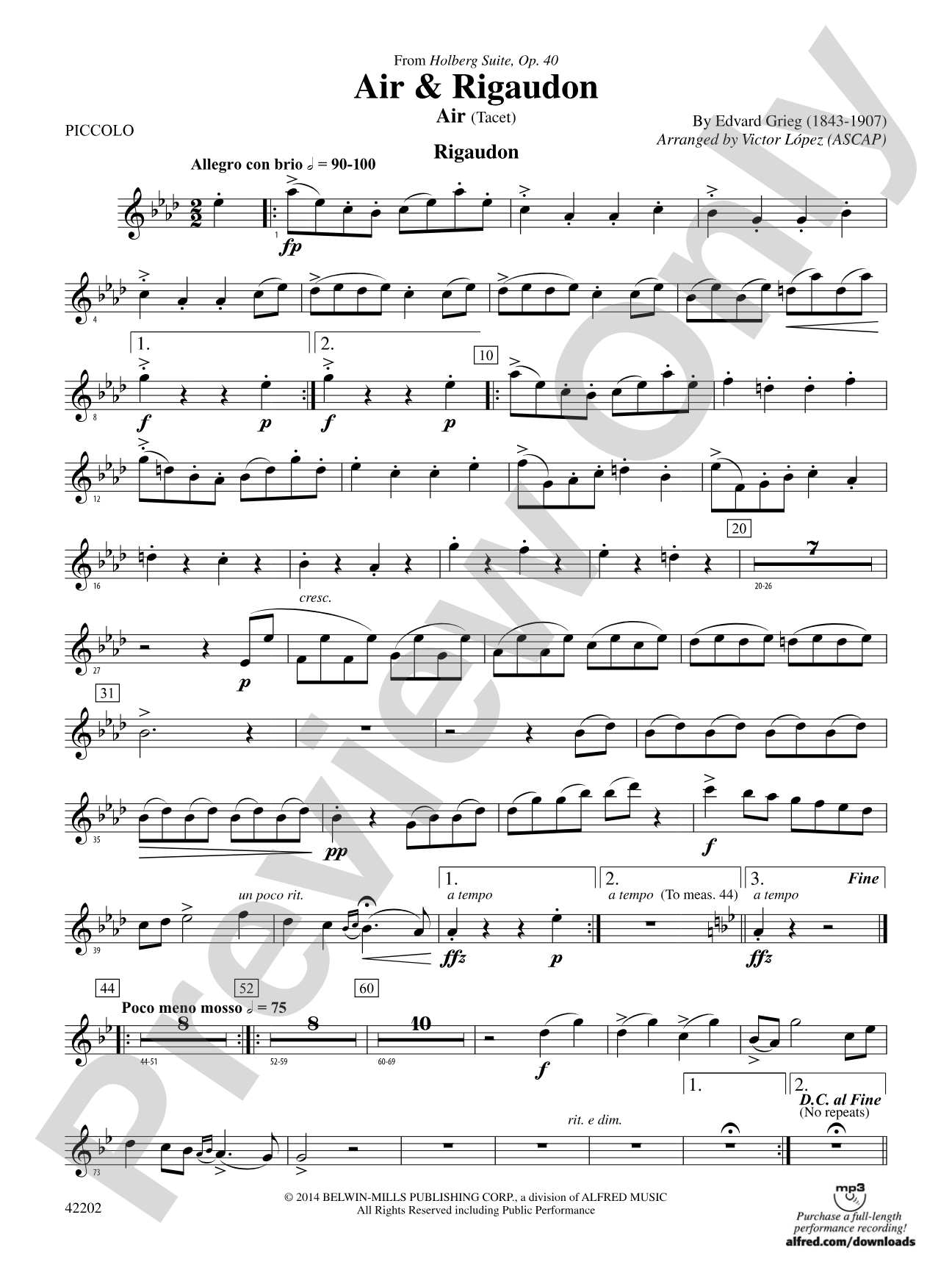
Air & Rigaudon: Piccolo

By Edvard Grieg / arr. Victor López

Grade: 3 (Medium Easy)

Item: 00-PC-0016563_P1

Digital Download
$3.00
Description
Edvard Greig's "Air," in ABA form, is one of his most beautiful and tender works while the "Rigaudon" is a characteristically playful French baroque-style dance. (9:00)

This installment concludes the complete Holberg Suite, Op. 40 including: Praeludium (00-38363) * Sarabande (00-39537) * Gavotte (00-39537) * Air (00-42202) * and Rigaudon (00-42202). All five movements may be performed in order as originally intended or independently.

Don't just read it, hear it, play along with it, and watch your students grow with it. In MakeMusic Cloud, Air & Rigaudon: Piccolo comes alive with professional accompaniment, adjustable tempo, and built-in practice tools that turn solo practice into real progress.

Sample Audio
0:00
0:00
Sample Video
Additional Details
Series: Belwin Concert Band
Publisher: Alfred Music
Page Count: 258
SKU: 00-PC-0016563_P1

More about this title

About the Composer: Edvard Grieg

Edvard Grieg (1843-1907) was a Norwegian composer whose music drew deeply from Scandinavian folk traditions and the dramatic landscapes of his homeland. Though best known for his piano concerto and incidental music for Peer Gynt, Grieg excelled at the miniature form, crafting intimate works that reveal remarkable harmonic sophistication and melodic grace within economical structures.

The Holberg Suite, Op. 40, stands as his homage to Danish Baroque composer Ludvig Holberg. Written originally for solo piano in 1884 and later orchestrated by the composer himself, the suite demonstrates Grieg's ability to honor historical forms while infusing them with his own lyrical voice. His arrangements of these movements for band have become cornerstone repertoire in concert band literature.

Why we love this

Victor López's arrangement captures the essential character of Grieg's original while crafting an accessible entry point to the complete Holberg Suite. The "Air" offers your band a chance to nurture legato phrasing and lyrical intensity, while the "Rigaudon" provides textural clarity and rhythmic precision without sacrificing the music's inherent charm. At Grade 3, this pairing delivers genuine artistic substance alongside technical accessibility.

What to expect

The Air unfolds with tender intimacy, its ABA form allowing for contrasting textures and emotional nuance that feels both ancient and deeply personal. The Rigaudon sparkles with elegant wit, its rhythmic playfulness and lighter orchestration creating a sense of courtly refinement without pretension.

Who it's for

Band directors seeking Grade 3 concert repertoire that introduces students to both refined lyrical writing and baroque-influenced formal structures. Students gain exposure to Romantic-era artistry and orchestration principles through music that sits comfortably within their technical range.

How to get the most out of it

  • Shape the Air's melodic line with a singing tone across the ensemble; this isn't merely sustained harmony but a vehicle for ensemble cohesion and dynamic architecture.
  • Articulate the Rigaudon's rhythmic motor clearly without sacrificing the baroque dance character—aim for clarity rather than heaviness in the rhythmic passages.
  • Balance the interplay between melody and accompaniment in the Air by rotating which sections carry the principal theme, ensuring transparency without losing harmonic warmth.
  • Let the Rigaudon's playfulness emerge through rhythmic precision; overly legato playing flattens the baroque character and dulls the piece's character.

How to use it

Program these two movements as a self-contained concert pairing, or continue the Holberg Suite narrative by performing all five movements across a season or single concert. The nine-minute duration and contrasting characters make this installment ideal for a mid-concert transition or as a bridge between heavier works.

Skills your students will build

  • Sustained legato phrasing and phrase breathing in the Air
  • Balance between melody and harmonic accompaniment
  • Clarity and articulation in baroque-influenced rhythmic figures
  • Understanding ABA form and thematic development
  • Ensemble blend and dynamic control across contrasting textures

You May Also Like