Air On The G String Sheet Music Preview

Air On The G String: Really Easy Piano

As performed by Johann Sebastian Bach

Item: 35-DS01587918

Digital Download
$4.99
Description

Discover MakeMusic Cloud: thousands of interactive titles your students can play along with today.

Sample Audio
No sample audio found.
Sample Video
Additional Details
Publisher: Hal Leonard
Page Count: 2
SKU: 35-DS01587918

More about this title

About the Artist: Johann Sebastian Bach

Johann Sebastian Bach (1685-1750) was a German composer whose mastery of counterpoint, harmony, and form established foundations that shaped Western music for centuries. His output spanned sacred cantatas, keyboard works, orchestral suites, and chamber music, each demonstrating technical brilliance married to profound musical expression. For music educators, Bach remains essential: his works teach voice leading, motivic development, and structural clarity while offering endless interpretive possibilities across skill levels.

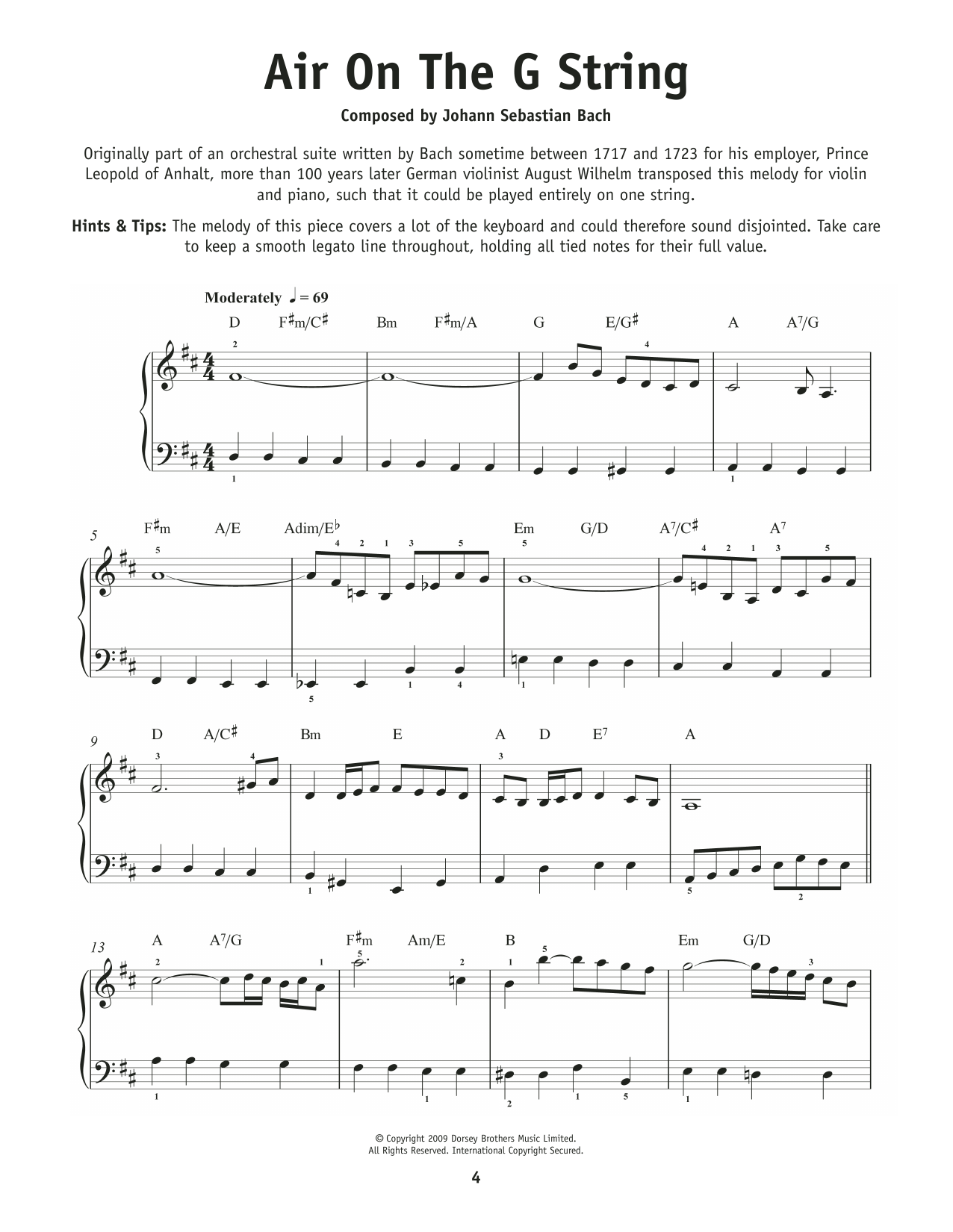
Why we love this

This arrangement strips Bach's beloved melody to its essence, making it accessible for students and audiences alike without sacrificing the harmonic sophistication that gives the original its emotional weight. The two-page format respects the piece's intimate character while remaining practical for weddings, recitals, and classroom performance. Few baroque works carry such immediate recognition and emotional resonance across contexts.

What to expect

Serene and introspective, this piece unfolds like a quiet conversation. The melody floats over gentle harmonic support, creating an atmosphere of elegance and restraint that Bach achieves through simplicity rather than ornamentation.

Who it's for

This edition serves vocalists, string players, and wind instrumentalists preparing solo repertoire or collaborative chamber work. Wedding musicians, recital performers, and music students looking for manageable baroque material will find both the musical substance and approachability they need.

How to get the most out of it

  • Shape the opening phrase with gentle direction toward the second measure; avoid a static, mechanical delivery of the opening notes.
  • Balance the accompanying voices so they support rather than compete with the primary melodic line.
  • Observe fermatas as expressive moments for breath or reflection rather than arbitrary stopping points.
  • Lean slightly into strategic cadences to give the piece architectural clarity without losing its singing quality.

How to use it

Position this as a bridge between opening remarks and more energetic repertoire, or use it to frame a recital's emotional arc. It works equally well as a solo vehicle in mixed recitals, a featured moment in collaborative concerts, or a teaching tool for studying baroque melody and phrasing.

Skills your students will build

  • Singing or playing long, sustained melodic lines with consistent tone quality
  • Understanding baroque phrase structure and harmonic progression
  • Interpreting baroque ornamentation and articulation conventions
  • Balancing solo melody with accompanying voices in ensemble settings

You May Also Like