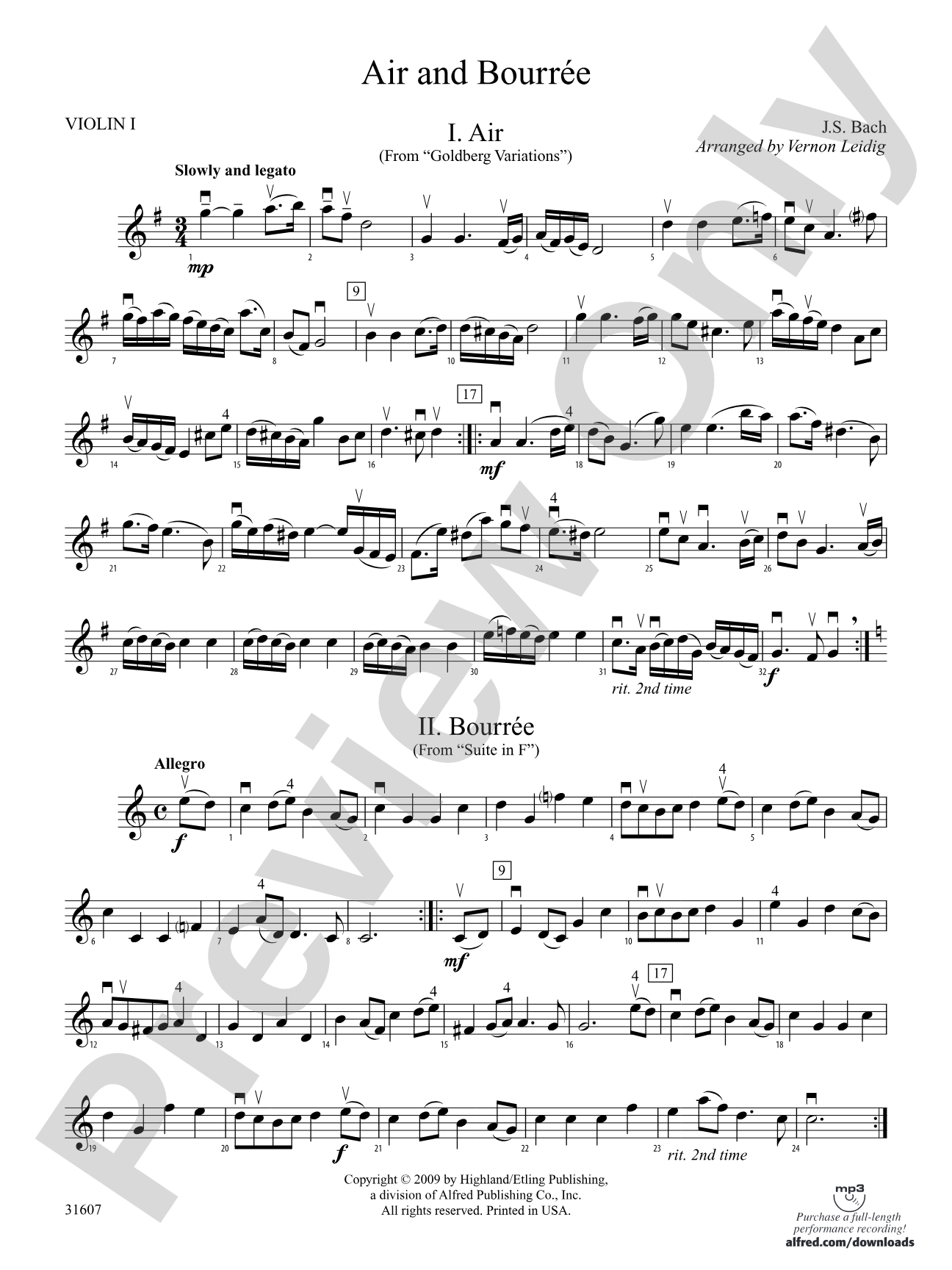
Air and Bourreé: 1st Violin Sheet Music Preview

Air and Bourreé: 1st Violin

By Johann Sebastian Bach / arr. Vernon Leidig

Grade: 2.5

Item: 00-PC-0001772_VN1

Digital Download
$5.99
Description
Beautiful Bach! A lovely transcription of the Air from the Goldberg Variations and the Bourreé from the Suite in F set in two movements. Perfectly scored for young orchestra!

Don't just read it, hear it, play along with it, and watch your students grow with it. In MakeMusic Cloud, Air and Bourreé: 1st Violin comes alive with professional accompaniment, adjustable tempo, and built-in practice tools that turn solo practice into real progress.

Sample Audio
0:00
0:00
Sample Video
Additional Details
Series: Highland/Etling String Orchestra
Publisher: Alfred Music
Page Count: 62
SKU: 00-PC-0001772_VN1

More about this title

About the Composer: Johann Sebastian Bach

Johann Sebastian Bach (1685-1750) stands at the center of Western music history, synthesizing German, Italian, and French musical traditions into a body of work that defined polyphonic composition. His mastery of counterpoint, harmonic architecture, and instrumental writing established principles that musicians still study and perform today. For student orchestras, Bach's music offers an unmatched foundation in melodic clarity, balanced texture, and the relationship between individual voices and the whole.

Why we love this

Vernon Leidig's arrangement presents two of Bach's most recognizable keyboard works in a setting that young orchestras can handle without sacrificing the elegance of the originals. The Grade 2.5 scoring distributes the voices logically across strings while maintaining the compositional integrity your students need to understand what they're playing. This pairing works beautifully in a single concert slot and gives developing musicians direct access to genuine masterworks rather than simplified substitutes.

What to expect

The Air flows with unhurried dignity, each phrase singing naturally through the string texture in a way that rewards careful listening. The Bourreé dances with articulate precision, its lighter energy and rhythmic bounce offering a refreshing contrast that leaves the audience with a sense of joy rather than strain.

Who it's for

Young string orchestras at the intermediate level who are ready to engage with genuine baroque composition. Both players and audiences benefit from the clear melodic writing and the satisfaction of performing recognizable, beautiful music that respects their developing abilities.

How to get the most out of it

  • Balance the inner voices carefully during the Air's opening statements; the viola and second violin parts carry harmonic material that shouldn't disappear under the first violins.
  • Bring out the rhythmic character of the Bourreé without rushing; the French style calls for clarity and articulation, not speed.
  • Use the conductor parts to shape the longer lines of the Air with subtle dynamic waves rather than terraced terraces, allowing the baroque phrasing to breathe naturally.
  • Lock in rhythmic precision during the Bourreé's dotted figures; inconsistency here disrupts the dance-like character Leidig's arrangement preserves.

How to use it

Program these movements as a complementary pair within a baroque-themed concert, or use the Air as an intermission piece and the Bourreé as part of a lighter closing group. The work also suits festival competition formats well, giving judges immediate insight into your orchestra's tone production and phrase control across two distinct moods.

Skills your students will build

  • Baroque phrasing and articulation in string writing
  • Balancing inner voices in four-part texture
  • Reading conductor parts and responding to interpretive shaping
  • Maintaining rhythmic precision in dotted figures and dance rhythms
  • Understanding the harmonic function of supporting voices

You May Also Like