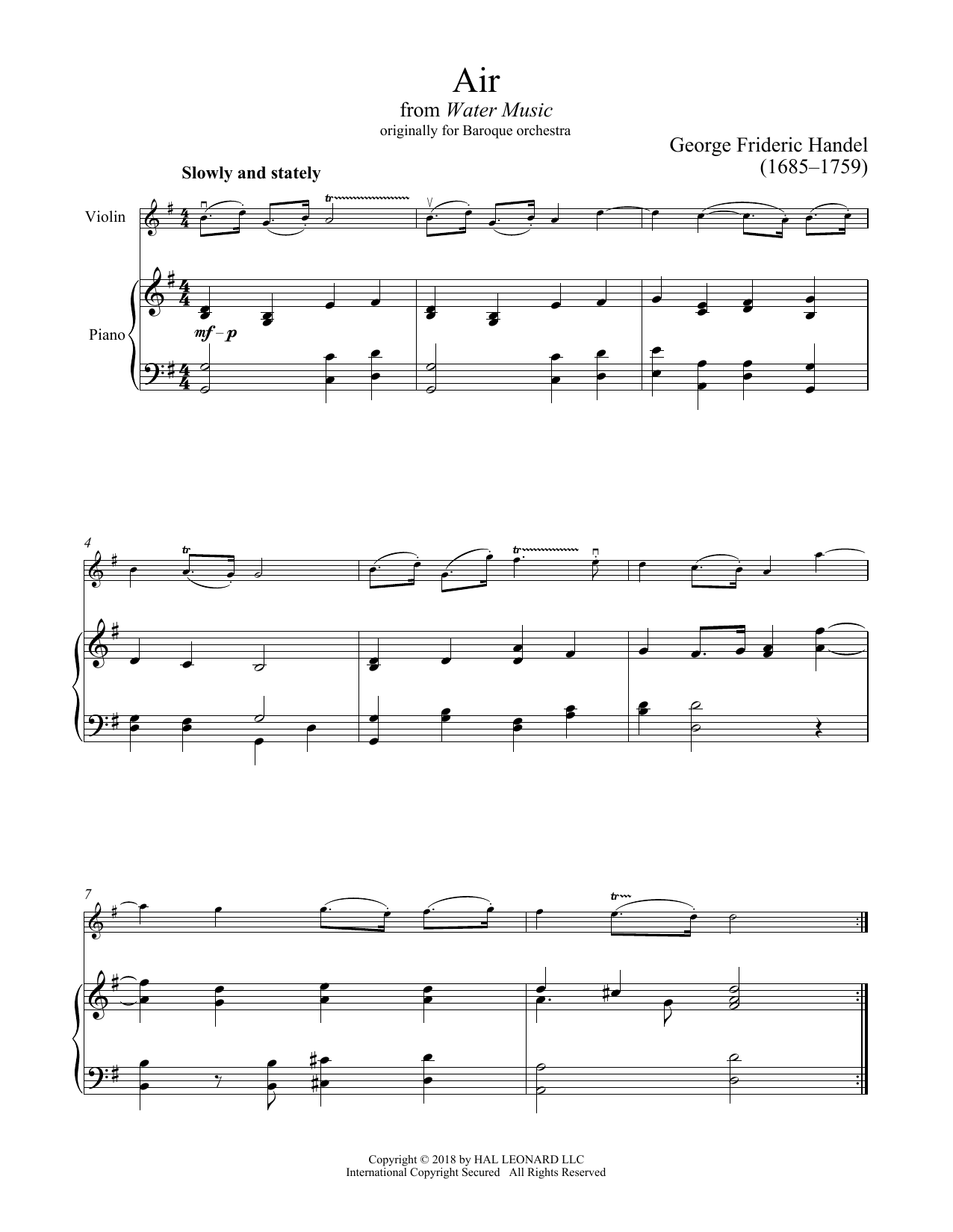
Air Sheet Music Preview

Air: Violin and Piano

By George Frideric Handel

Item: 35-DS00428020

Digital Download
$5.99
Description

Discover MakeMusic Cloud: thousands of interactive titles your students can play along with today.

Sample Audio
No sample audio found.
Sample Video
Additional Details
Publisher: Hal Leonard
Page Count: 3
SKU: 35-DS00428020

More about this title

About the Composer: George Frideric Handel

George Frideric Handel (1685-1759) dominated the musical life of London for nearly fifty years, composing operas, oratorios, and instrumental works that defined the Baroque era. His gift for melody was unmatched; he could write a tune that lodged itself in memory after a single hearing, which explains why his music remains essential repertoire across all genres and levels. As a teacher, you'll find his instrumental works invaluable for their perfect balance of musical substance and accessibility.

Why we love this

Handel's Air works beautifully for violin and piano pairings at all levels because it asks musicians to find elegance rather than pyrotechnics. The piece has that rare quality of sounding effortlessly sophisticated while remaining genuinely singable, making it a joy to prepare and a pleasure to perform. It's exactly what you need when you want something polished and genuine for a chamber concert or ceremony.

What to expect

Handel's Air breathes with the unhurried grace of 18th-century courtly elegance. The melody unfolds like a quietly spoken confidence, supported by harmonies that are warm without becoming sentimental. You'll find yourself drawn into a world of natural phrasing and genuine expression, where every note serves the whole.

Who it's for

This Air suits violinists preparing chamber repertoire for recitals, competitions, or graduation portfolios, as well as pianists looking for elegant accompaniment literature. Music educators often program this for wedding ceremonies, special events, or concert series when authenticity and refinement matter. It works equally well for serious students still building technique and accomplished players seeking repertoire that rewards thoughtful interpretation.

How to get the most out of it

  • Shape the opening phrase with a gentle arrival on the second measure rather than starting with equal weight on every note; this reveals Handel's melodic architecture.
  • Balance the violin line so it floats above the piano accompaniment without dominating it; think of the piano as providing a harmonic cushion rather than background filler.
  • Choose your tempo based on the venue acoustics. In a resonant space, a slightly broader pace prevents blurriness; in a dry room, you can move forward with confidence.
  • Attend to the bar line as a breathing point, not a hard stop. Baroque phrasing benefits from gentle momentum that carries across the measures.

How to use it

Position this as a transition piece in a mixed recital, perhaps between larger works that demand more dramatic energy. It pairs beautifully with other Baroque chamber repertoire or serves as the perfect opening number for a formal concert. Consider it an ideal choice for ceremonies, where its three-page scope fits neatly into a program flow and its musical character conveys respect and occasion.

Skills your students will build

  • Baroque phrasing and articulation
  • Maintaining lyrical line without sentimentality
  • Violin-piano balance and ensemble listening
  • Tempo stability in moderate tempos
  • Ornamentation interpretation (if present in the score)

You May Also Like