
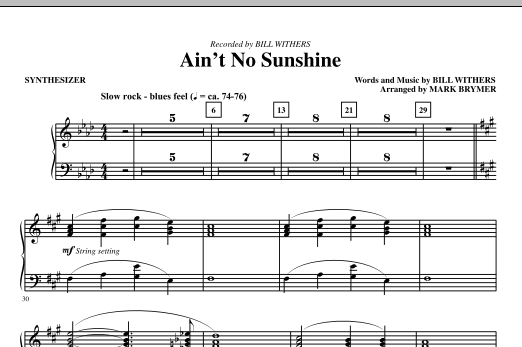

Ain't No Sunshine: Choral Instrumental Pak
By Bill Withers / Arranged by Mark Brymer
Item: 35-PK00153951
$28.00
Pickup currently not available
Buy Extra Parts (Digital PDF Download)
Parts Added to Cart!
Description
Bill Withers is one of America's premier singer/songwriters and his timeless music combines soulful warmth with a genuine honesty and sensitivity. This pop hit continues to connect with audiences today just as strongly as it did when it debuted in 1972. Duration: ca. 2:30.


Ain't No Sunshine: Choral Instrumental Pak isn't in MakeMusic Cloud just yet...but it could be. Let us know you'd like to see it, and you'll help shape what comes next. In the meantime, start a free trial and dive into thousands of interactive titles your students can play along with today.
Request This Title
Tell us you want it.
Start Your Free Trial
Explore everything that's ready to play right now.
Sample Audio
No sample audio found.
Sample Video
No sample videos found.
Additional Details
Publisher:
Hal Leonard
SKU:
35-PK00153951
More about this title
About the Composer: Bill Withers
Bill Withers emerged from the soul and R&B tradition to become one of the most influential American songwriters of the 1970s. His compositions, marked by conversational lyrics and deeply felt melodies, reflect his background in both gospel music and the working world, giving his work an authenticity that transcends genre boundaries. Withers' influence on choral arrangers and contemporary music educators stems from his ability to merge accessibility with emotional depth, making his songs natural vehicles for vocal instruction and ensemble performance.
His catalog includes some of the most enduring songs in American popular music, songs that reward both careful listening and vocal exploration. For music teachers and directors, Withers' output offers richly expressive material that connects students to contemporary songwriting craftsmanship while maintaining genuine artistic substance.
Why we love this
Mark Brymer's arrangement captures the song's essential character while giving your ensemble something genuine to sing. The rhythm voicing sits naturally for mixed groups and accommodates various rehearsal scenarios, whether you're working with a full choir or a smaller ensemble. This is the kind of arrangement that satisfies both performer and audience because it honors what made the original compelling in the first place.
What to expect
There's a quiet power in this song that comes from emotional honesty rather than technical display. The arrangement preserves that intimacy even as it scales to ensemble size, creating moments where the whole group feels like a single voice expressing something deeply human. The approximately two and a half minute duration keeps the emotional arc tight and focused.
Who it's for
Directors programming pop and contemporary music in concert settings will find this arrangement accessible for developing ensembles while still offering enough substance for more experienced groups. It works equally well in secular concerts, school assemblies, and community performances where authenticity and audience connection matter. Students benefit from singing material that already lives in their cultural memory, which accelerates engagement and deepens investment in the performance.
How to get the most out of it
- Spend rehearsal time on the lyrical phrasing rather than rushing the tempo; Withers' songwriting depends on conversational, unhurried delivery that lets the words breathe.
- Balance the rhythm section carefully so it supports rather than overshadows the vocal line; the accompaniment should feel like a conversation, not a wall of sound.
- Pay particular attention to vowel consistency within chords, especially on sustained moments where the harmonic color becomes the focal point of the phrase.
How to use it
Pair this with other contemporary pop or soul standards to create a thematic concert section that explores the American songwriting tradition. It also serves as an excellent opener or closer because audiences connect immediately with the melody and message, setting an authentic tone for the rest of your program. Consider programming it in the second half of a concert after more formal repertoire to shift energy and remind the audience that great musicianship includes engagement with modern material.
Skills your students will build
- Authentic phrasing and storytelling in popular music idiom
- Ensemble balance and blend within contemporary harmonic language
- Sustained singing and breath management through longer melodic phrases
- Connecting emotional expression to technical execution