Ain't No Sunshine Sheet Music Preview

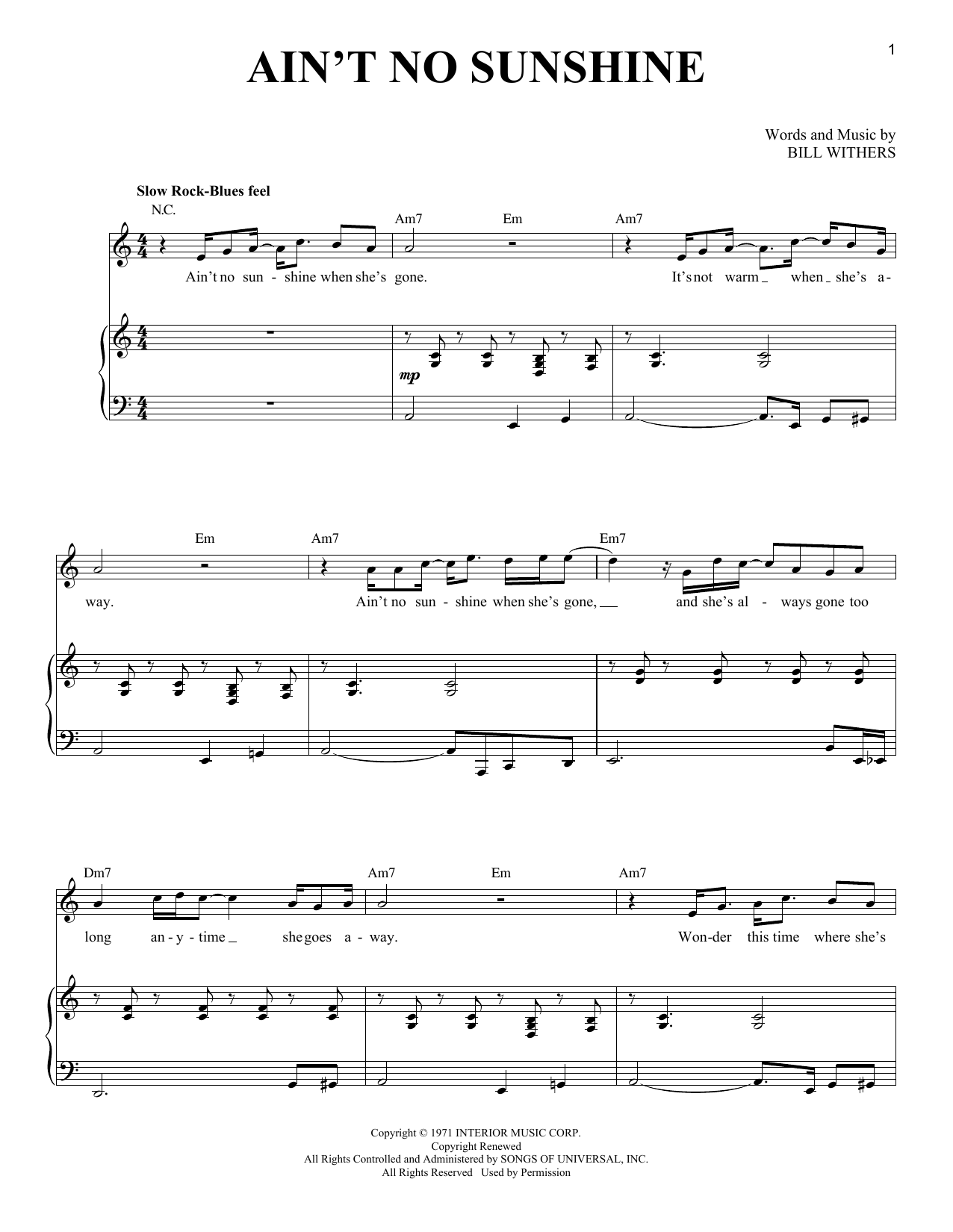
Ain't No Sunshine: Piano Vocal

As performed by Bill Withers

Item: 35-DS01444721

Digital Download
$5.99
Description

Ain't No Sunshine: Piano Vocal isn't in MakeMusic Cloud just yet...but it could be. Let us know you'd like to see it, and you'll help shape what comes next. In the meantime, start a free trial and dive into thousands of interactive titles your students can play along with today.

Sample Audio
No sample audio found.
Sample Video
Additional Details
Publisher: Hal Leonard
Page Count: 3
SKU: 35-DS01444721

More about this title

About the Artist: Bill Withers

Bill Withers emerged from the soul music landscape of the early 1970s with a distinctive blend of introspection and groove. His sparse, guitar-driven arrangements and conversational vocal delivery set him apart from the more orchestral soul productions of his era, influencing generations of singer-songwriters and producers who valued emotional authenticity over technical excess.

Withers' songwriting reveals a deep understanding of melody and restraint. "Ain't No Sunshine" exemplifies this philosophy: a deceptively simple composition built on hypnotic repetition and minor key melancholy that achieves its power through what is deliberately left out. For music educators, his work offers a masterclass in how limitation and focus can create impact.

Why we love this

This arrangement captures the song's essential architecture without losing the grooved, understated quality that made the original compelling. Students encounter a complete three-minute piece in just three pages, making it ideal for those learning to balance accompaniment patterns with vocal phrasing and interpretation.

What to expect

Sparse and melancholic, with an undercurrent of groove beneath the sadness. The minor key and repetitive structure create an almost meditative quality, drawing listeners into intimate emotional space through restraint rather than dramatic gesture.

Who it's for

Vocalists building a contemporary song repertoire will find this accessible yet musically substantial. Pianists working as accompanists can use this to develop skills in maintaining hypnotic ostinato patterns while responding to a singer's phrasing and emotional intent.

How to get the most out of it

  • Establish the repetitive piano figure as a locked groove from the opening; the hypnotic quality depends on rhythmic consistency rather than expressive rubato
  • Treat the vocal melody with restraint and simplicity. The power emerges from honest delivery, not embellishment
  • Pay attention to the lyrical rhythm, particularly the phrasing of "Ain't no sunshine when she's gone." Let the words breathe naturally rather than forcing them into rigid metric placement
  • Balance the vocal layer so the piano's rhythmic foundation remains audible throughout; this isn't a ballad where the accompaniment recedes

How to use it

Include this in a jazz ensemble or contemporary music concert to represent the soul and R&B influence on American popular songwriting. It pairs well with other introspective singer-songwriter material from the era and offers a stylistic shift when programmed alongside more classical vocal repertoire.

Skills your students will build

  • Maintaining consistent accompaniment patterns while responding to vocal phrasing
  • Navigating syncopated rhythms within a blues-influenced harmonic framework
  • Balancing ensemble awareness (keeping piano and voice in dialogue without one dominating)
  • Interpreting lyrical text through melodic line and tempo flexibility

You May Also Like