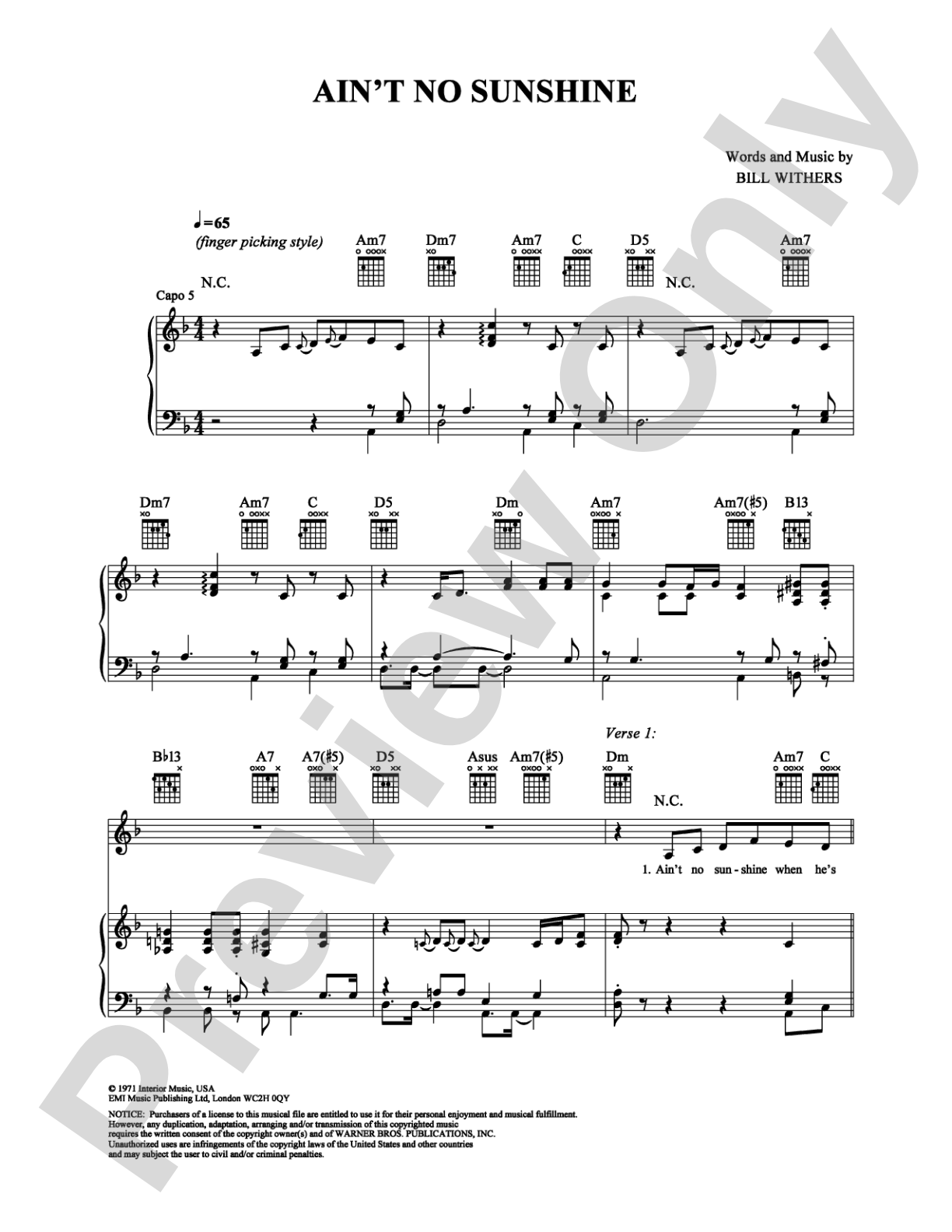
Ain't No Sunshine: Piano/Vocal/Chords Digital Sheet Music

Ain't No Sunshine: Piano/Vocal/Chords Digital Sheet Music

Eva Cassidy, Bill Withers

Item: 00-PS-0004383

Digital Download
$2.95
Description

Ain't No Sunshine: Piano/Vocal/Chords Digital Sheet Music isn't in MakeMusic Cloud just yet...but it could be. Let us know you'd like to see it, and you'll help shape what comes next. In the meantime, start a free trial and dive into thousands of interactive titles your students can play along with today.

Sample Audio
No sample audio found.
Sample Video
Additional Details
SKU: 00-PS-0004383

More about this title

About the Artist: Eva Cassidy

Eva Cassidy (1963, 1996) was a vocalist known for her stripped-down interpretations of jazz, blues, folk, and pop standards. Working primarily in Washington, D.C., she built a devoted local following before her early death from cancer. Her legacy rests on her ability to inhabit a song completely, finding emotional truth in material across genres without pretense or over-arrangement.

Cassidy's interpretive gifts have made her recordings valuable teaching tools. Her versions demonstrate how a singer can honor a composition's essence while making it entirely their own, a lesson that serves students across classical, jazz, and contemporary idioms.

Why we love this

Cassidy's rendition strips this Bill Withers classic to its emotional core, creating a intimate arrangement that works beautifully in jazz-inflected pop or adult contemporary settings. Her interpretation prioritizes vocal vulnerability over instrumental embellishment, making this a smartly programmed choice for recitals or concert sets exploring contemporary song interpretation. The piano/vocal format invites singers to focus on phrasing and interpretive nuance rather than competing with dense instrumentation.

What to expect

Quiet and contemplative, with a minor-key melancholy that feels lived-in rather than theatrical. The stripped-down piano-and-voice format creates an almost confessional intimacy, inviting the listener into a moment of longing and reflection. Cassidy's interpretation finds beauty in simplicity and emotional honesty rather than technical display.

Who it's for

Singers who gravitate toward interpretive standards and want to explore how contemporary artists have reimagined classic soul and pop compositions. This arrangement suits developing vocalists in high school through adult levels who are building their repertoire in jazz, pop, or singer-songwriter contexts. It also works well for teachers seeking accessible yet emotionally sophisticated material for recitals or performance classes.

How to get the most out of it

  • Study the original Bill Withers recording alongside Cassidy's version to understand how she shapes phrasing and where she holds back versus where she leans into emotional intensity.
  • Pay attention to rubato and space in the vocal line; Cassidy's power comes from restraint and the breathing room she creates, not from pushing volume.
  • Work with your pianist on dynamic balance so the voice remains the clear focal point while the piano provides supportive harmonic and rhythmic structure.
  • Experiment with subtle vocal production choices (breath placement, vibrato control, consonant clarity) that serve the song's introspective mood rather than showcase technique.

How to use it

Program this as a solo in a recital exploring contemporary interpretations of standards, or pair it with other Cassidy arrangements to create a thematic set. It fits naturally in jazz or pop-influenced concert programs alongside original singer-songwriter material. The introspective quality makes it particularly effective as a set-closer or as a bridge between more uptempo numbers.

Skills your students will build

  • Dynamic control and vocal shaping in a minor key
  • Interpretive phrasing and rubato in a stripped-down arrangement
  • Lyrical storytelling and emotional connection without over-singing
  • Collaboration and balance between vocalist and pianist
  • Recognition of how existing songs can be reinterpreted through arrangement and vocal approach

You May Also Like