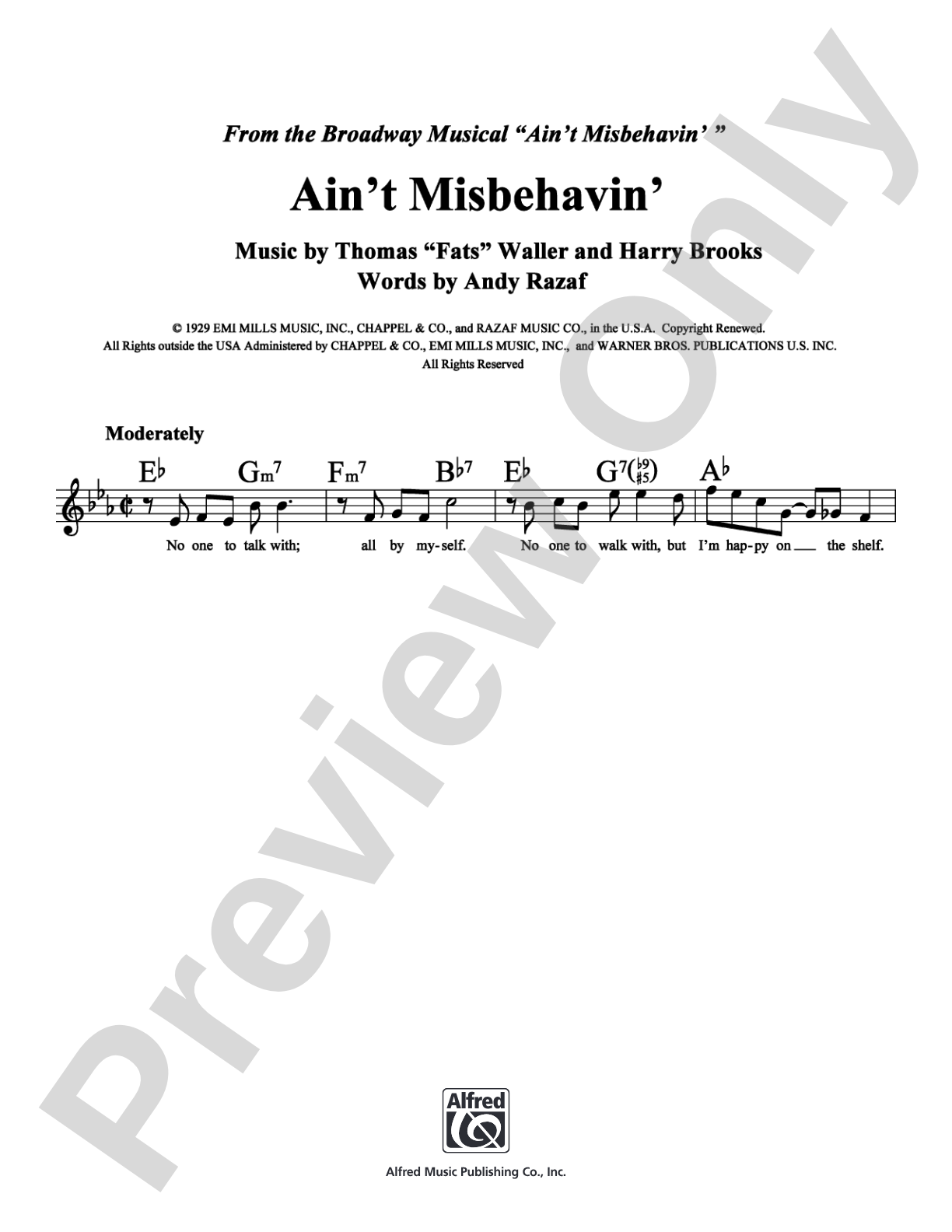
Ain't Misbehavin': Lead Sheet Digital Sheet Music

Ain't Misbehavin': Lead Sheet Digital Sheet Music

Harry Brooks, Louis Armstrong, Fats Waller

Item: 00-PS-0007502

Digital Download
$1.99
Description

Ain't Misbehavin': Lead Sheet Digital Sheet Music isn't in MakeMusic Cloud just yet...but it could be. Let us know you'd like to see it, and you'll help shape what comes next. In the meantime, start a free trial and dive into thousands of interactive titles your students can play along with today.

Sample Audio
No sample audio found.
Sample Video
Additional Details
SKU: 00-PS-0007502

More about this title

About the Artist: Louis Armstrong

Louis Armstrong (1901-1971) transformed jazz from a regional novelty into a global art form. His innovative approach to phrasing, his distinctive warm tone, and his gift for melodic interpretation set the standard for jazz vocalists and instrumentalists alike. Armstrong's influence extends far beyond jazz; his interpretations of American songbook standards helped establish the repertoire that defines jazz education today.

Fats Waller (1904-1943) was a pianist, organist, composer, and vocalist whose wit and musicality made him one of the most recorded artists of the 1920s and 1930s. "Ain't Misbehavin'" showcases Waller's gift for accessible melody and his ability to infuse popular song with genuine swing and harmonic sophistication. His prolific output remains central to the jazz standards curriculum.

Why we love this

This lead sheet captures one of the most recorded jazz standards, and its straightforward harmonic language makes it ideal for teaching jazz interpretation and improvisation. The melody sits naturally for singers and instrumentalists alike, giving students room to develop their own phrasing while maintaining the song's essential character. It's the kind of tune that rewards repeated study and never stops revealing new possibilities.

What to expect

Warm, good-natured, and unpretentious. The tune has a gentle swing and an almost conversational quality that invites relaxation rather than tension. There's humor and humanity in every phrase, a sense that the song is talking directly to the listener about everyday pleasures and small rebellions.

Who it's for

Jazz students learning to interpret standards, vocalists or instrumentalists preparing lead sheet-based arrangements, and ensemble directors looking for accessible material that demonstrates authentic jazz melody and harmony. This works equally well for a featured soloist, a small combo, or a big band.

How to get the most out of it

  • Sing or play the melody straight through first to internalize its conversational quality; Waller's composition breathes like speech, so resist the urge to over-phrase early on.
  • Use the chord changes as a launching point for improvisation, but remember the melody's gentleness; this is a song of restraint, not fireworks.
  • Pay attention to the rhythmic placement of notes relative to the beat; much of the tune's swing comes from subtle syncopation rather than aggressive phrasing.

How to use it

Program this alongside other jazz standards to build a cohesive set, or use it as a contrast to more complex contemporary jazz compositions. It works beautifully as an opening number or a lighter moment in a jazz concert, and it's substantial enough to anchor a small combo set while remaining approachable for student performers and audiences unfamiliar with jazz vocabulary.

Skills your students will build

  • Interpreting jazz melody from a lead sheet
  • Improvising over II-V-I progressions and other foundational jazz changes
  • Understanding swing articulation and rhythmic placement in jazz phrasing
  • Balancing lyrical singing or playing with rhythmic forward motion
  • Comping and accompaniment techniques from a lead sheet

You May Also Like