
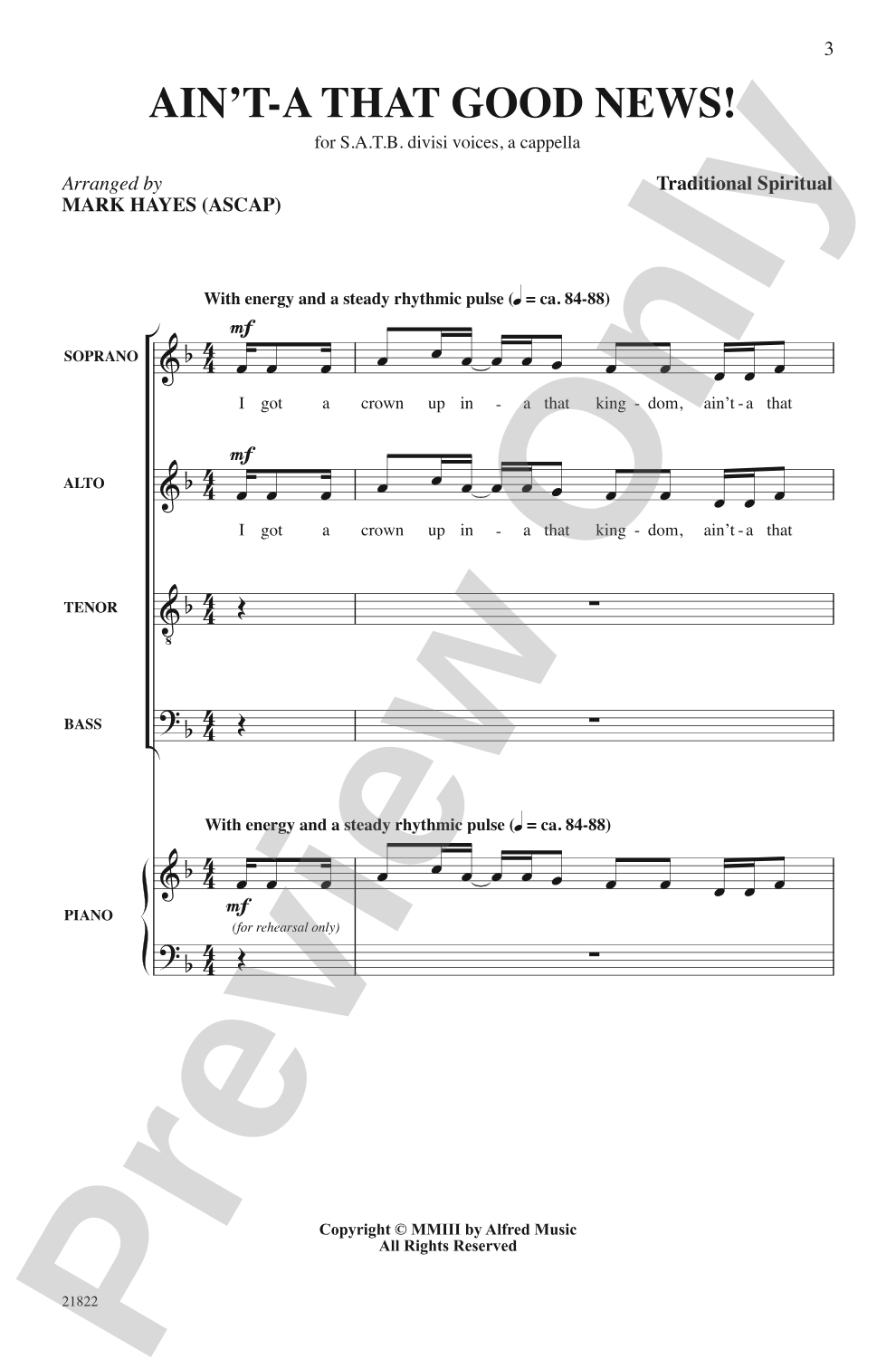

Ain't-a That Good News!: SATB divisi, a cappella Choral Octavo
Arr. Mark Hayes
Item: 00-PO-0002207
$2.95
Minimum order quantity: 20 copies
Pickup currently not available
Related Items
Ain't-a That Good News!: SATB divisi, a cappella Choral Octavo |
$2.95
|
View |
Description
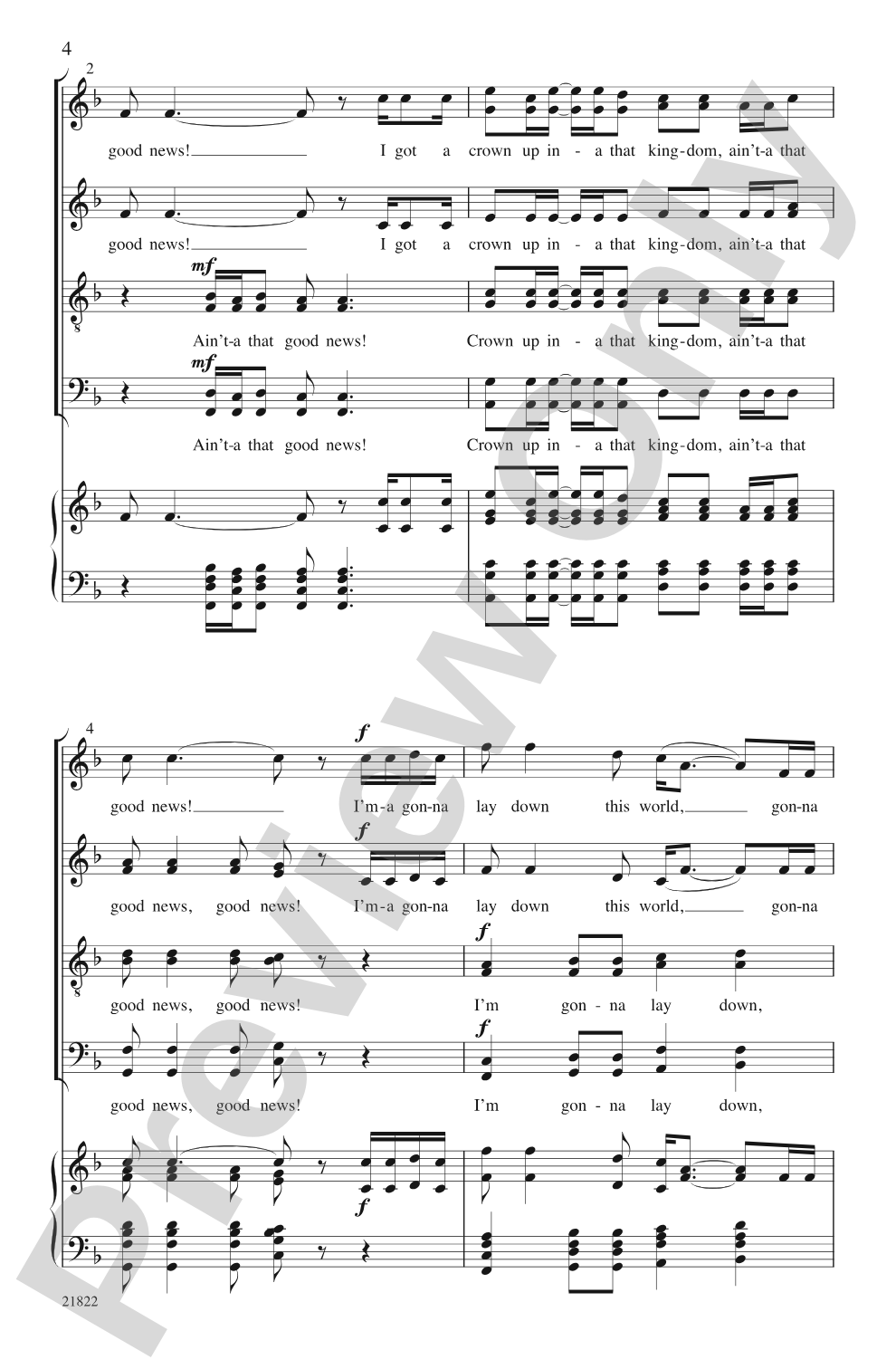
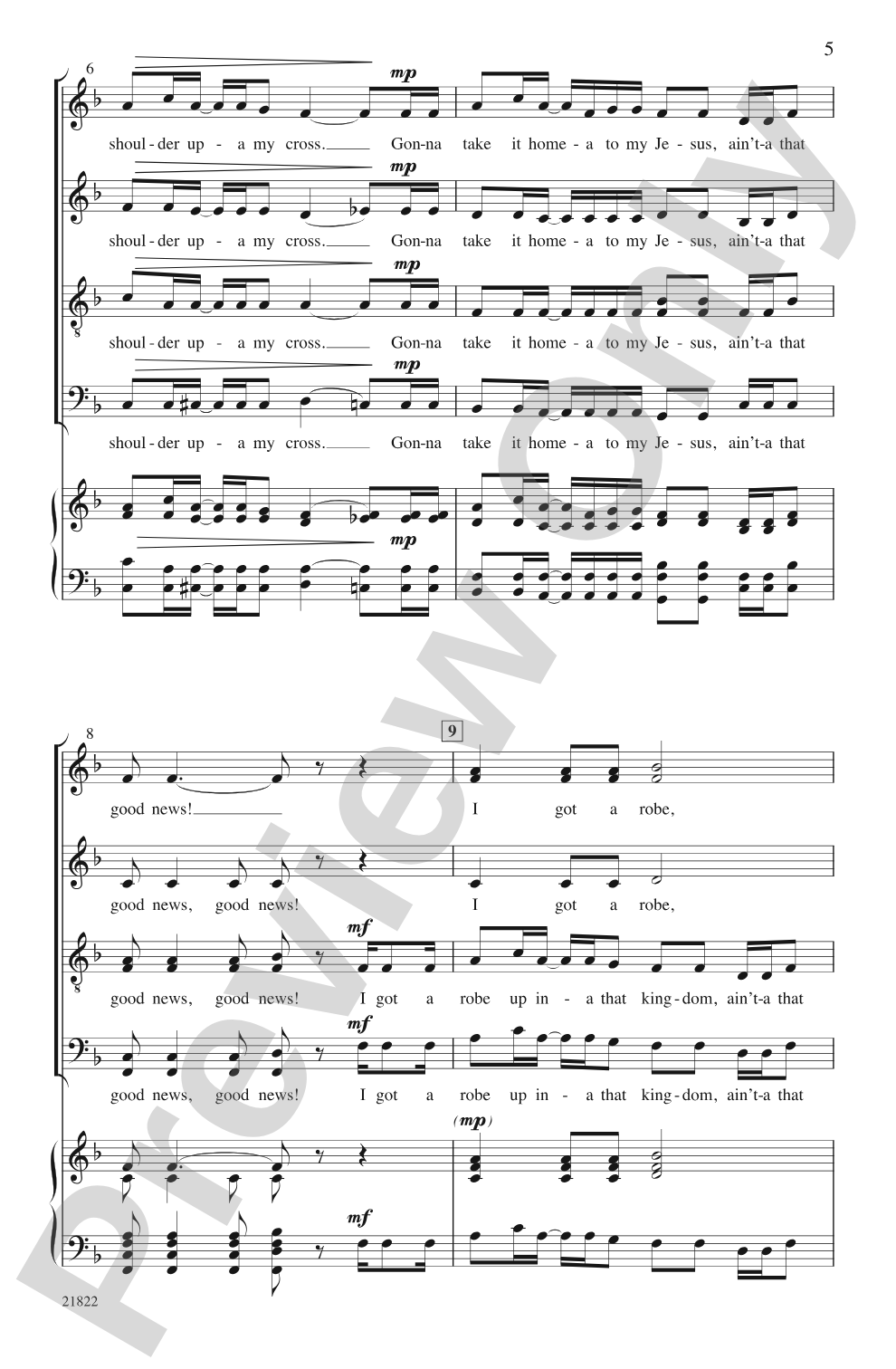
Only Mark Hayes could so brilliantly transform this favorite spiritual into an thrilling new arrangement for your advanced choir. Each section takes its turn singing the vibrant melodic theme while others add fresh harmonies, interesting counter melodies, a skillful modulation, and original spirited text. An exciting a cappella feature appropriate for concerts, festivals, contests, and adjudications.


Ain't-a That Good News!: SATB divisi, a cappella Choral Octavo isn't in MakeMusic Cloud just yet...but it could be. Let us know you'd like to see it, and you'll help shape what comes next. In the meantime, start a free trial and dive into thousands of interactive titles your students can play along with today.
Request This Title
Tell us you want it.
Start Your Free Trial
Explore everything that's ready to play right now.
Sample Audio
1
Audio File
--:--
0:00
0:00
Sample Video
No sample videos found.
Additional Details
Series:
Alfred Archive Edition: Alfred Choral Designs
Publisher:
Alfred Music
Page Count:
16
SKU:
00-PO-0002207
More about this title
About the Arranger: Mark Hayes
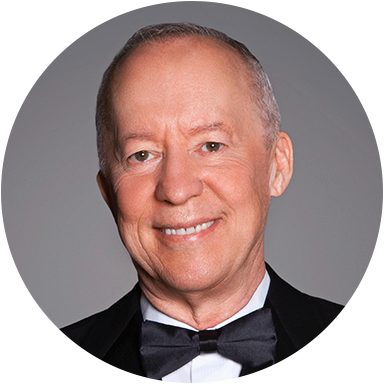
Mark Hayes has established himself as one of the most prolific voices in sacred choral music, with over 1,750 published works spanning concert music, choral literature, and piano compositions. A graduate of Baylor University with a degree in Piano Performance, Hayes has conducted at Lincoln Center, the National Cathedral, and Carnegie Hall, while his compositions (including his Te Deum, Magnificat, and Gloria) have been performed internationally. In 2010, Baylor University honored him with the Award for Exemplary Leadership in Christian Music, and he subsequently conducted the world premiere of his Requiem at Lincoln Center in 2013 and again at St. Ignatius Basilica in Rome as part of the Vatican-sponsored Festival Pro Musica E Arte Sacra.
Beyond sacred music, Hayes has composed for musical theater, orchestrated for Broadway productions, and maintained an active career as a concert pianist and record producer. His gift for making music accessible without sacrificing sophistication shows in every genre he touches, from gospel and jazz to classical and show tunes. Based in Kansas City, Missouri, Hayes continues to compose music designed to serve performers and audiences across the widest possible range of musical contexts.
Why we love this
Hayes captures the irresistible energy of this spiritual while creating genuine musical substance for an advanced choir. The writing showcases each section's voice through distinctive material and counter-melodies rather than asking singers to simply support a melody, which means your sopranos, altos, tenors, and basses all have moments to shine. This is the kind of a cappella arrangement that works equally well in a concert hall, festival, or adjudication because the craft is audible in every measure.
What to expect
Jubilant and purposeful, this arrangement moves with infectious momentum while honoring the spiritual's dignity. The interplay between sections creates constant forward motion, and Hayes's harmonies feel both fresh and rooted in the tradition. Your singers will feel the lift of the original melody meeting Hayes's sophisticated additions, resulting in an arrangement that energizes both performers and listeners.
Who it's for
This arrangement belongs in the hands of advanced high school and college choirs with the vocal maturity and blend to handle divisi writing and a cappella precision. Directors preparing singers for competitive festivals, adjudicated events, or concert programs will find this piece rewarding because it demands real musicianship while remaining highly satisfying to perform.
How to get the most out of it
- Establish the rhythmic pulse early in rehearsal through body percussion or conducting patterns; this arrangement's energy depends on precise ensemble alignment without instrumental support.
- Balance the divisi sections carefully by bringing out the counter-melodies just enough to be heard without obscuring the primary theme that's being sung by another voice part.
- Shape the modulation as a moment of fresh energy rather than a jarring shift; this transition should feel like the arrangement is discovering new ground, not simply jumping up.
- Work the original text alongside the familiar melody; Hayes's lyrical additions deserve clarity and intentional phrasing to register with your audience.
How to use it
Program this when you want a spiritual arrangement that stands alongside other advanced choral work without apology. It pairs naturally with other sacred a cappella selections in a concert devoted to choral artistry, or it can anchor a set of spirituals and folk arrangements. The piece also makes an excellent festival or contest selection because it showcases both ensemble discipline and expressive depth in a single performance.
Skills your students will build
- Sustaining blend and intonation in divisi SATB writing without instrumental reference
- Balancing multiple melodic lines simultaneously while maintaining harmonic clarity
- Navigating modulation by ear and maintaining pitch integrity during key changes
- Singing counter-melodies that complement rather than compete with the primary theme
- Interpreting rhythmic precision and stylistic phrasing in spiritual idiom with contemporary arranging techniques