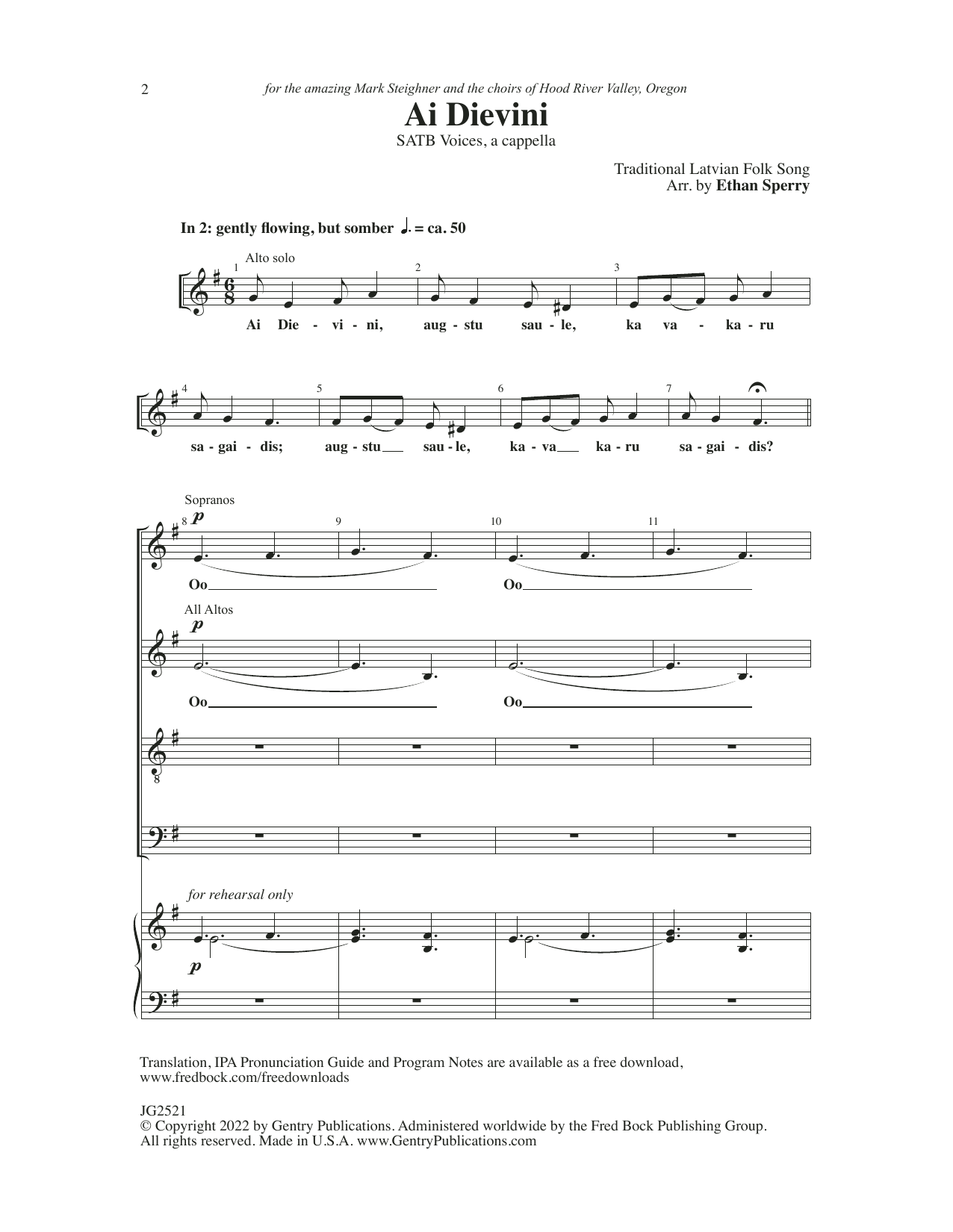
Ai Dievini: SATB Choral Octavo

By Traditional Latvian Folk Song / Arranged by Ethan Sperry

Item: 35-DS01120749

Digital Download
$2.99
Description

Ai Dievini: SATB Choral Octavo isn't in MakeMusic Cloud just yet...but it could be. Let us know you'd like to see it, and you'll help shape what comes next. In the meantime, start a free trial and dive into thousands of interactive titles your students can play along with today.

Sample Audio
No sample audio found.
Sample Video
Additional Details
Publisher: Hal Leonard
Page Count: 11
SKU: 35-DS01120749

More about this title

About the Composer: Traditional Latvian Folk Song

Latvian folk music emerges from one of Europe's oldest continuous musical traditions, where vocal lines interweave with the rhythms of seasonal celebrations, work songs, and ritual gatherings. These melodies carry the collective memory of the Baltic people, passed down through generations and shaped by the landscape, language, and cultural identity of Latvia.

Why we love this

Ethan Sperry's arrangement opens up this traditional melody to choirs seeking authentic repertoire that feels fresh and accessible without compromising cultural integrity. The piece sits comfortably for mixed voices while maintaining the modal character and emotional directness that make Latvian folk music so compelling in concert.

What to expect

The melody carries an understated gravity, moving with the deliberate beauty of something ancient and trusted. There is singing here rather than virtuosity, warmth rather than display, and the arrangement lets that character shine through without unnecessary embellishment.

Who it's for

SATB choirs building multicultural programming or exploring repertoire beyond the standard art song tradition. This works equally well for community choirs seeking accessible yet substantive material and for concert ensembles wanting a solid anchor piece for a thematic program.

How to get the most out of it

  • Attend to the vowel colors the language suggests; even singing in English, the melodic contours want a slightly rounder, more grounded tone than standard art song repertoire.
  • Balance the inner voices carefully so the harmony supports without obscuring the primary melodic line; folk arrangements often depend on subtle voice-leading rather than dramatic contrast.
  • Let the piece breathe at phrase endings rather than pushing through; the folk idiom values clarity of shape over legato sweep.

How to use it

Place this alongside other folk arrangements or world music selections to create a program section that celebrates vocal traditions beyond Western classical forms. It also serves as an excellent warm-up piece that grounds singers in foundational technique while building cultural awareness.

Skills your students will build

  • Singing with clear diction in a non-English text
  • Balancing harmonic blend across voice parts
  • Recognizing and performing modal melodic movement
  • Interpreting folk style with appropriate phrasing and tone
  • Maintaining tuning in open harmonies with minimal accompaniment

You May Also Like