
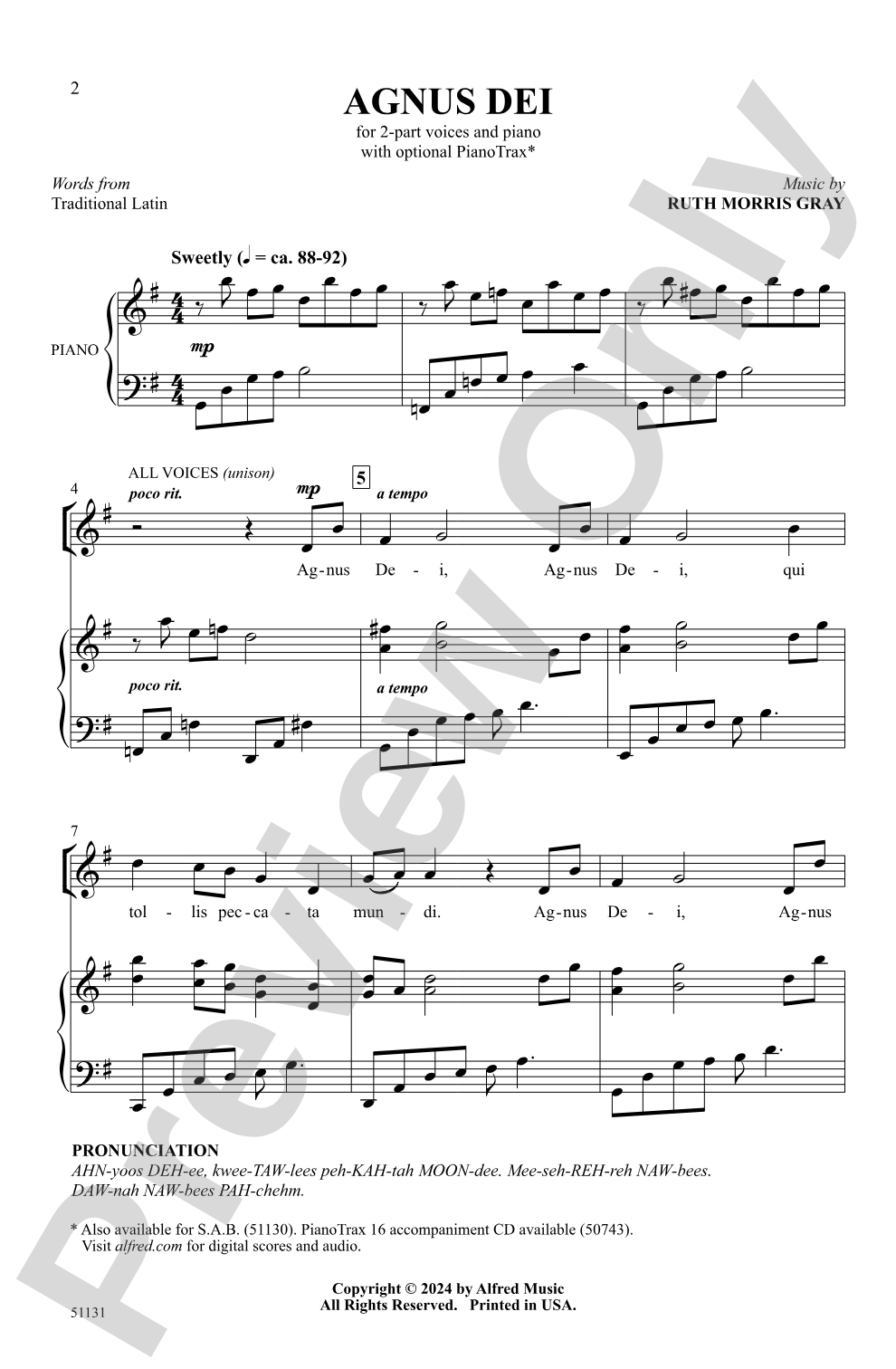
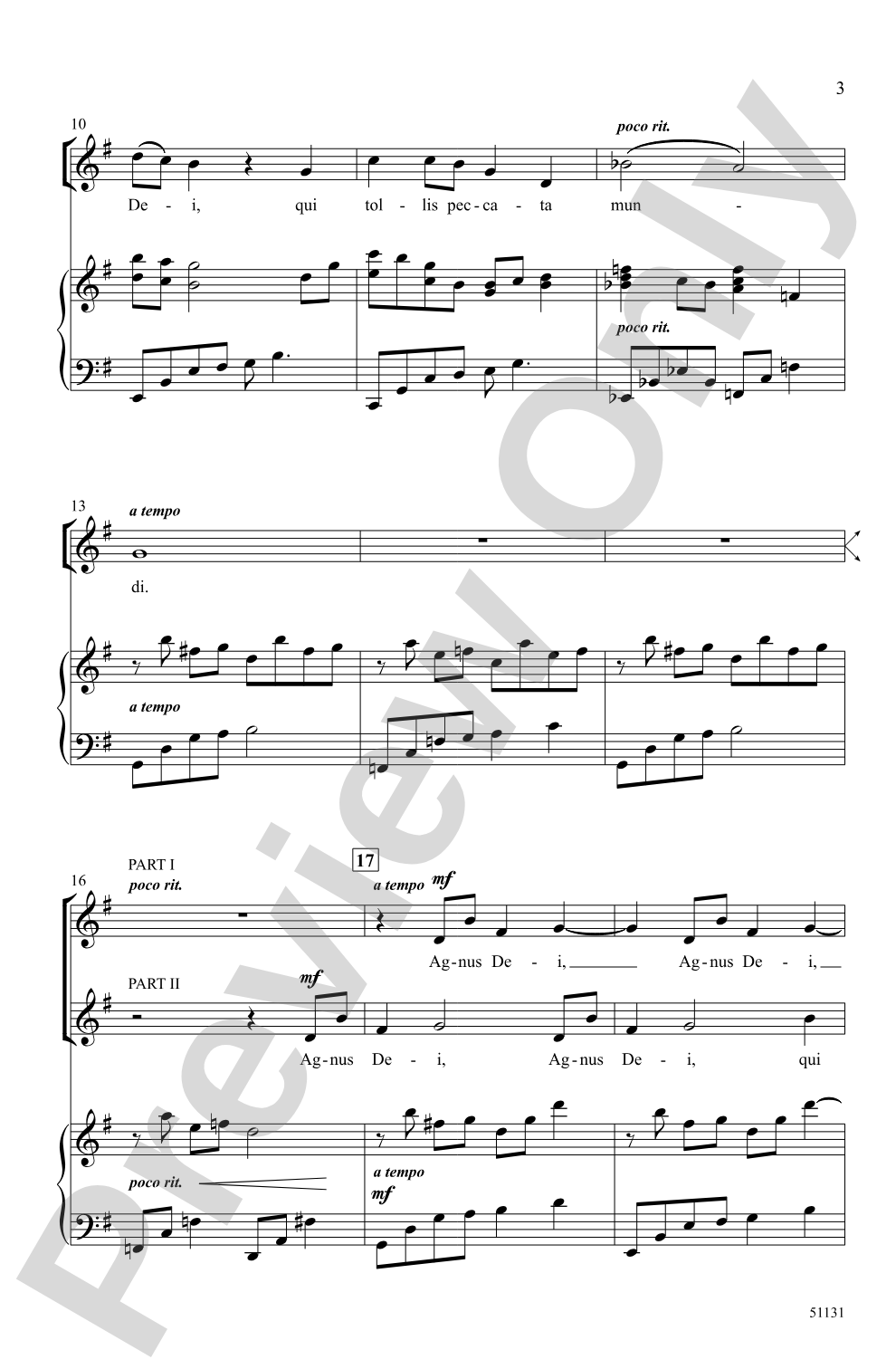

Agnus Dei: 2-Part Choral Octavo
Words from Traditional Latin, music by Ruth Morris Gray
Item: 00-PO-0007211
$2.20
Minimum order quantity: 20 copies
Pickup currently not available
Description
Ruth Morris Gray presents an exquisite minor-key setting that elevates choral musicianship. A rich melody ebbs and flows over the colorful harmonic palette, while a captivating piano theme winds its way throughout. Various textures, expressive dynamics, and rubato tempos encourage artistry. For added flexibility, a few optional notes in the 2-Part voicing offer moments of SSA harmony.


Discover MakeMusic Cloud: thousands of interactive titles your students can play along with today.
Sample Audio
1
Audio File
--:--
0:00
0:00
Sample Video
Additional Details
Series:
Alfred Choral Designs
Publisher:
Alfred Music
Page Count:
8
SKU:
00-PO-0007211
More about this title
About the Composer: Ruth Morris Gray

Ruth Morris Gray brings two decades of classroom experience to her compositions, having directed choirs at Rosemead High School since 2004 where she also teaches piano. Her catalog of over 100 published works reflects a composer deeply invested in creating repertoire that serves the needs of working choirs across diverse skill levels.
Gray holds a Bachelor of Music in Piano Performance and Composition from Biola University and earned her Master of Arts in Music Composition from UC Santa Barbara. She completed her California Single Subject Music Credential at California State University, Northridge, solidifying her foundation in both composition and music pedagogy.
Why we love this
Gray's setting proves that minor-key sacred music doesn't require a large ensemble to achieve sophistication. The interplay between vocal melody and piano accompaniment creates textural interest that rewards careful rehearsal, while the optional SSA moments give directors the flexibility to adjust voicing based on their singers' strengths. This is the kind of piece that sounds more ambitious than it reads.
What to expect
The piece unfolds with quiet dignity, its minor tonality and flowing melody creating an introspective quality. As the harmonic palette shifts beneath the surface, the sacred text gains emotional weight; the music never rushes, instead allowing space for both reflection and connection.
Who it's for
Directors of developing or intermediate choirs seeking a concert piece that sounds polished without requiring advanced vocal technique. This works equally well for singers building toward contest or festival appearances and for programs that simply need a sacred work with musical depth and artistic challenge.
How to get the most out of it
- Allow the piano theme to anchor interpretation. Once your singers understand how their melodic line relates to the accompaniment pattern, phrasing becomes more intuitive and ensemble cohesion strengthens.
- Approach the optional SSA harmony moments as deliberate color choices rather than technical add-ons. Decide in advance whether your singers have the blend and security to use them, then commit fully to that choice.
- Shape dynamics with the harmonic rhythm. Gray's colorful harmonies often shift underneath sustained notes; highlighting those changes prevents the piece from feeling static.
- Experiment with subtle rubato in the passages marked for expressive timing. Minor-key repertoire often benefits from flexible phrasing that honors the lyrical quality of the text and melody.
How to use it
This octavo fits naturally into mixed concert programs where a single sacred work provides contrast to secular selections. Its moderate length and expressive demands make it suitable for both honor choir festivals and regular concert programming, where it can anchor the second half of a concert or serve as a reflective transition between contrasting pieces.
Skills your students will build
- Balancing a sustained melodic line over moving harmonic accompaniment
- Reading optional harmony notes and making musical decisions about voicing placement
- Interpreting expressive dynamics and tempo flexibility in a minor-key context
- Blending with piano accompaniment while maintaining independent vocal line integrity