Agnus Dei Sheet Music Preview

Agnus Dei: 3-Part Choral Octavo

By Audrey Snyder

Item: 00-PO-0002728

Digital Download
$2.25

Minimum order quantity: 20 copies

Description

Agnus Dei: 3-Part Choral Octavo isn't in MakeMusic Cloud just yet...but it could be. Let us know you'd like to see it, and you'll help shape what comes next. In the meantime, start a free trial and dive into thousands of interactive titles your students can play along with today.

Sample Audio
No sample audio found.
Sample Video
Additional Details
Series: Alfred Archive Edition: Belwin Sacred Choral Series
Publisher: Alfred Music
Page Count: 8
SKU: 00-PO-0002728

More about this title

About the Composer: Audrey Snyder

Audrey Snyder is a prolific composer whose choral writing balances accessibility with artistic depth. Her works span sacred and secular genres, and her facility with text setting and ensemble sonority has made her a staple in educational and professional choral programs across North America.

Why we love this

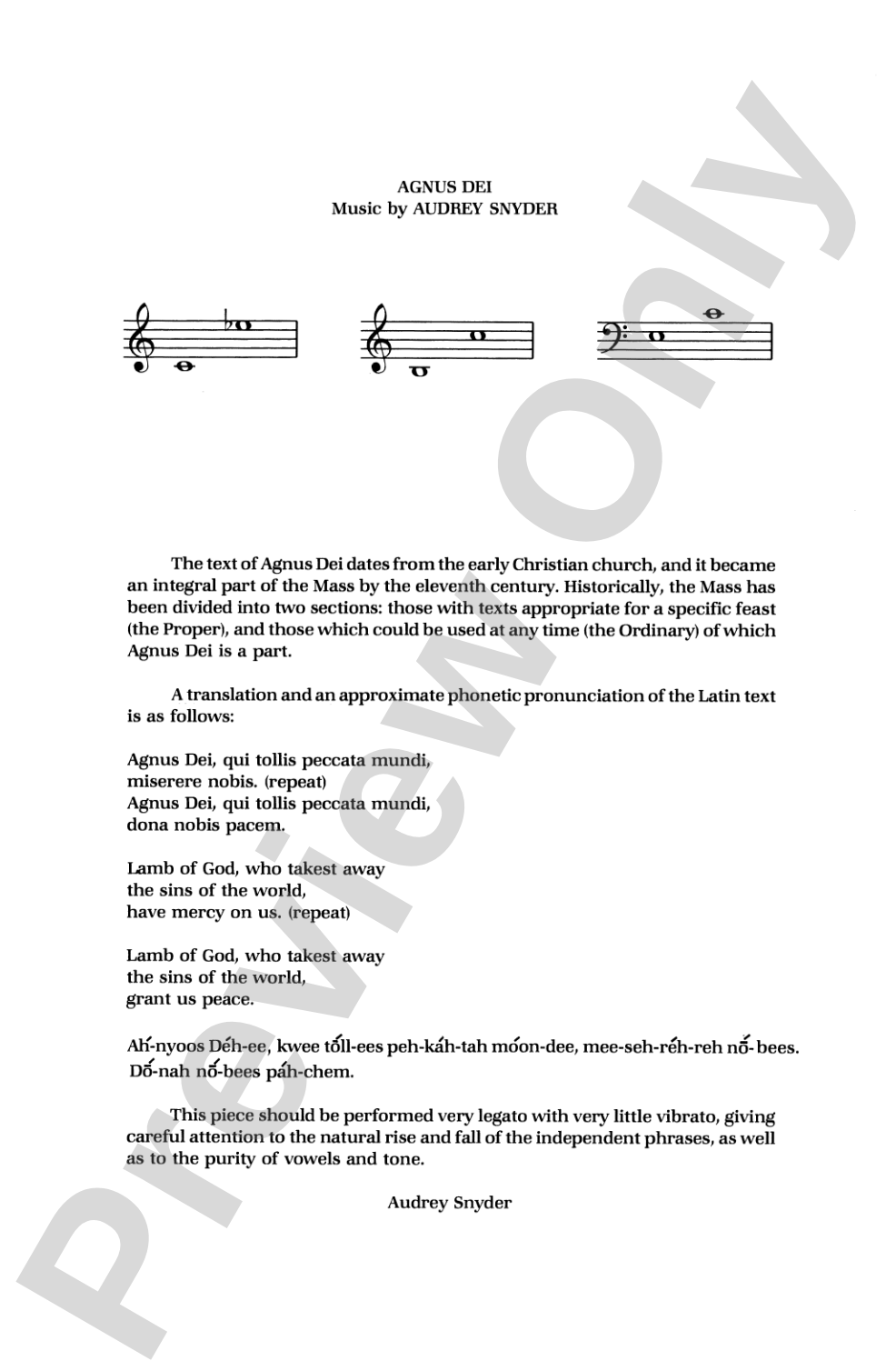
Snyder's setting of this liturgical text achieves something rare: it feels genuinely reverent without demanding advanced vocal technique. The three-part voicing opens the piece to wider ranges of singers, and her harmonic language creates real warmth without sacrificing musical integrity. Conductors consistently report that this arrangement resonates with audiences and singers alike.

What to expect

The piece carries a quiet dignity. Snyder's harmonies feel grounded and contemplative, with moments of gentle luminosity that arise from straightforward voice leading and clear textural choices. It's music that invites singers to listen to each other and to the words they're singing.

Who it's for

This works well for mixed choirs with modest ranges and varied experience levels. It's equally at home in church services, concert programs, and festival competitions where three-part literature is needed.

How to get the most out of it

  • Shape the phrasing around the text underlay rather than metric regularity; the liturgical rhythm should feel natural, not metronomic.
  • Balance the soprano and alto lines carefully in passages where they move in parallel motion to preserve textural clarity.
  • Let the harmonic resolutions breathe slightly; resist the urge to push through cadences too quickly.

How to use it

Program this as a centerpiece for a sacred concert set or pair it with other shorter liturgical works for a meaningful service anthem slot. Its moderate length and focused emotional arc make it an effective closer to a longer program.

Skills your students will build

  • Singing sustained vowels with consistent tone across dynamic changes
  • Balancing parts in three-part mixed voicing
  • Connecting text meaning to musical phrasing
  • Reading and interpreting standard choral notation in SAB format

You May Also Like