
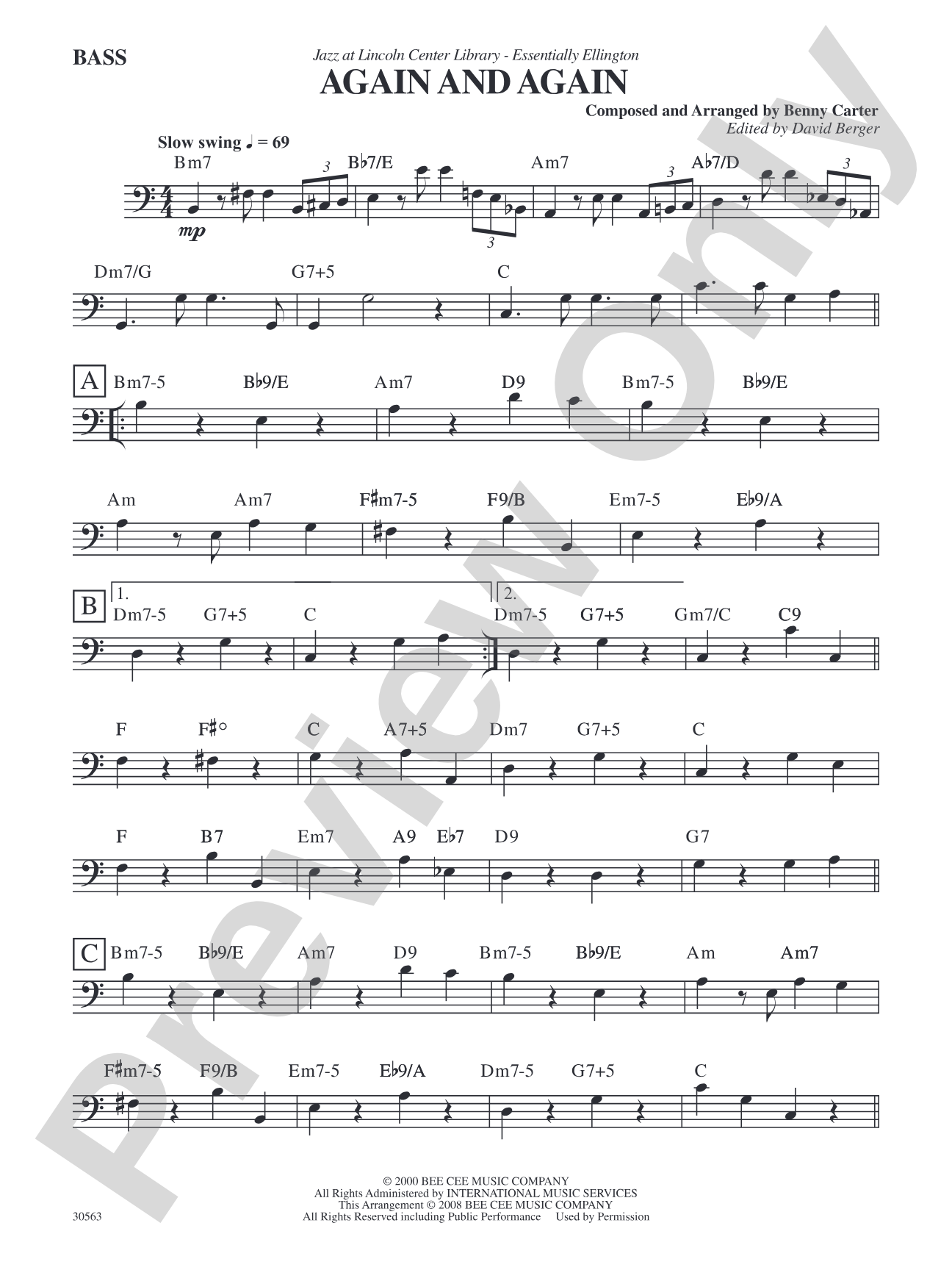

Again and Again: String Bass
By Benny Carter
Grade: 5 (Advanced / Difficult)
Item: 00-PC-0016189_SB
$5.99
Pickup currently not available
Description
Even when Benny Carter wasn't writing for Count Basie, many of his charts from the 1950's onward sound like they could have been written for Basie. Maybe this is because so many of Basie's arrangers (Sammy Nestico, Quincy Jones, Billy Byers and Neal Hefti) were influenced by Carter. The writing is straightforward, with simple harmonies, swinging rhythms and very clear counterpoint. Again And Again has much of the style of an alto feature that Quincy Jones might have written for Marshall Royal. Although Carter gives the pianist two little solo spots, the focus is on the lead alto. The backgrounds are spare and dry, so it is incumbent upon the soloist to supply the warmth and personality to tell this gentle story. Vibrato, scoops, bends, turns, and other devices can be used to bring this simple line to life.


Don't just read it, hear it, play along with it, and watch your students grow with it. In MakeMusic Cloud, Again and Again: String Bass comes alive with professional accompaniment, adjustable tempo, and built-in practice tools that turn solo practice into real progress.
Open in the Player
Jump straight in and assign it today.
Start Your Free Trial
Open this title and explore the full library in minutes.
Sample Audio
1
Audio File
--:--
0:00
0:00
Sample Video
No sample videos found.
Additional Details
Series:
Essentially Ellington: Jazz at Lincoln Center Library
Publisher:
Alfred Music
Page Count:
62
SKU:
00-PC-0016189_SB
More about this title
About the Composer: Benny Carter
Benny Carter (1907-2003) was a saxophonist, trumpeter, composer, and arranger whose influence shaped the sound of big band jazz across seven decades. As both a performer and writer, Carter developed a compositional style marked by clean voicings, singable melodies, and orchestral clarity that made him invaluable to bandleaders from Duke Ellington to Count Basie.
Carter's arrangements became a school unto themselves. His gift for counterpoint and his ability to write parts that sounded idiomatic to each instrument meant that younger arrangers studied his work to understand how to voice a band. He proved that sophisticated harmonic thinking and swinging groove were not opposites but partners, a lesson his students carried into their own writing for decades.
Why we love this
Carter's writing here strips away excess and trusts the ensemble to deliver maximum impact with minimal orchestration. The sparse backgrounds throw the spotlight entirely on the lead alto soloist, which means your best player gets genuine responsibility and the section players learn how to support without filling every harmonic space. This is exactly how the greatest swing charts work: economy of means paired with absolute clarity of purpose.
What to expect
Gentle and sophisticated, like overhearing a master musician reflect quietly on a familiar story. The melody unfolds with the ease of natural conversation, the harmonies sit just right, and the whole piece has the warmth of a late-night jam session among friends who trust each other completely.
Who it's for
Advanced jazz ensembles with a strong lead alto player and a rhythm section ready to execute understated, swinging support. This score suits groups that have moved beyond unison learning and are ready to explore how great arrangers use negative space and counterpoint to create impact.
How to get the most out of it
- Shape the alto solo line with full command of dynamics and tone color. Carter's simple melody demands interpretive maturity from the soloist; let vibrato, scoops, and bends articulate the emotional arc rather than relying on fast notes or flashy technique.
- Balance the lead alto against sparse backgrounds by training the ensemble to listen and resist the urge to swell. The backgrounds exist to frame and support, not to compete.
- Give the pianist's solo spots room to breathe. These moments are brief, but they should sound like genuine conversation with the alto, not filler between choruses.
- Lock the swing feel across the rhythm section before adding horn lines. Carter's straightforward rhythms depend on a rock-solid pulse that the ensemble can hang its phrasing on.
How to use it
Pair this with other Basie-band-influenced charts to build a cohesive set that showcases how post-war swing arranging evolved. The solo feature makes it ideal for a recital highlighting your best alto player, and the sophisticated voicings work well on a program aimed at adult or college audiences who appreciate understated musicianship.
Skills your students will build
- Listening to and balancing solo voice against accompaniment
- Executing sparse, dry voicings with clarity and precision
- Understanding counterpoint in jazz orchestration
- Developing expressive solo technique (vibrato, scoops, bends, turns)
- Reading and playing authentic swing rhythms at Grade 5 difficulty
- Sustaining a gentle, conversational ensemble sound