
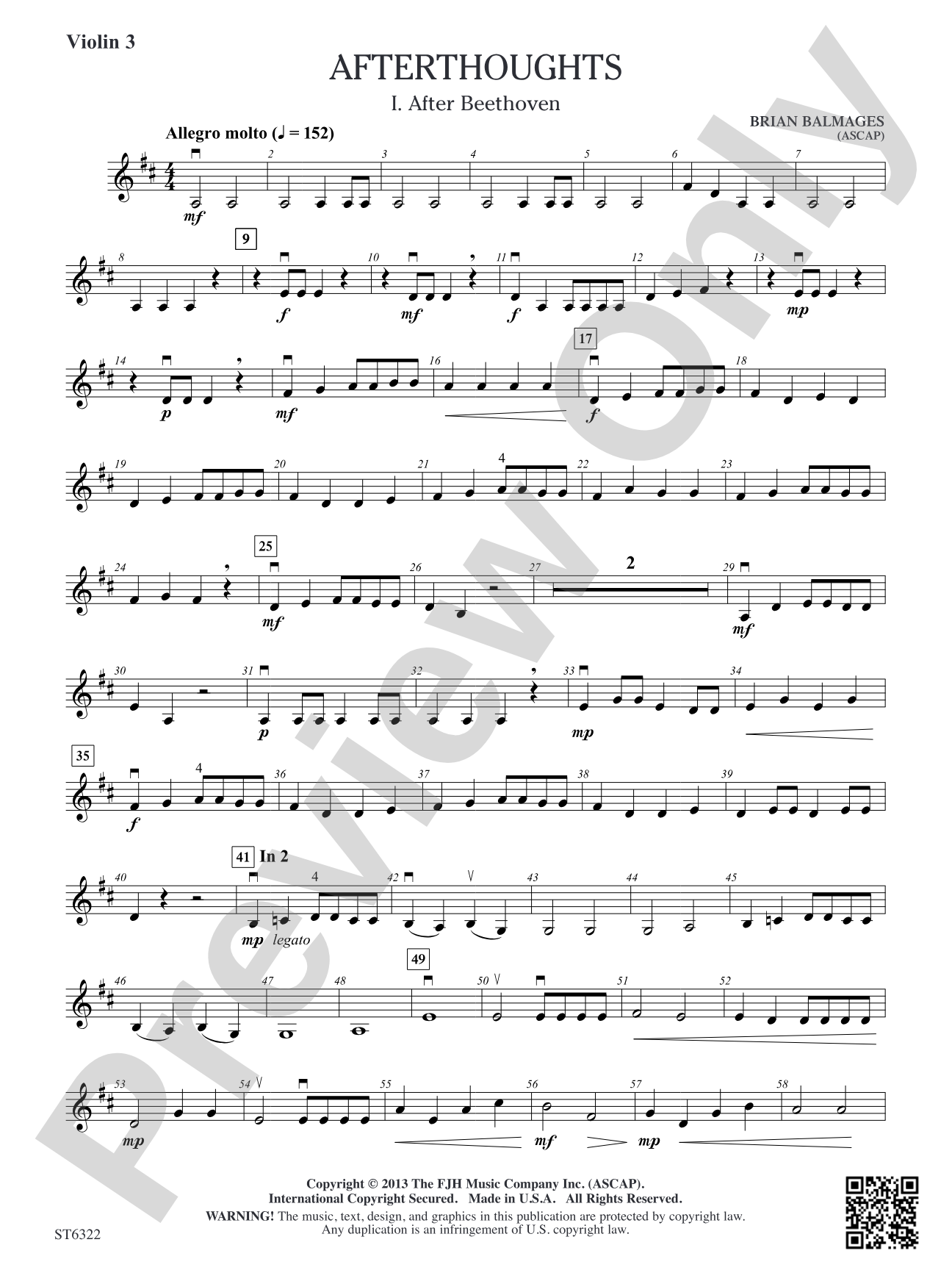

Afterthoughts: Violin 3 (Viola T.C.)
By Brian Balmages
Grade: 2
Item: 98-PC-DST6322_VN3
$7.00
Pickup currently not available
Description
Cleverly titled, this three movement work features original music in the style of famous composers from different periods in classical music. The first movement, After Beethoven, follows the form and style of the opening movement of his 5th Symphony. The second movement, After Tchaikovsky, evokes stylistic elements from the 2nd movement of his 5th Symphony along with his piano nocturnes. The final movement, After Bartók, combines the aggressive sound of his Allegro Barbaro with the epic nature of his Concerto for Orchestra. A wealth of teaching and musical opportunities!


Don't just read it, hear it, play along with it, and watch your students grow with it. In MakeMusic Cloud, Afterthoughts: Violin 3 (Viola T.C.) comes alive with professional accompaniment, adjustable tempo, and built-in practice tools that turn solo practice into real progress.
Open in the Player
Jump straight in and assign it today.
Start Your Free Trial
Open this title and explore the full library in minutes.
Sample Audio
1
Audio File
--:--
0:00
0:00
Sample Video
No sample videos found.
Additional Details
Series:
FJH Developing Strings
Publisher:
The FJH Music Company, Inc.
SKU:
98-PC-DST6322_VN3
More about this title
About the Composer: Brian Balmages

Brian Balmages has built an international reputation as a composer and conductor working across orchestral, band, and chamber repertoires. His works have been performed by ensembles at every level, from professional orchestras at venues including Carnegie Hall and the Kennedy Center to school groups worldwide. He holds membership in the American Bandmasters Association and received the A. Austin Harding Award from the American School Band Directors Association, along with winning the 2020 NBA William D. Revelli Composition Contest.
As a guest conductor, Balmages regularly appears with all-state and regional ensembles, university orchestras, and professional groups. His music was performed at the 2013 Presidential Inaugural Prayer Service, and he has received commissions from major institutions including the University of Miami. Currently, he serves as Director of MakeMusic Publications and Digital Education for Alfred and MakeMusic.
Why we love this
This piece teaches essential orchestral concepts through genuine musical engagement rather than exercises. By embedding compositional techniques and period styles into three distinct movements, students encounter Beethovenian structure, Romantic lyricism, and rhythmic vitality all within a single rehearsal cycle. The pedagogical architecture here is seamless: students aren't studying "form" abstractly; they're inhabiting it.
What to expect
Moving through three worlds in one concert experience. The first movement drives forward with Beethovenian inevitability, the second invites you into Romantic introspection, and the third explodes with primitive, architectural power. Each world feels complete, yet together they form a coherent musical statement about how composers learn from and reimagine their predecessors.
Who it's for
High school and advanced middle school orchestras ready to explore compositional craftsmanship in real time. This works well for programs seeking repertoire that combines solid technique with genuine musical curiosity; students develop awareness of how composers build identity and emotion through style.
How to get the most out of it
- Shape the opening movement's thematic material with the clarity Beethoven demands; the iconic rhythmic cell needs precise articulation across the entire section to register as the unifying element it becomes.
- Balance the lyrical second movement carefully between violas and lower strings, which carry much of the Tchaikovsky-influenced melody; this isn't background harmony but essential voice leading.
- Commit fully to the rhythmic aggression of the final movement's opening; the Allegro Barbaro character requires energy and precision from all players, especially the lower strings establishing the harmonic foundation.
- Use the contrasting textures in the final movement to build transparency; the epic, blockier sections benefit from full-bodied sound, while transitional passages need articulation clarity.
How to use it
Program this as a centerpiece for a concert exploring classical influences in contemporary composition, or pair it with authentic works by Beethoven, Tchaikovsky, and Bartók to show how Balmages engages with their styles. It also works as a strong closing piece for a spring concert, offering both musical substance and enough originality to feel fresh without being obscure.
Skills your students will build
- Recognizing and performing compositional forms and stylistic conventions across different historical periods
- Balancing multiple thematic layers and voices within a single movement
- Executing rhythmic precision in both lyrical and aggressive contexts
- Responding to dramatic shifts in texture, tempo, and orchestration within a unified work
- Understanding how composers reference, adapt, and recontextualize musical styles