Afternoon in Paris (arr. Michael Philip Mossman) Sheet Music Preview

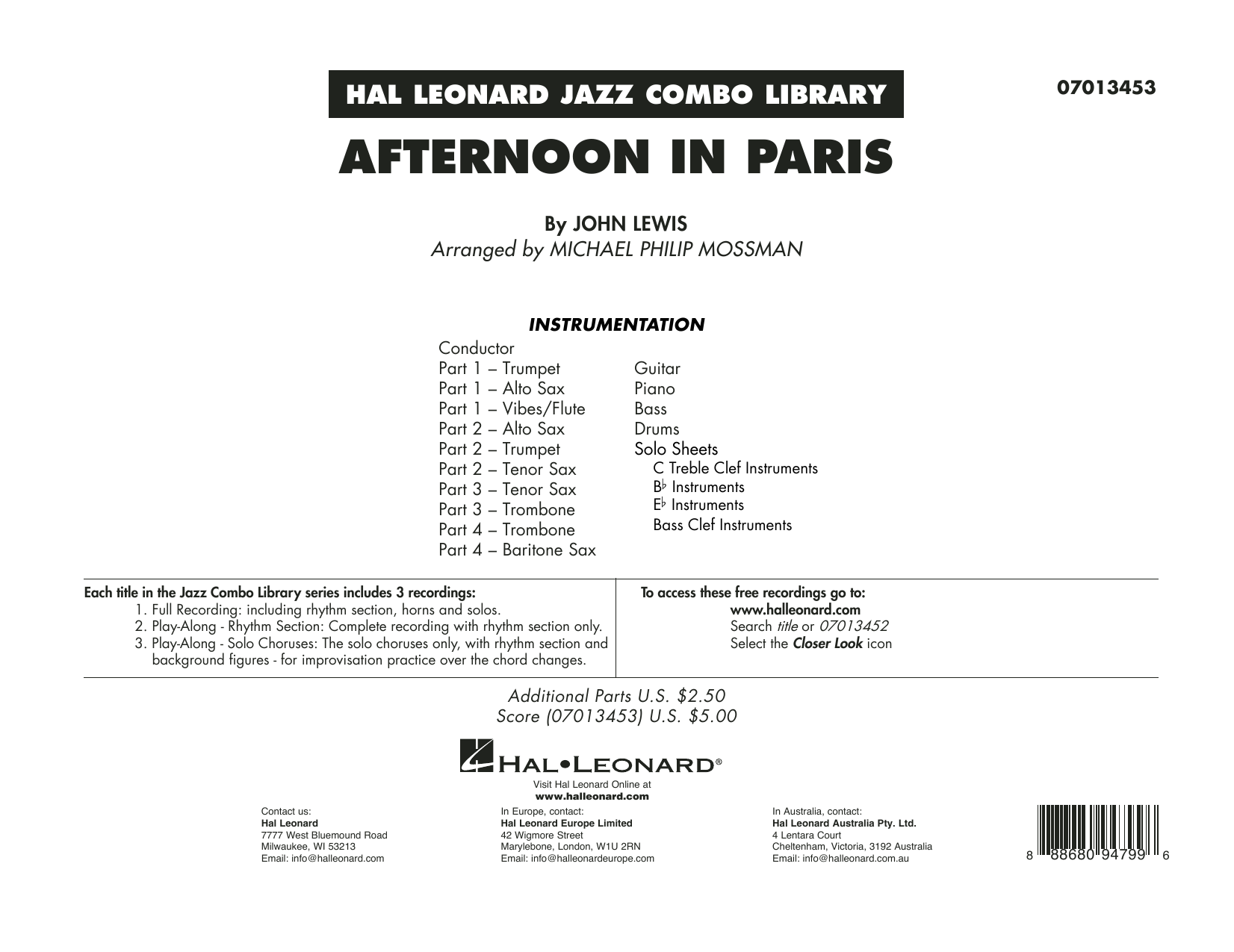
Afternoon in Paris (arr. Michael Philip Mossman): Jazz Ensemble Conductor Score & Parts

By John Lewis / Arranged by Michael Philip Mossman

Grade: 4

Item: 35-PK00450035

Digital Download
$40.00

One moment…

Description
Jazz standard from John Lewis in a medium swing style.

Afternoon in Paris (arr. Michael Philip Mossman): Jazz Ensemble Conductor Score & Parts isn't in MakeMusic Cloud just yet...but it could be. Let us know you'd like to see it, and you'll help shape what comes next. In the meantime, start a free trial and dive into thousands of interactive titles your students can play along with today.

Sample Audio
No sample audio found.
Sample Video
Additional Details
Publisher: Hal Leonard
SKU: 35-PK00450035

More about this title

About the Composer: John Lewis

John Lewis was a pianist, composer, and founding member of the Modern Jazz Quartet, one of the most influential small ensembles in jazz history. His compositions balanced sophisticated harmonic language with accessibility, and he became known for writing pieces that worked equally well in concert halls and intimate clubs. Lewis's approach to composition influenced generations of jazz musicians and educators.

Why we love this

Mossman's arrangement captures the unhurried elegance of the original while giving your ensemble room to breathe and swing. The Grade 4 difficulty means your students engage with real harmonic content and rhythmic independence without the instrumental pyrotechnics that distract from the tune's essential charm.

What to expect

Strolling through a Paris afternoon with nowhere to be. The melody unfolds in gentle curves, the harmonies are warm and slightly impressionistic, and the rhythm section locks into a lazy but purposeful swing that lets the tune breathe naturally.

Who it's for

Jazz ensembles with solid fundamentals in swing feel and section work. This arrangement works for high school groups with a year or more of jazz experience, college ensembles seeking a standard with real musical substance, and any group that needs a concert opener with immediate audience appeal.

How to get the most out of it

  • Shape the melody with long phrase lines rather than hitting every note evenly; let the swing feel carry the weight of the line.
  • Balance the comping voices so soloists emerge naturally from the ensemble without requiring aggressive dynamics.
  • Establish the ride cymbal groove early in rehearsal and anchor all rhythmic decisions around it; this piece lives in the space between strict time and rubato.
  • Bring out the harmonic movement in the accompaniment during ensemble passages; listeners should hear the sophistication beneath the relaxed surface.

How to use it

Use this as a concert centerpiece that balances heavier original works or more aggressive swing charts. It also serves as an excellent vehicle for feature solos, giving your best improvisers space to develop ideas over changes that are accessible yet sophisticated enough to reward exploration.

Skills your students will build

  • Swing feel and ride cymbal coordination
  • Comping chords with harmonic awareness and space
  • Long-phrase melody reading with attention to phrasing over syntax
  • Solo improvisation over ii-V-I progressions and related harmonic movement
  • Section balance and ensemble listening in a quiet, introspective context

You May Also Like