
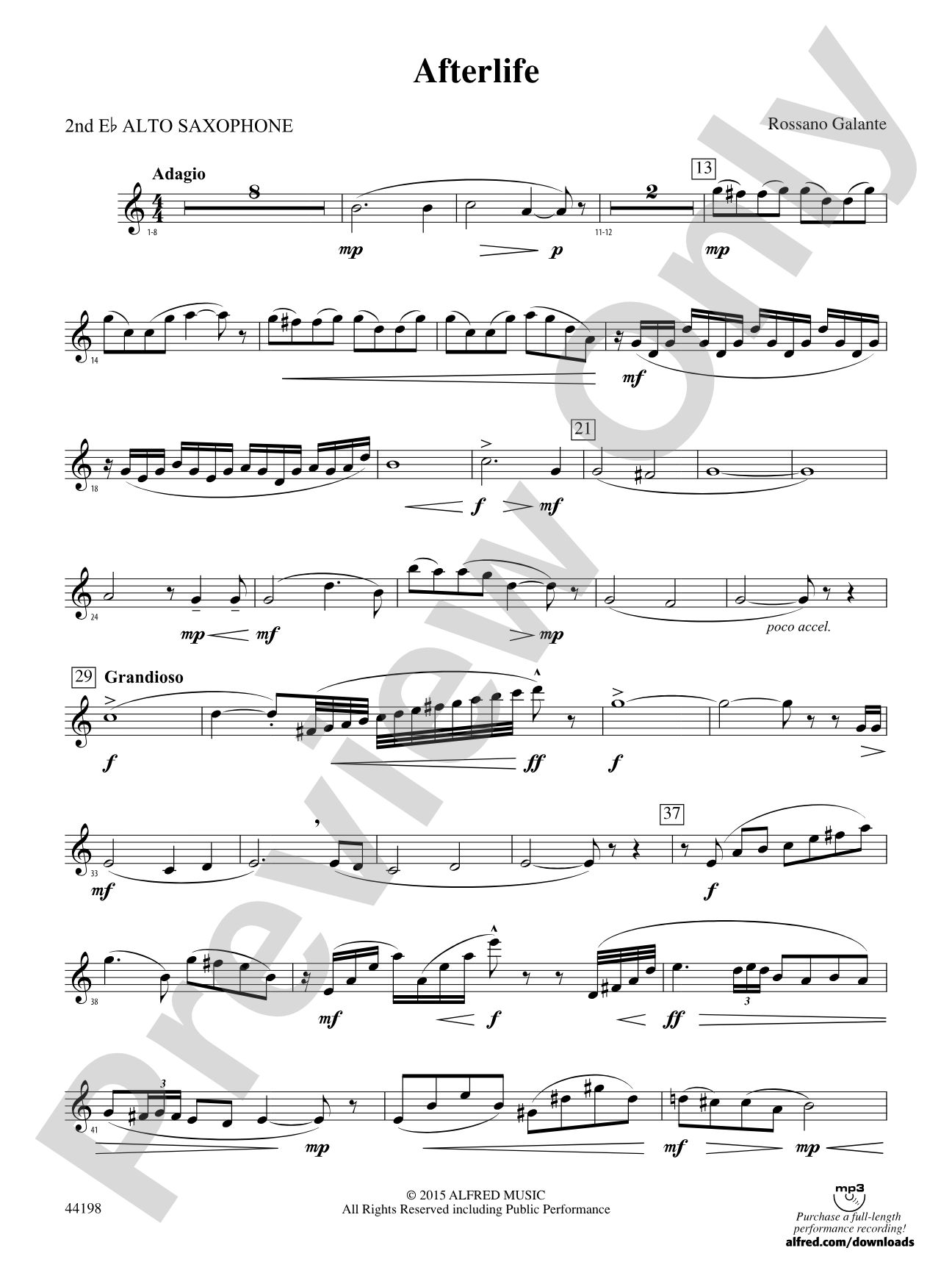

Afterlife: 2nd E-flat Alto Saxophone
By Rossano Galante
Grade: 4 (Medium Difficult)
Item: 00-PC-0017048_AX2
$5.99
Pickup currently not available
Description
Since the beginning of time man has pondered what happens when our physical body dies. Some believe we go to Heaven. Others doubt its existence entirely. Then there are those who have had near death experiences and live to tell their stories. This composition starts delicately as peacefulness returns to the soul. It intensifies as we approach our new consciousness, constantly modulating between the two as we gain knowledge of our new surroundings. (4:45) This title is available in MakeMusic Cloud.


Don't just read it, hear it, play along with it, and watch your students grow with it. In MakeMusic Cloud, Afterlife: 2nd E-flat Alto Saxophone comes alive with professional accompaniment, adjustable tempo, and built-in practice tools that turn solo practice into real progress.
Open in the Player
Jump straight in and assign it today.
Start Your Free Trial
Open this title and explore the full library in minutes.
Sample Audio
1
Audio File
--:--
0:00
0:00
Sample Video
Additional Details
Series:
Alfred Concert Band
Publisher:
Alfred Music
Page Count:
208
SKU:
00-PC-0017048_AX2
More about this title
About the Composer: Rossano Galante
Rossano Galante started his career in Buffalo, studying trumpet performance at SUNY Buffalo before earning acceptance to USC's Film Scoring Program in 1992, where he worked under Jerry Goldsmith's mentorship. Since relocating to California in 1999, he has built a prolific career as an orchestrator and composer, collaborating with Oscar-nominated composers and contributing orchestrations to over eighty feature films spanning blockbuster franchises and intimate dramas alike.
Beyond his film work, Galante has established himself as a sought-after composer for concert bands and orchestras worldwide. His catalog includes over 68 published compositions across multiple publishers, demonstrating a commitment to enriching the repertoire available to student and professional ensembles.
Why we love this
Galante translates cinematic storytelling into concert band language here, crafting a piece that holds philosophical weight without demanding advanced technical fireworks. The constant modulation between peacefulness and intensity mirrors the piece's conceptual journey, giving students a tangible musical reason for the harmonic shifts they're executing rather than treating modulation as an abstract exercise.
What to expect
The piece inhabits a liminal space between serenity and awakening, its harmonic landscape shifting like consciousness itself. You emerge from darkness into light, moving through uncertainty and eventual recognition, carried along by orchestration that feels cinematic in scope yet deeply introspective.
Who it's for
Conductors programming a concert that balances technical challenges with meaningful content. This works equally well for a festival performance or a concert exploring thematic depth, and the 208-page format indicates substantial arrangement breadth that keeps all sections engaged.
How to get the most out of it
- Establish the opening's quietness as genuine vulnerability, not merely soft dynamics. The ensemble needs to breathe together and listen inward before the intensity arrives.
- Mark where each modulation occurs in your score and identify which sections anchor the 'consciousness' theme versus the 'peacefulness' material. Consistency in character between these poles matters more than dramatic tempo swings.
- The four-minute-forty-five-second runtime demands rhythmic precision throughout the ensemble. Use rehearsals to lock transitions between the delicate and intense sections so they feel like natural progressions rather than shifts.
- Balance the harmonic richness without muddying the texture. At Grade 4, your middle voices carry crucial voice-leading; ensure those players hear their responsibility in the modulations.
How to use it
Position this as a centerpiece concert piece that bookends your program meaningfully, perhaps pairing it with contrasting repertoire to highlight its contemplative character. Alternatively, it suits a festival where judges appreciate compositional craft and thematic coherence at the Grade 4 level.
Skills your students will build
- Reading and executing multiple key modulations within a single work
- Sustaining dynamic control through extended soft passages
- Responding to harmonic color shifts that signal conceptual changes
- Ensemble listening and balance in richly voiced textures
- Interpreting a conductor's leadership through gestural story-telling across a four-minute span