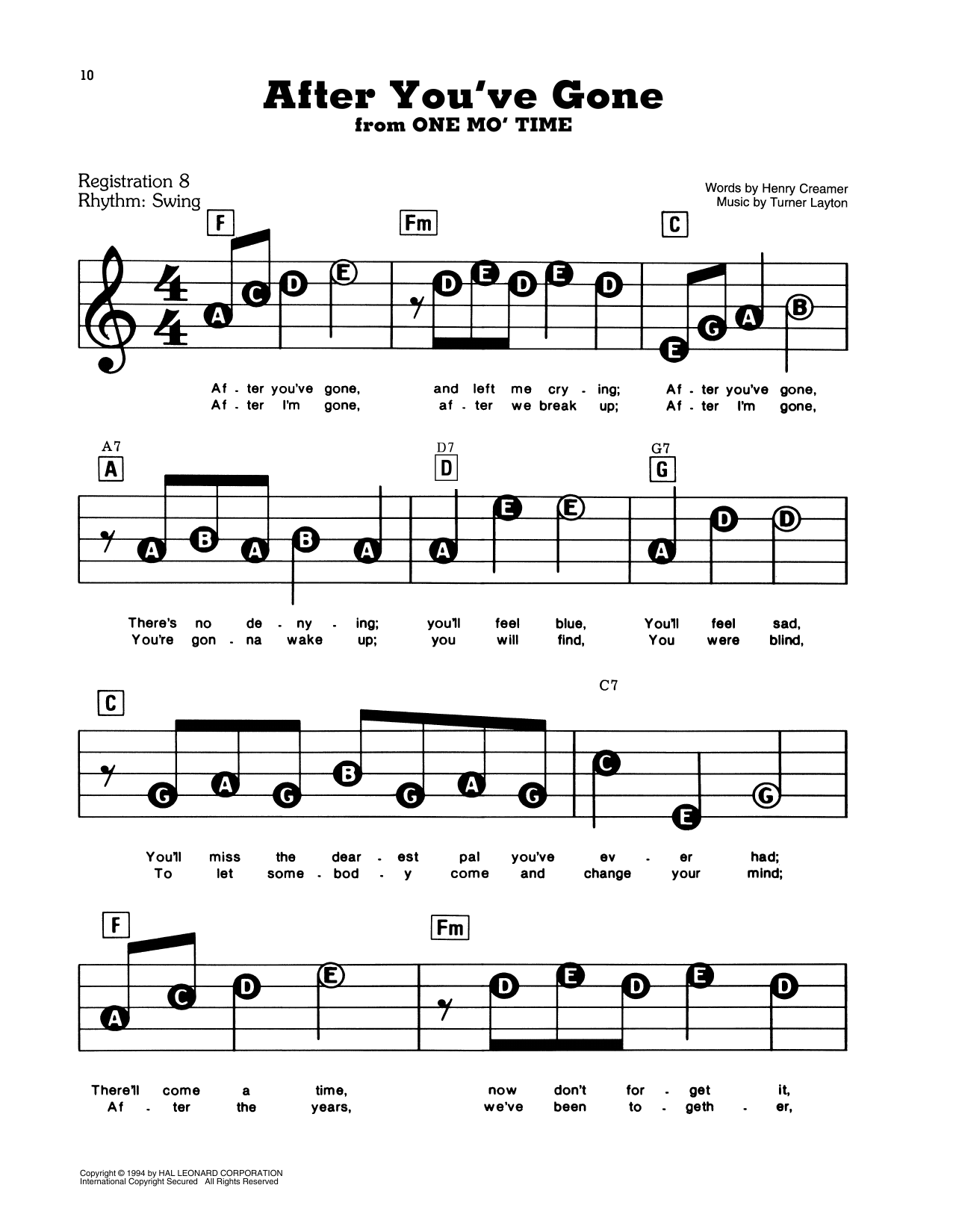
After You've Gone (from One Mo' Time) Sheet Music Preview

After You've Gone (from One Mo' Time): E-Z Play Today

Item: 35-DS00455614

Digital Download
$4.99
Description

After You've Gone (from One Mo' Time): E-Z Play Today isn't in MakeMusic Cloud just yet...but it could be. Let us know you'd like to see it, and you'll help shape what comes next. In the meantime, start a free trial and dive into thousands of interactive titles your students can play along with today.

Sample Audio
No sample audio found.
Sample Video
Additional Details
Publisher: Hal Leonard
Page Count: 2
SKU: 35-DS00455614

More about this title

About the Creator

Henry Creamer and Turner Layton wrote "After You've Gone" in 1918, and the song quickly became a jazz standard that defined an era. Their composition captures the emotional core of early jazz songwriting: a memorable melody that sits naturally for singers while offering improvisers endless room to explore.

Why we love this

E-Z Play Today gives pianists direct access to a tune that shaped jazz history without demanding advanced technique or sight-reading skills. The simplified voicings and straightforward notation let students focus on phrasing, swing feel, and the conversational quality that makes jazz piano rewarding to play.

What to expect

Bittersweet and wistful. The melody floats with a natural elegance, supported by warm chord voicings that evoke early twentieth-century jazz ballroom intimacy. There's room for tenderness and subtle expression without ever feeling heavy.

Who it's for

Early intermediate pianists exploring jazz standards and students who want to build jazz vocabulary without complex harmonic reading. This works well for singers looking for an accessible backing arrangement and for pianists teaching themselves the language of jazz comping.

How to get the most out of it

  • Shape the melody with subtle rubato in the first phrase; let the rhythm section breathe rather than lock into strict time immediately.
  • Voice the chord changes simply and clearly, leaving space for the tune to sing rather than filling every beat with harmonic movement.
  • Listen for the emotional arc within the bridge. This is where the lyrical content deepens, so let that affect your dynamic choices.
  • Practice the left hand as a conversation partner to the melody, not a strict timekeeper. Jazz piano depends on this responsiveness.

How to use it

Pair this with vocal students learning to interpret standards, or use it as a solo piano interlude in a concert that mixes classical with jazz traditions. It's also ideal for introducing students to the standard repertoire that underpins jazz education.

Skills your students will build

  • Jazz comping and voicing chord changes with minimal notes
  • Swing phrasing and rubato within a structured melody
  • Reading lead sheet symbols and realizing them on the keyboard
  • Balancing melody projection with accompaniment texture

You May Also Like