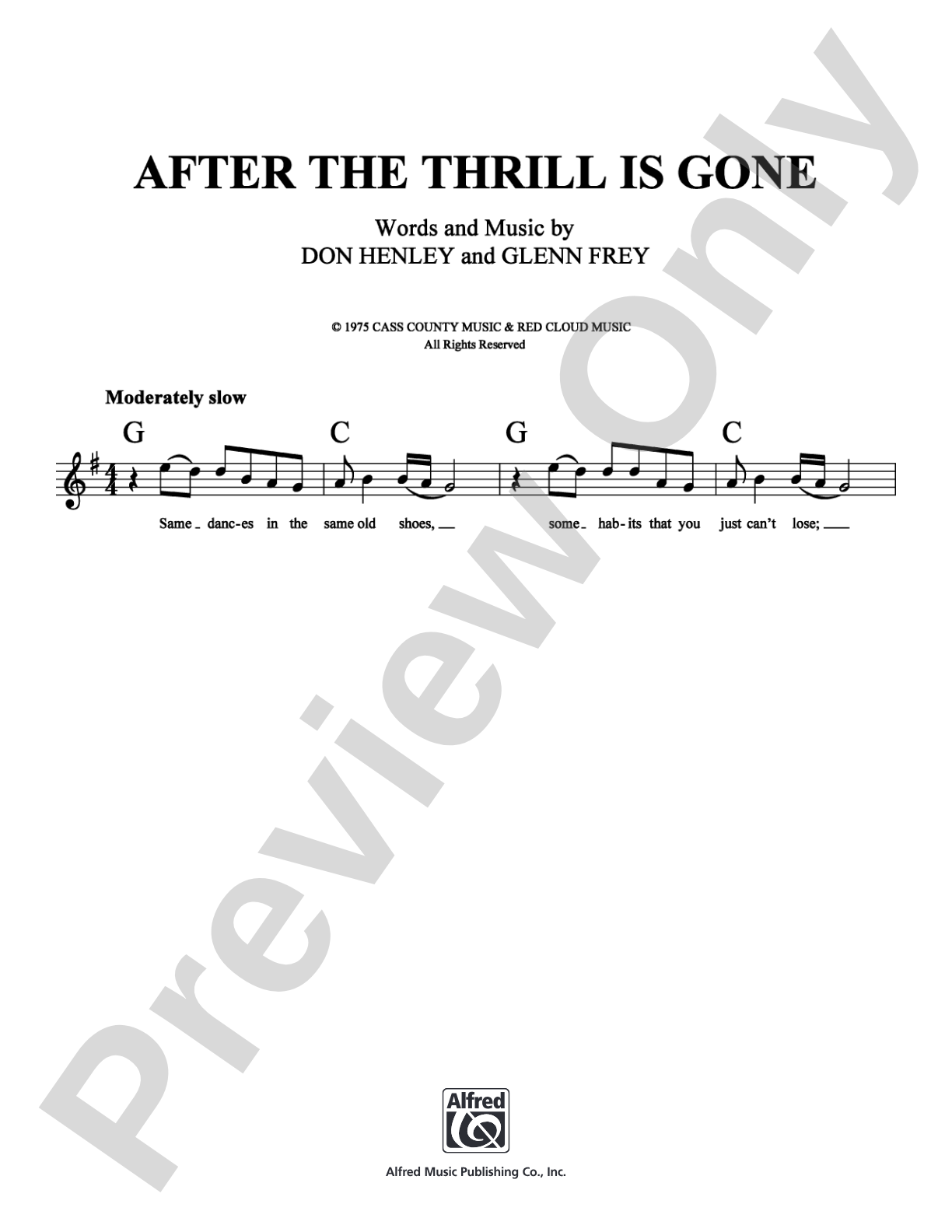
After the Thrill Is Gone: Lead Sheet Digital Sheet Music

After the Thrill Is Gone: Lead Sheet Digital Sheet Music

Eagles, Glenn Frey, Don Henley

Item: 00-PS-0008875

Digital Download
$1.99
Description

After the Thrill Is Gone: Lead Sheet Digital Sheet Music isn't in MakeMusic Cloud just yet...but it could be. Let us know you'd like to see it, and you'll help shape what comes next. In the meantime, start a free trial and dive into thousands of interactive titles your students can play along with today.

Sample Audio
No sample audio found.
Sample Video
Additional Details
SKU: 00-PS-0008875

More about this title

About the Artist: Eagles

The Eagles emerged from Southern California in the early 1970s to become one of the most commercially successful rock bands in history. Their sophisticated approach to harmony, layered instrumentation, and introspective songwriting redefined what popular rock music could accomplish, influencing generations of musicians across multiple genres.

Why we love this

This lead sheet captures a masterclass in rock songwriting and vocal arrangement. The harmonic progression and melodic contour reward musicians who dig into chord substitutions and voice leading, making it equally valuable for jazz ensembles exploring pop standards and pop musicians studying how to build emotional depth into a familiar song.

What to expect

Introspective and soulful, with the kind of restless melancholy that comes from processing loss or disillusionment. The melody sits conversationally in your voice or instrument, never straining, while the harmony underneath carries emotional weight and sophistication that rewards careful listening.

Who it's for

Pianists, guitarists, and vocalists preparing this song for recital, jam session, or ensemble performance will find this lead sheet essential. It works equally well for arrangers building a new version, ensembles exploring rock repertoire in educational settings, or musicians studying the harmonic language of classic rock songwriting.

How to get the most out of it

  • Sing the melody with conversational phrasing rather than forcing every note to land on the beat; the lyrical quality depends on rubato and breath placement that reflects how the original artists deliver the line.
  • Mark chord changes clearly and test your harmonic understanding by playing the progression on an instrument before rehearsal; these chords have movement and voice-leading logic that becomes obvious once you hear them voiced.
  • Shape the form by varying dynamic energy across sections; a lead sheet gives you freedom to build intensity or pull back, so use it to create narrative arc rather than rendering every section at the same volume.

How to use it

Pair this with other introspective rock standards to build a set exploring how rock music engages with mature emotional content. It also anchors a retrospective of 1970s songwriting or works beautifully in a program that mixes pop and jazz repertoire, showing students how the same song can be interpreted across different genres.

Skills your students will build

  • Reading and interpreting lead sheet notation
  • Understanding chord progressions and voice leading in rock songwriting
  • Phrasing melody with conversational dynamics rather than mechanical rhythm
  • Harmonizing from a chord chart across different instruments
  • Analyzing emotional narrative structure in popular song forms

You May Also Like