After a Dream: Solo Viola Sheet Music Preview

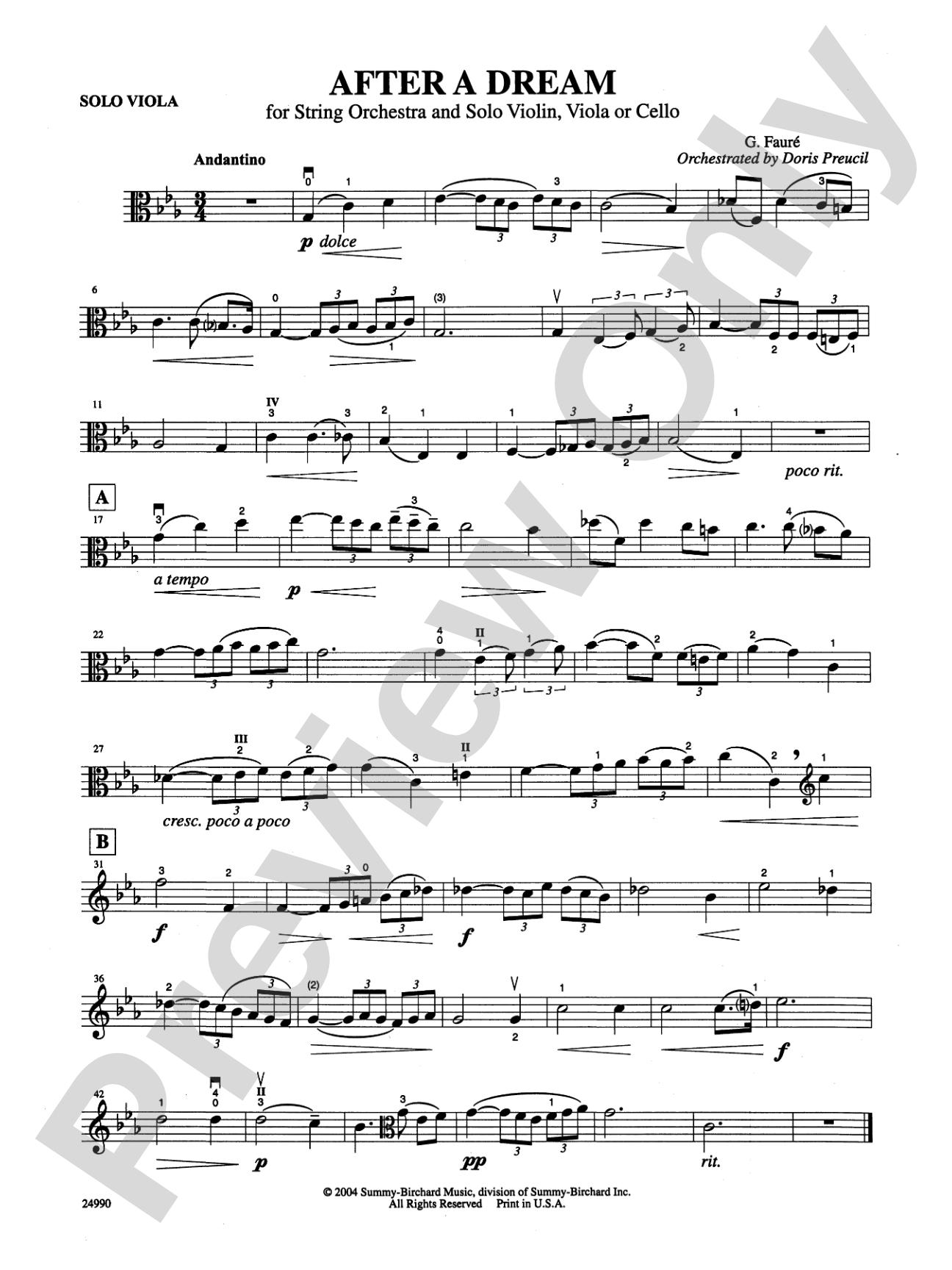
After a Dream: Solo Viola

For String Orchestra & Solo Violin, Viola, or Cello

By Gabriel Fauré / arr. Doris Preucil

Item: 00-PC-0000972_SVA

Digital Download
$5.99
Description
This exciting new series, arranged by Doris Preucil, was created to fulfill the needs of violists everywhere. Each set includes a Score plus ten Violin I parts, six Violin II parts, and six Violin III, Viola, Cello, and Bass parts. The themes underscored will give your viola students a chance to expand their performance opportunities.

Don't just read it, hear it, play along with it, and watch your students grow with it. In MakeMusic Cloud, After a Dream: Solo Viola comes alive with professional accompaniment, adjustable tempo, and built-in practice tools that turn solo practice into real progress.

Sample Audio
No sample audio found.
Sample Video
Additional Details
Series: Solo with Orchestra Series
Publisher: Alfred Music
Page Count: 72
SKU: 00-PC-0000972_SVA
Instrumentation: String Orchestra & Solo Violin, Viola, or Cello

More about this title

About the Composer: Gabriel Fauré

Gabriel Fauré (1845-1924) occupies a distinctive place in French music history as a bridge between the Romantic tradition and early modernism. His harmonic innovations and gift for melodic elegance influenced generations of composers, and his chamber and orchestral works remain central to the string repertoire. Fauré served as director of the Paris Conservatoire and composed prolifically across all genres, but his songs and instrumental works are especially prized in educational settings for their sophistication and emotional directness.

Why we love this

Doris Preucil's arrangement opens a masterwork to orchestras where violas often lack meaningful solo material. The Impressionistic harmony remains intact while the orchestration creates genuine dialogue between soloist and ensemble, rewarding both your featured player and the supporting strings with active, musical parts.

What to expect

Fauré's dreamlike Impressionism unfolds in gentle, luminous harmonies that seem to float weightlessly. The melody emerges like a half-remembered reverie, tender and introspective, supported by shimmering orchestral colors that shift subtly beneath the solo voice.

Who it's for

String orchestras with developing viola soloists who need substantial repertoire beyond student-level pieces. Directors seeking to highlight their violas in a concert context will find this particularly valuable, as it delivers musicianship and audience appeal without requiring advanced technical facility from the soloist.

How to get the most out of it

  • Balance the solo line so it sings above the accompaniment without the ensemble drowning it out; string orchestras tend toward homogeneous blend, so isolate the soloist slightly in rehearsal to establish clear hierarchy.
  • Attend to Fauré's subtle dynamic shifts and voice leading in the accompaniment figures; secondary lines carry expressive weight and shouldn't flatten into pure textural support.
  • Shape the piece in long, singing phrases rather than individual measures; Romantic lyricism requires trust in the line's architecture and patience through moments of harmonic suspension.

How to use it

Schedule this as a feature for a concerto or chamber night, pairing it with other French Romantic strings to create a thematic program. It also serves as an elegant transition piece in a broader concert, providing breathing room and lyrical contrast between more structurally ambitious works.

Skills your students will build

  • Sustaining long singing lines with consistent vibrato and tone quality
  • Balancing as a soloist within ensemble texture
  • Interpreting Impressionistic harmony and phrasing in string music
  • Reading and responding to subtle dynamic and expression markings
  • Ensemble coordination between solo and accompaniment voices

You May Also Like