
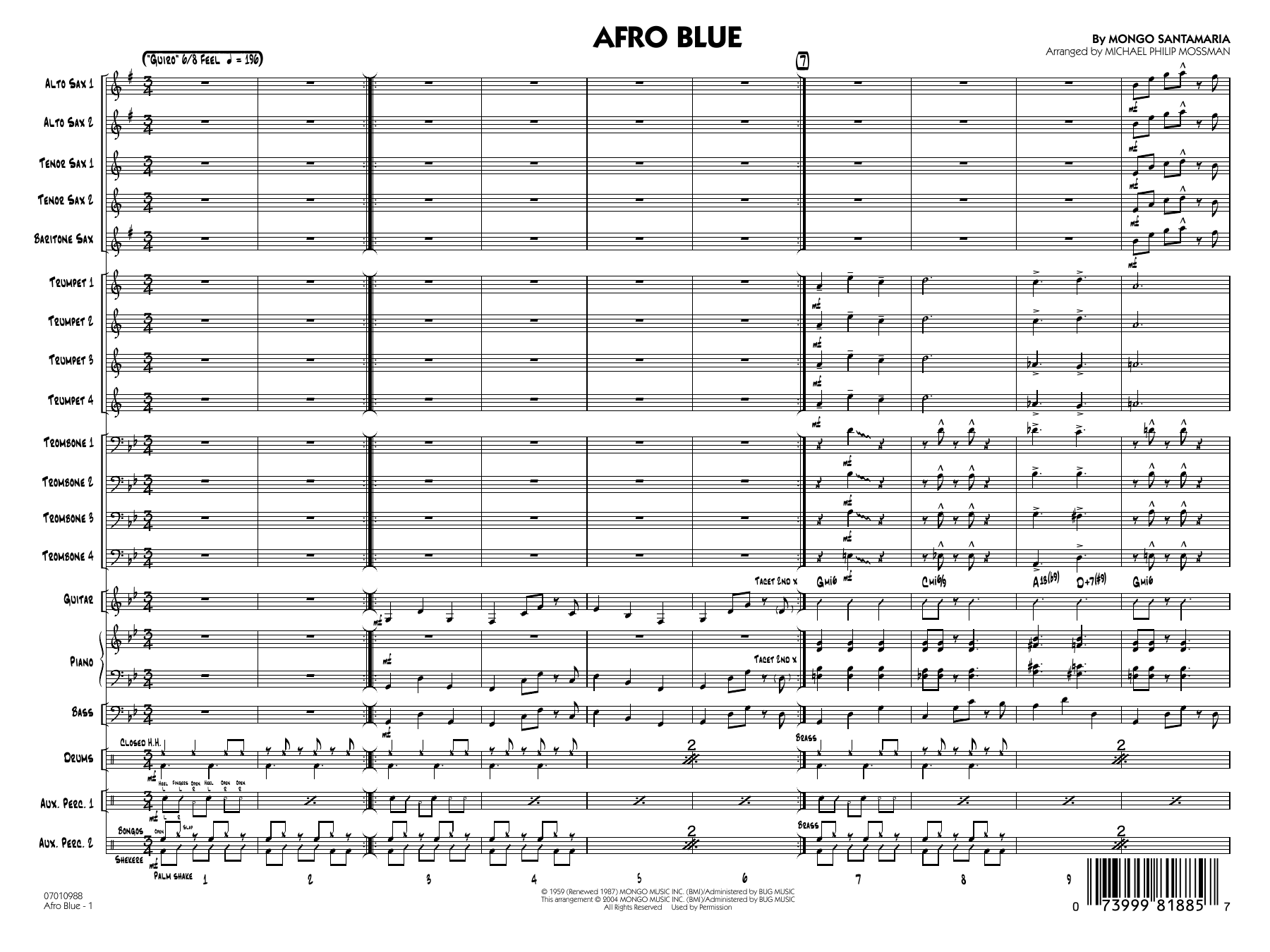

Afro Blue (arr. Michael Philip Mossman): Jazz Ensemble Conductor Score & Parts
As performed by John Coltrane / Arranged by Michael Philip Mossman
Grade: 4
Item: 35-PK01210195
$55.00
Pickup currently not available
Buy Extra Parts (Digital PDF Download)
Parts Added to Cart!
Description
Jazz Ensemble Library (Grade 4) Made famous by John Coltrane, but treated here in a more traditional Afro-Latin style, this is something a little different for jazz ensemble. As with all Mossman charts, the rhythm section is meticulously notated to insure the correct style. The 3/4 pattern throughout draws heavily on African influences and the melody is masterfully passed from section to section. A single pentatonic scale works for the solo section making this a wonderful vehicle for involving many soloists.


Afro Blue (arr. Michael Philip Mossman): Jazz Ensemble Conductor Score & Parts isn't in MakeMusic Cloud just yet...but it could be. Let us know you'd like to see it, and you'll help shape what comes next. In the meantime, start a free trial and dive into thousands of interactive titles your students can play along with today.
Request This Title
Tell us you want it.
Start Your Free Trial
Explore everything that's ready to play right now.
Sample Audio
No sample audio found.
Sample Video
No sample videos found.
Additional Details
Publisher:
Hal Leonard
SKU:
35-PK01210195
More about this title
About the Artist: John Coltrane
John Coltrane (1926-1967) stands as one of jazz's most influential saxophonists and composers, a musician whose relentless pursuit of harmonic and spiritual expression transformed the instrument's possibilities. His work across bebop, hard bop, modal jazz, and free jazz established him as a towering figure whose compositions remain essential to any serious jazz curriculum. "Afro Blue" exemplifies Coltrane's interest in world music and pentatonic melodic structures, offering educators a gateway into discussions of modal improvisation and cross-cultural musical dialogue.
Why we love this
Mossman's arrangement cuts against Coltrane's mystical, sheets-of-sound aesthetic to deliver something grounded and danceable. The 3/4 meter and African rhythmic sensibility create immediate cultural specificity that stretches students beyond standard swing feels, while the single pentatonic solo scale democratizes improvisation in ways that unlock meaningful contributions from developing soloists across your section.
What to expect
Earthy and propulsive, with an undercurrent of mystery that never tips into the cosmic or avant-garde. The melody floats above a groove that feels both ancient and modern, invoking African rhythmic ancestry while remaining thoroughly contemporary in its orchestration.
Who it's for
Grade 4 jazz ensembles ready to move beyond basic swing charts into repertoire that honors non-American jazz traditions. This arrangement rewards rhythm sections that have solid fundamentals and soloists comfortable with pentatonic improvisation, making it ideal for mid-level high school or upper community college groups.
How to get the most out of it
- Lock the rhythm section into the 3/4 pattern early in rehearsal. Mossman's meticulous notation means the groove lives in precise coordination between drums, bass, and piano; get that foundation solid before adding horns.
- Rotate soloists through the pentatonic scale section to build ensemble culture around taking turns. This approach naturally develops listening skills and reduces the pressure on any single player to carry the weight.
- Shape the melody hand-offs between sections with clear articulation and consistent phrasing. As the tune moves from saxes to trombones to trumpets, each transition should feel inevitable rather than mechanical.
- Keep the tempo steady and unbrushed. The Afro-Latin character depends on forward motion without rushing; a metronome or click track stabilizes the ensemble's collective feel.
How to use it
Place this on a concert exploring the jazz ensemble's relationship to world music and cultural hybridity. It pairs naturally with other Latin or African-influenced jazz charts and offers a natural talking point about how American jazz absorbed and transformed global influences. The accessible solo section also makes it a strong choice for a program section dedicated to ensemble improvisation.
Skills your students will build
- Reading and executing 3/4 time in swing contexts
- Pentatonic improvisation within a defined harmonic space
- Section-specific melody passing with coordinated articulation
- Rhythmic precision in Afro-Latin grooves with notated rhythm section parts
- Listening and responding to solo trading across multiple soloists