
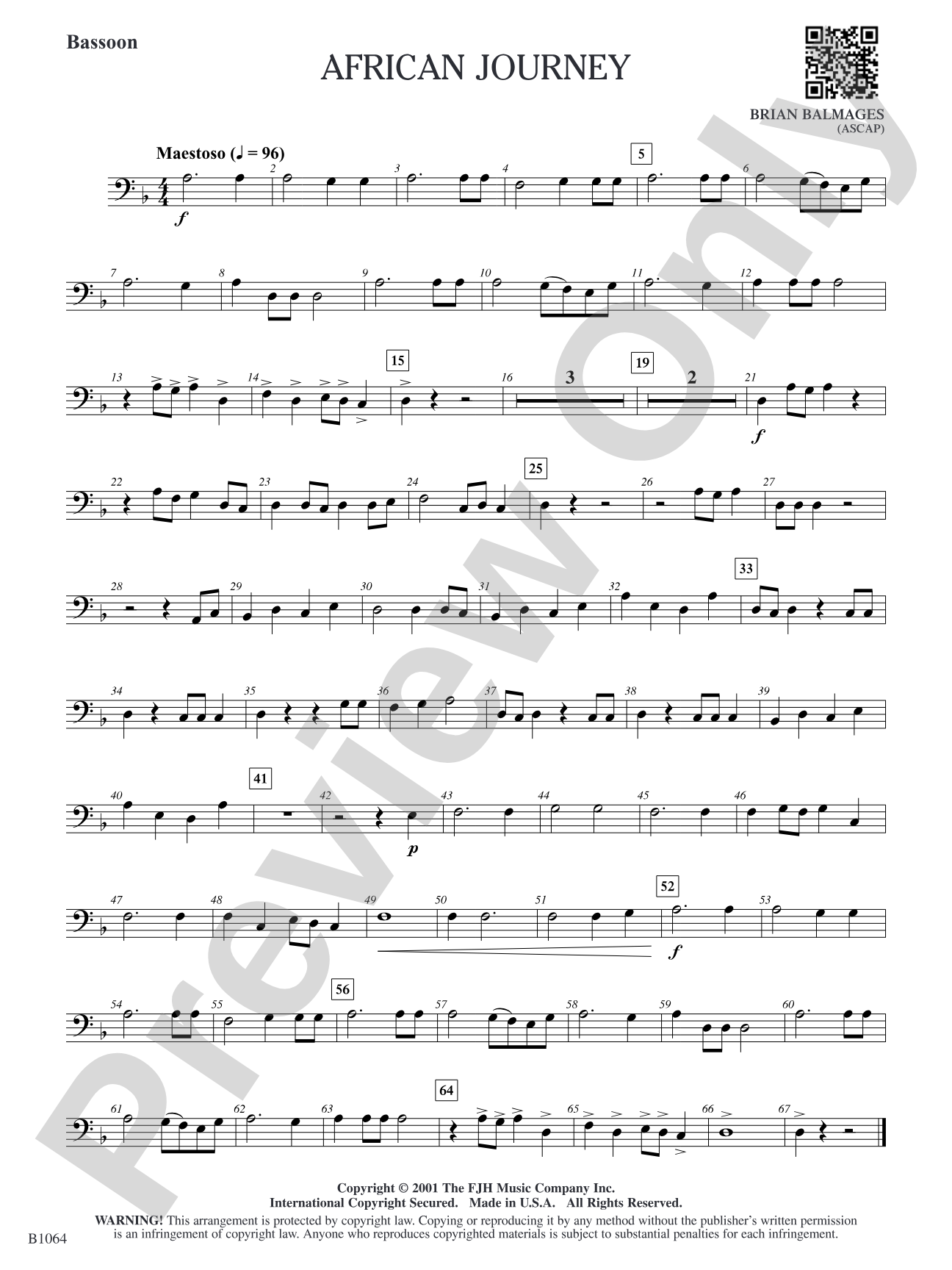

African Journey: Bassoon
By Brian Balmages
Grade: 1.5
Item: 98-PC-DB1064_B1
$7.00
Pickup currently not available
Description
The use of "snares off" and a tom-tom part will take your students on a musical safari with African Journey. Open 4ths and 5ths create a very mysterious setting. The piece also features some excellent contrapuntal writing between the ostinato figures and the melodic line that will keep student interest high during both rehearsal and performance time. (2:40)


African Journey: Bassoon isn't in MakeMusic Cloud just yet...but it could be. Let us know you'd like to see it, and you'll help shape what comes next. In the meantime, start a free trial and dive into thousands of interactive titles your students can play along with today.
Request This Title
Tell us you want it.
Start Your Free Trial
Explore everything that's ready to play right now.
Sample Audio
1
Audio File
--:--
0:00
0:00
Sample Video
No sample videos found.
Additional Details
Series:
FJH Developing Band
Publisher:
The FJH Music Company, Inc.
SKU:
98-PC-DB1064_B1
More about this title
About the Composer: Brian Balmages

Brian Balmages has established himself as a composer and conductor with a commanding presence across orchestral, band, and chamber music. His works have been heard in some of the world's most prestigious venues, from Carnegie Hall to the Sydney Opera House, performed by ensembles ranging from professional orchestras to elementary school groups. He received the A. Austin Harding Award from the American School Band Directors Association and won the 2020 NBA William D. Revelli Composition Contest for Love and Light. He is an elected member of the American Bandmasters Association.
Balmages holds distinguished alumni status from James Madison University's School of Visual and Performing Arts and was commissioned by the University of Miami to compose music for the inauguration of the institution's 6th president. His work has been performed at the Presidential Inaugural Prayer Service and in significant national contexts. As a guest conductor, he regularly leads all-state and regional ensembles, university groups, and professional orchestras worldwide, with notable appearances at the Midwest Clinic, Western International Band Clinic, and numerous international venues. He currently serves as Director of MakeMusic Publications and Digital Education for Alfred and MakeMusic.
Why we love this
Balmages crafts an engaging teaching piece here that feels purposeful rather than utilitarian. The orchestration choices—snares off, tom-tom coloring, and those open 4ths and 5ths—create genuine atmosphere without overcomplicating the technical demands on your ensemble. The contrapuntal interplay between ostinato and melody gives young musicians something substantive to listen for and execute, turning rehearsal time into real musical learning.
What to expect
African Journey evokes a sonic landscape of mystery and discovery, with open harmonies that suggest wide horizons and the gentle percussion textures of a distant landscape. The interweaving of rhythmic figures and melody creates forward momentum without abandoning clarity, engaging young ears in the architecture of the music itself.
Who it's for
This piece serves beginning band students who are ready to tackle musical storytelling beyond straightforward march or fanfare writing. It works equally well for groups building foundational ensemble skills and those introducing multicultural perspectives to their concert programming.
How to get the most out of it
- Shape the mysterious mood by keeping the tom-tom part warm and controlled; resist the urge to make it percussive or sharp, letting it blend with the harmonic foundation.
- Balance the ostinato figures against the melodic line so both parts remain distinct; use dynamics and sectional awareness to prevent the accompaniment from overwhelming the primary voice.
- Maintain steady time in the open harmonic writing; these sparse textures expose any rhythmic unevenness, so lock the ensemble's pulse before addressing articulation or phrasing.
- Allow the 2:40 duration to breathe naturally without rushing; young players often accelerate slightly when they're engaged, so conductor awareness of tempo stability matters here.
How to use it
Program this as a concert opener that establishes a thematic journey or place your audience in a different cultural context early in the set. Its compact length and accessible Grade 1.5 difficulty make it ideal for inclusion in festival performances, school assemblies, or community concerts where you want to program something musically substantial yet appropriate for developing ensembles.
Skills your students will build
- Reading open 4th and 5th intervals and understanding harmonic sparseness
- Balancing ostinato accompaniment with melodic material
- Listening for and executing contrapuntal writing
- Maintaining steady tempo in non-traditional harmonic contexts
- Dynamic control and blend in ensemble playing
- Percussion ensemble awareness (snares off, tom-tom integration)