
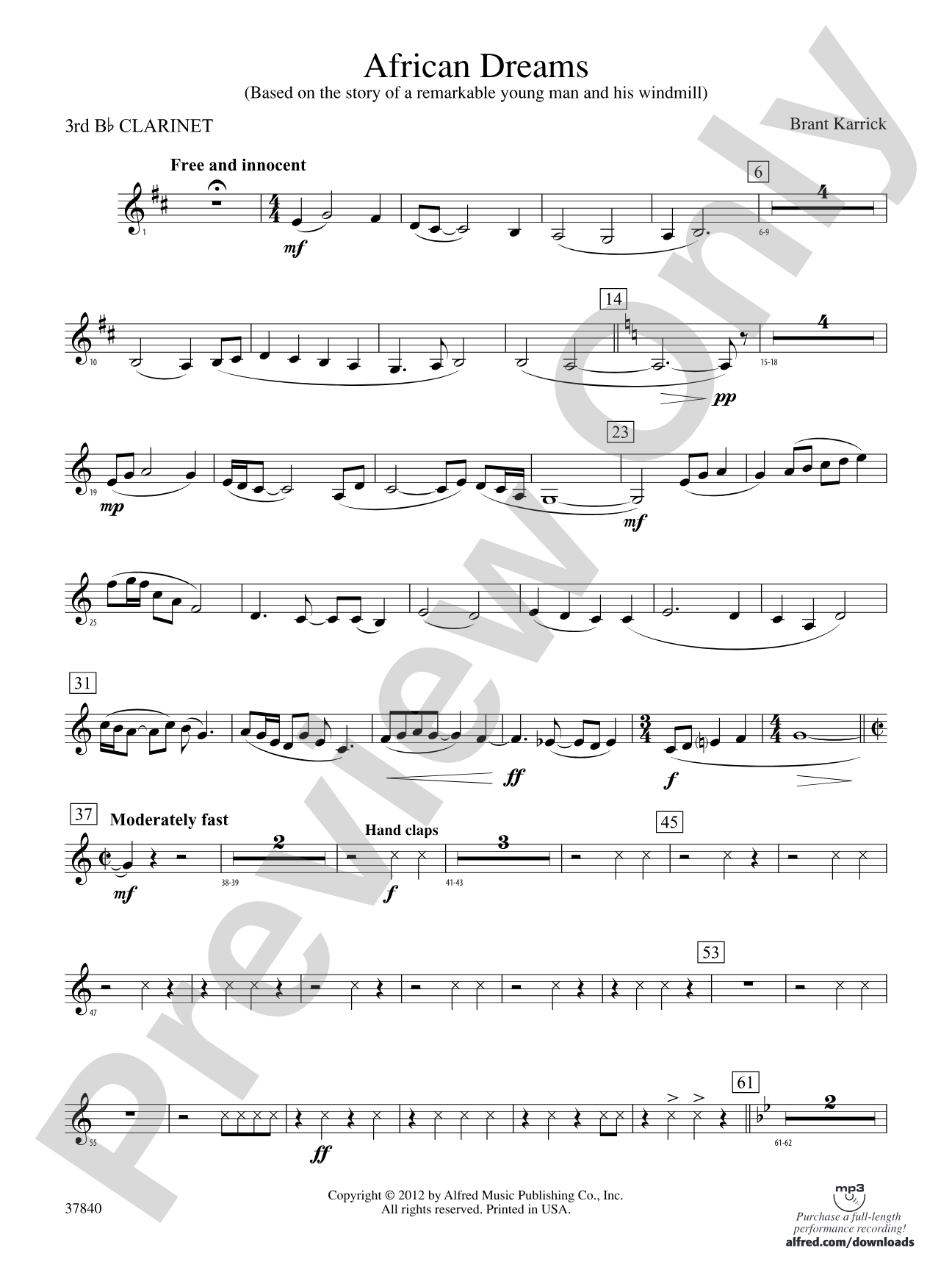

African Dreams: 3rd B-flat Clarinet
Based on the story of a remarkable young man and his windmill
By Brant Karrick
Grade: 3 (Medium)
Item: 00-PC-0015369_C3
$3.00
Pickup currently not available
Description
William Kamkwamba was raised in Malawi, an African country where magical thoughts prevailed but modern technology was a mystery. From books he read, young William imagined building a windmill that might, one day, bring electricity and water to his village and drastically change the lives of his neighbors. Hoping to someday study science, his country was debilitated by famine that forced William to drop out of school and forage for food as thousands throughout the country died of starvation. However, William's passion remained indefatigable and, using scrap metal, tractor parts, and bicycle halves, he ingeniously built a crude yet operable windmill that powered four lights and his radio. News of William's achievement soon spread beyond his country's borders, and the young boy who was once thought of as crazy became a hero to many around the world. (5:30)


Don't just read it, hear it, play along with it, and watch your students grow with it. In MakeMusic Cloud, African Dreams: 3rd B-flat Clarinet comes alive with professional accompaniment, adjustable tempo, and built-in practice tools that turn solo practice into real progress.
Open in the Player
Jump straight in and assign it today.
Start Your Free Trial
Open this title and explore the full library in minutes.
Sample Audio
1
Audio File
--:--
0:00
0:00
Sample Video
No sample videos found.
Additional Details
Series:
Alfred Concert Band
Publisher:
Alfred Music
Page Count:
276
SKU:
00-PC-0015369_C3
More about this title
About the Composer: Brant Karrick

Brant Karrick has spent his career building comprehensive band programs while maintaining an active presence as a composer and conductor. Since joining Northern Kentucky University in 2003 as Director of Bands, he has shaped the institution's entire wind ensemble curriculum, teaching conducting, orchestration, and instrumental methods alongside his administrative duties. His work as a guest conductor and clinician has taken him across the United States and internationally to Europe, South Africa, South America, Japan, and Australia.
Karrick's compositional voice developed through rigorous study with David Livingston, Steve Beck, and Cecil Karrick, informed by his early training in music education and conducting under respected mentors. His degrees span music education (University of Louisville), education (Western Kentucky University), and a Ph.D. in music education (Louisiana State University), grounding his approach in both pedagogical depth and artistic craft. He remains active in ASCAP, the College Band Directors National Association, and continues to balance his university responsibilities with teaching public school experiences that inform his understanding of what students need at every level.
Why we love this
Karrick transforms a contemporary true story of ingenuity and perseverance into music that speaks to students without patronizing them. The composition honors William Kamkwamba's achievement while remaining musically sophisticated enough to engage advanced middle school and high school musicians, making it equally valuable for concert programming and festival competition.
What to expect
The music captures the quiet determination of a young person against overwhelming odds, building from moments of doubt toward hard-won hope. Karrick's orchestration reflects both the simplicity of Malawi's rural landscape and the intellectual spark that drives William's vision, creating an emotional landscape that feels earned rather than imposed.
Who it's for
This works well for grade 3 concert bands seeking repertoire that combines accessibility with genuine artistic substance. It appeals to young musicians who respond to music with a human story and to directors who want their ensembles playing pieces that matter beyond the concert hall.
How to get the most out of it
- Balance the narrative arc across the full five and a half minutes; resist the temptation to rush toward climactic moments. Let the progression from hardship to triumph breathe naturally through tempo and dynamic control.
- Emphasize the African musical elements that Karrick weaves throughout the score. These aren't decorative touches but essential to the work's identity, so approach them with the same care you'd give to any stylistic requirement.
- Attend carefully to the conductor score's dynamic markings and articulation indications. They map the emotional journey more precisely than the surface melody alone suggests.
How to use it
Program this on a concert focused on stories of innovation and resilience, pairing it with other works that explore human achievement or cultural identity. It also serves effectively as an opening piece that establishes a concert's thematic direction or as a bridge piece between heavier dramatic works, giving your audience a moment of genuine connection.
Skills your students will build
- Sustained phrasing across longer melodic lines without dropping dynamic support
- Stylistic interpretation of African musical idioms and world music elements
- Ensemble balance when multiple independent lines carry thematic material simultaneously
- Emotional communication through careful control of tempo and dynamic shape
- Articulation clarity in passages with mixed rhythmic patterns