
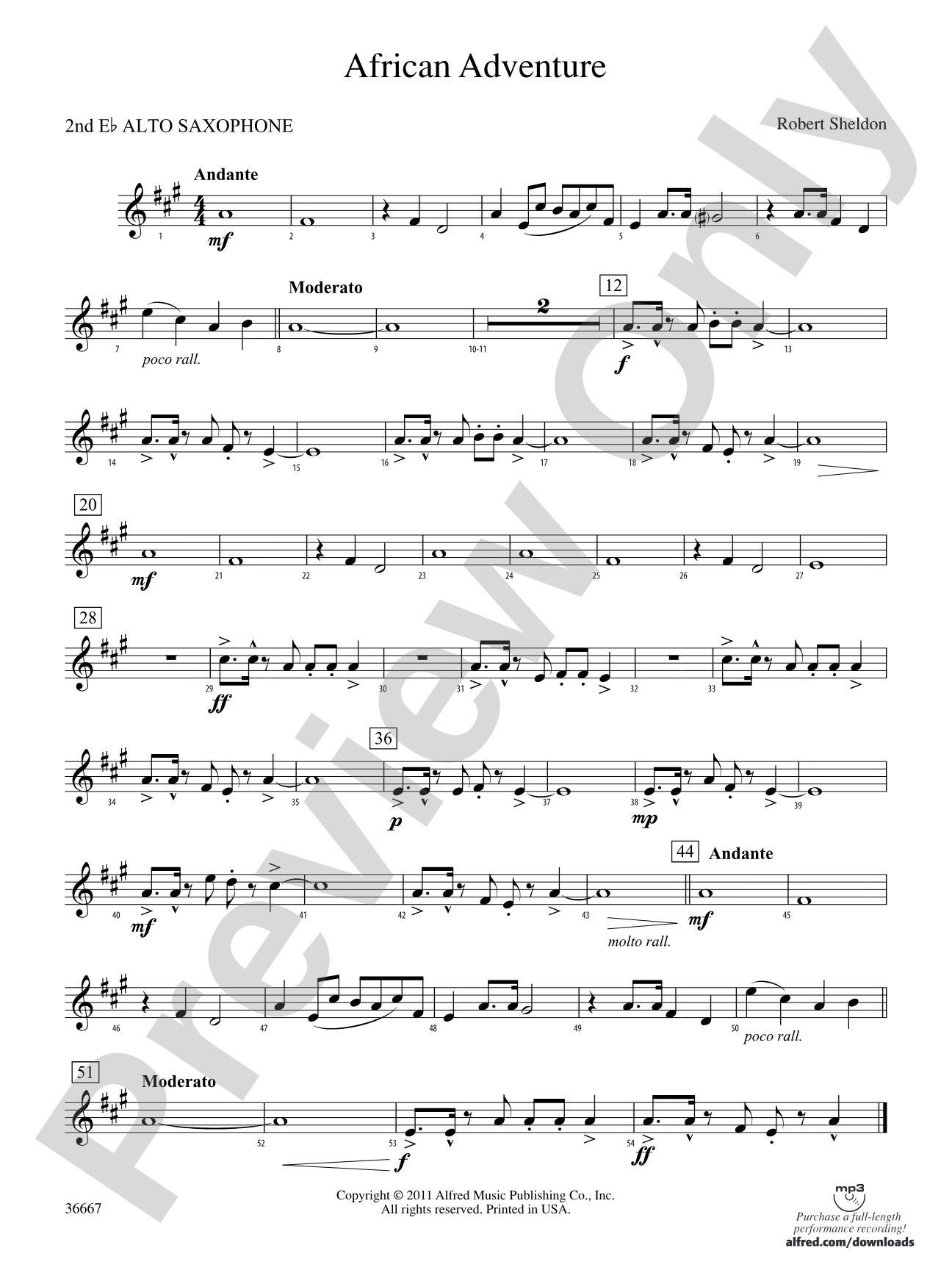

African Adventure: 2nd E-flat Alto Saxophone
By Robert Sheldon
Grade: 1 (Very Easy)
Item: 00-PC-0015095_AX2
$3.00
Pickup currently not available
Description
Take your young musicians and the audience on a trip to a mysterious continent with this tuneful and rhythmic offering. The tribal Swahili beat and authentic-sounding harmonies will provide a colorful and vibrant moment on your next concert.
"African Adventure" correlates to Book 2, Level 3 of Sound Innovations for Concert Band. It is an enhanced version of the popular piece of the same name that appears in Sound Innovations, Book 2.


"African Adventure" correlates to Book 2, Level 3 of Sound Innovations for Concert Band. It is an enhanced version of the popular piece of the same name that appears in Sound Innovations, Book 2.
Don't just read it, hear it, play along with it, and watch your students grow with it. In MakeMusic Cloud, African Adventure: 2nd E-flat Alto Saxophone comes alive with professional accompaniment, adjustable tempo, and built-in practice tools that turn solo practice into real progress.
Open in the Player
Jump straight in and assign it today.
Start Your Free Trial
Open this title and explore the full library in minutes.
Sample Audio
1
Audio File
--:--
0:00
0:00
Sample Video
No sample videos found.
Additional Details
Series:
Sound Innovations for Concert Band
Publisher:
Alfred Music
Page Count:
146
SKU:
00-PC-0015095_AX2
More about this title
About the Composer: Robert Sheldon

Robert Sheldon stands among the most widely performed composers in wind band repertoire. His works appear consistently on concert and contest programs across the United States and internationally, and he serves as lead author of the Sound Innovations series. Sheldon has earned recognition from the American School Band Director's Association, Phi Beta Mu, and ASCAP for compositions that balance accessibility with musical substance.
His career encompasses regular guest conducting appointments at All-State and Regional Honor Bands, clinician roles at universities and state music education conferences, and conducting residencies across North America, Europe, Asia, and Australia. His works have been performed at Carnegie Hall, Orchestra Hall in Chicago, Boston Symphony Hall, the Sydney Opera House, and the Kennedy Center. VanderCook College of Music awarded him an honorary doctorate in 2020.
Why we love this
Sheldon nails the balance between authenticity and accessibility that Grade 1 bands need. The Swahili rhythmic elements and world music colors give your musicians genuine cultural exposure without overwhelming technical demands, while the straightforward melodic writing keeps rehearsals focused on ensemble cohesion rather than individual struggle.
What to expect
Vibrant and propulsive, with an infectious rhythmic energy that makes you want to move. The piece conjures images of landscape and movement without relying on literal pictorialism, letting the interplay of Swahili-inspired rhythms and warm harmonic writing create a sense of discovery and travel.
Who it's for
This work suits beginning to early intermediate concert bands seeking repertoire that ventures beyond standard European materials. It pairs well with Grade 1 ensembles that want to program something with real personality and cultural substance on a concert or festival.
How to get the most out of it
- Pay close attention to dynamic contrast between sections to bring out the harmonic colors. Young bands often play everything at a similar volume level, so marking clear soft and loud passages in parts will make the tribal elements register.
- Establish the Swahili beat patterns early in rehearsal as a physical anchor. Have sections tap the rhythm while singing their lines to internalize the relationship between their melody and the driving pulse underneath.
- Balance the auxiliary percussion thoughtfully. The drums and percussion effects are essential to the character, but they should enhance rather than cover the band sound.
How to use it
Program this as a centerpiece in a world music or global cultures concert theme, or use it as a lighter moment between more serious works to refresh the audience and your musicians. Its tuneful, accessible character also makes it ideal for community engagement concerts where you want to showcase young musicians in a piece that feels substantial and entertaining.
Skills your students will build
- Rhythmic precision in syncopated ensemble passages
- Balance and blend in harmonic progressions featuring non-traditional tonal centers
- Shaping phrases with dynamic contrast and strategic breathing
- Interpreting world music idioms and cultural musical language
- Listening for and responding to layered percussion textures