
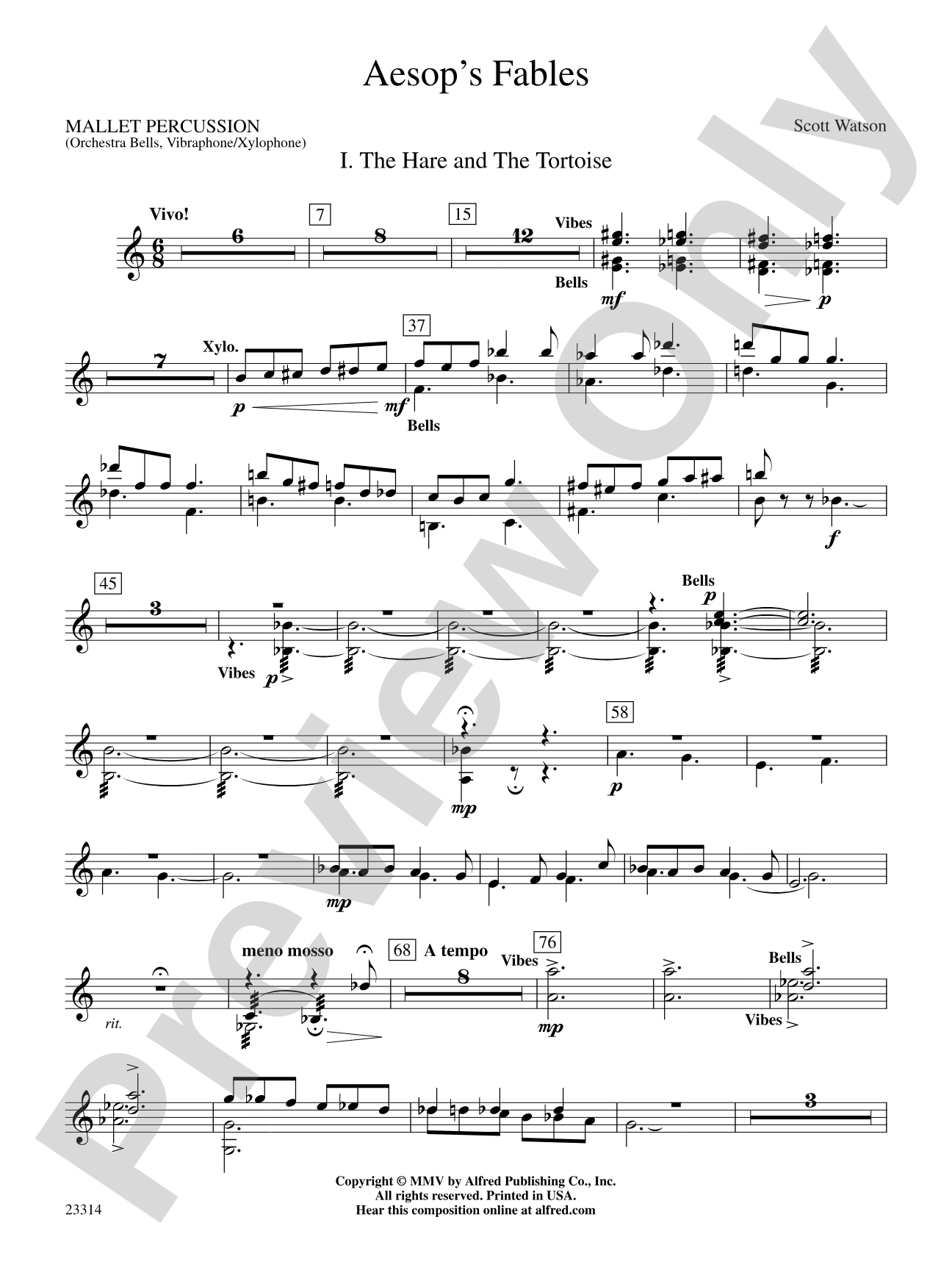

Aesop's Fables: Mallets
By Scott Watson
Grade: 5 (Advanced)
Item: 00-PC-0000664_M1
$3.00
Pickup currently not available
Description
Aesop's Fables, for narrator and band, musically portrays four tales attributed to the ancient moralist. The four movements are based on "The Hare and the Tortoise," "The Boy Who Cried Wolf," "The Dog and the Bone" and "The Wolf and His Shadow." Dynamic and highly dramatic! (9:45)


Don't just read it, hear it, play along with it, and watch your students grow with it. In MakeMusic Cloud, Aesop's Fables: Mallets comes alive with professional accompaniment, adjustable tempo, and built-in practice tools that turn solo practice into real progress.
Open in the Player
Jump straight in and assign it today.
Start Your Free Trial
Open this title and explore the full library in minutes.
Sample Audio
1
Audio File
--:--
0:00
0:00
Sample Video
Additional Details
Series:
Alfred Concert Band
Publisher:
Alfred Music
Page Count:
296
SKU:
00-PC-0000664_M1
More about this title
About the Composer: Scott Watson

Scott Watson brings three decades of classroom experience to his work as a composer and educator. After leading the instrumental program at Parkland School District in Allentown, Pennsylvania, he now serves as Associate Professor of Music at Cairn University while maintaining an active schedule as a commissioned composer and clinician.
Watson's output spans more than 120 published works across concert band, string orchestra, and chamber settings. His music draws equally from contemporary concert art traditions and the practical realities of the rehearsal room, a balance forged through years directing high school and elementary ensembles. His compositions have reached audiences at the Academy of Music in Philadelphia, the Midwest Clinic in Chicago, and the White House. He serves as exclusive composer and clinician for Alfred Publications and authored the Oxford University Press text Using Technology to Unlock Musical Creativity.
Why we love this
Watson captures the narrative arc of each fable with orchestral clarity and dramatic specificity; you'll hear the desperation in the boy's deception and the tortoise's steady momentum as if they were unfolding onstage. The addition of a narrator creates a genuine multimedia event without requiring theatrical infrastructure, making this accessible for standard concert programming while delivering genuine theatrical impact.
What to expect
Aesop's Fables unfolds with the clarity of a well-produced narrative film score. Watson's orchestration creates sonic landscapes for each tale: the furious chase of the hare, the mounting tension as the boy's lies unravel, the canine obsession over reflection, and the wolf's descent into paranoia. The band becomes storyteller as much as accompanist.
Who it's for
Directors programming advanced concert band repertoire who want to engage audiences beyond traditional instrumental virtuosity. This work suits ensembles with reliable narrators (staff, experienced students, community members) and bands comfortable executing sophisticated ensemble writing at Grade 5 level.
How to get the most out of it
- Establish clear communication with your narrator during sectionals. The band must lock onto the narrator's pacing and dramatic inflection rather than forcing the narrator to follow a metronomic band tempo; record your rehearsals so the narrator can study exact timings.
- Map the dynamic architecture across all four movements before ensemble rehearsals begin. Watson's use of sudden shifts and sustained tension relies on the band's ability to maintain clarity at soft volumes and project with precision at forte; mark cues in all parts.
- Balance the narrator's amplification carefully during dress rehearsal. The narrative content drives the entire work, so the audience must hear every word without the band becoming an inaudible background; position microphone placement and level during full run-throughs.
- Give the percussion section advance warning about the full scope of the work's instrumentation demands. At nine minutes forty-five seconds with programmatic requirements across four distinct scenarios, your players need time to organize mallets, beaters, and equipment changes.
How to use it
Program this as a centerpiece concert work where the narrative provides welcome variety from purely instrumental selections. The nine-minute duration and programmatic nature make it an ideal showcase piece for spring concerts, and the educational value of the fables themselves creates programming that appeals to mixed audiences including non-musicians.
Skills your students will build
- Following a non-metronomic soloist and adjusting ensemble tempo to match narrative pacing
- Executing dramatic dynamic contrasts and sudden shifts in intensity within and across movements
- Maintaining rhythmic precision and ensemble balance during extended soft passages
- Responding to programmatic cues and translating musical characterization into coordinated section playing