
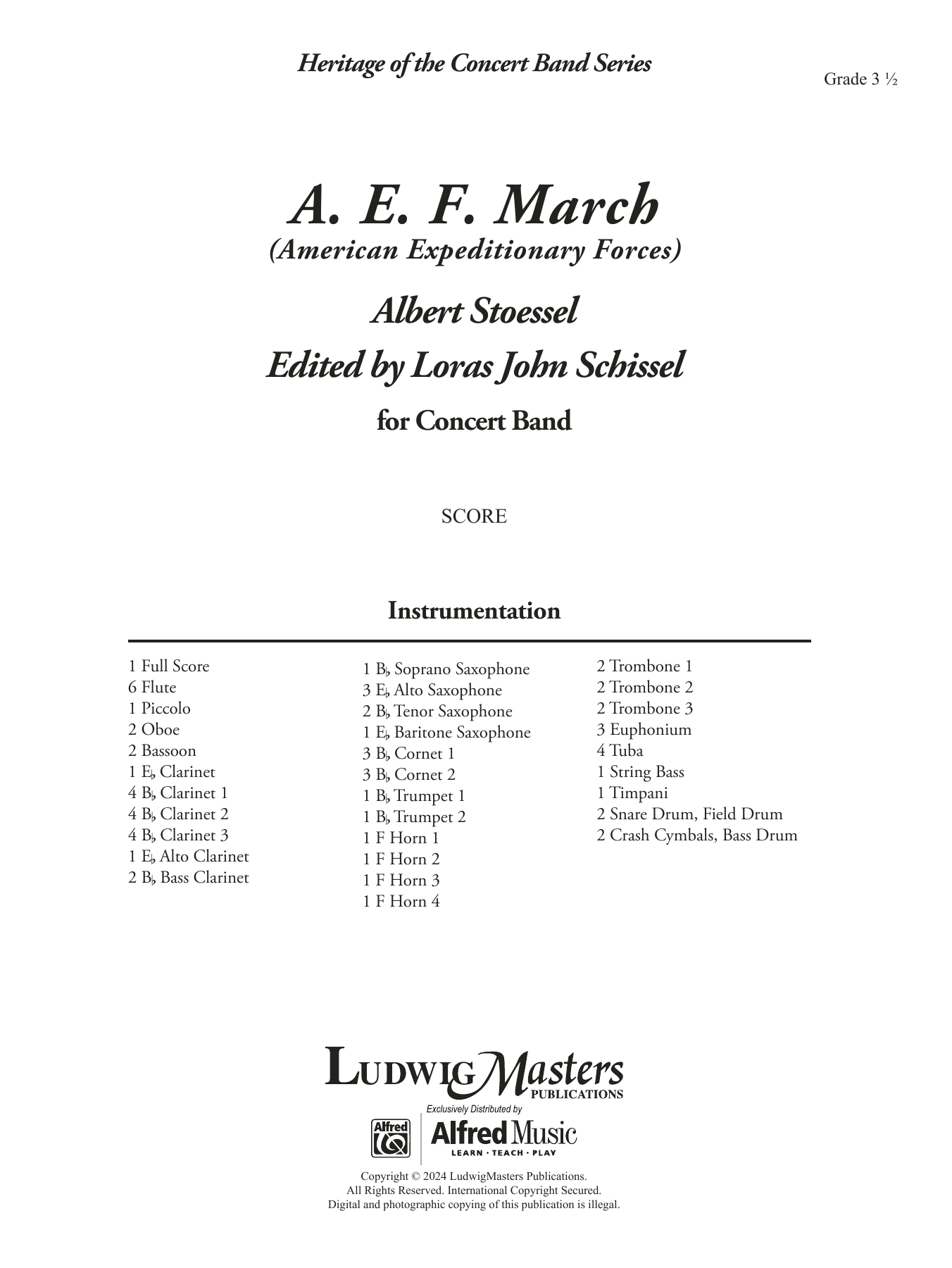

AEF March (arr. Loras John Schissel): Concert Band Conductor Score & Parts
By Albert Stoessel / Arranged by Loras John Schissel
Grade: 3.5
Item: 35-PK01549475
$80.00
Pickup currently not available
Buy Extra Parts (Digital PDF Download)
Parts Added to Cart!
Description
Written for the American Expeditionary Forces in World War I and dedicated to General John J. Pershing gives this march a special place in the history of the concert band. It is a patriotic salute of timeless honor and gratitude.


Discover MakeMusic Cloud: thousands of interactive titles your students can play along with today.
Sample Audio
No sample audio found.
Sample Video
No sample videos found.
Additional Details
Publisher:
Hal Leonard
SKU:
35-PK01549475
More about this title
About the Composer: Albert Stoessel
Albert Stoessel (1894-1943) was a conductor, composer, and educator who shaped American concert music during the early twentieth century. His work with the Juilliard School and his commitment to building the band repertoire made him a central figure in establishing concert band as a serious musical medium.
Why we love this
Stoessel's march carries authentic historical weight without feeling like a museum piece. The writing sits comfortably at 3.5, giving intermediate bands real substance to interpret while remaining accessible, and the patriotic foundation resonates with audiences across generations.
What to expect
The AEF March carries the formality of a military salute wrapped in sincere melody. Stoessel's writing is direct and warm, building from dignified opening statements into moments of genuine affirmation without ever losing its grounded, purposeful character.
Who it's for
Concert bands at the intermediate level seeking dignified, historically grounded repertoire with clear musical architecture. This is equally at home in a spring concert or a Veterans Day program.
How to get the most out of it
- Balance the counter-melody lines in the trio section; they support the main theme rather than compete with it.
- Maintain steady forward momentum through phrase connections. This march lives in its pulse, not in dramatic tempo shifts.
- Let the full band breathe together at structural cadences. The sense of arrival matters as much as the marching energy.
How to use it
Pair this with lighter concert fare to create a meaningful opening or closer that stakes out the band's ability to handle serious material. It works particularly well as the centerpiece of a program honoring service or national history.
Skills your students will build
- Clear phrasing within a steady march tempo
- Balancing independent melodic lines while maintaining ensemble cohesion
- Interpreting style markers that reflect early twentieth-century American concert music